Insights
Buying property in Portugal: a guide for foreign investors
The first thing foreign investors should know about the property market in Portugal is that international interest in this market has been growing steadily. Lisbon, Porto, the Algarve and, increasingly, the Alentejo coast attract foreign buyers seeking to diversify their assets, secure rental income or simply acquire a second home in Europe. Portugal imposes no restrictions on foreign buyers: a citizen of another country has exactly the same property rights as a national.
The process, however, has a logic of its own, often different from that of other countries. The final contract can be signed as a public deed (escritura pública) before a notary or as an authenticated private document (documento particular autenticado) certified by a lawyer (advogado), a solicitador or a registrar (for example through the Casa Pronta service), and whoever formalises it checks the formal legality of the transfer; closing costs work differently and municipal bureaucracy follows its own rules. Those who arrive unprepared lose time, pay more than they should and, at times, buy a property with problems that only come to light after the deed. At CertiAmb we work directly with foreign buyers in areas such as Grândola, Lisbon and Cartaxo, and this experience shapes what we describe below, drawn from what we encounter on site, in municipal case files and at the signing table.
What foreign investors should know before signing a single piece of paper
The first requirement, without exception, is the Portuguese NIF (Número de Identificação Fiscal, the Portuguese tax number). Without it, you cannot pay the purchase taxes or complete the purchase, and banks require it to open an account. For a foreign citizen with no tax address in Portugal, the NIF may require a Portuguese representante fiscal (tax representative), an individual or company with an address in Portugal who takes on responsibility for receiving notifications from the tax authority. This is not a single rule, however. Under Article 19 of the General Tax Law the appointment is merely optional for residents of another EU or EEA state, in the latter case provided that state is bound by administrative cooperation in tax matters equivalent to that of the Union. And since Decree-Law 44/2022 the obligation also does not apply to anyone who signs up to the public electronic notification service linked to the single digital address, to the notification regime on the Portal das Finanças, or to the electronic mailbox. For residents outside the EU and the EEA there is one extra caution: cancelling that subscription only takes effect once a tax representative has been appointed. The representative receives notifications from the tax authority (Autoridade Tributária) on your behalf. The process typically takes one to two weeks; representation costs are indicative 2026 estimates and range between €100 and €300 per year depending on the provider and whether the service is in person or remote.
Once you have the NIF, it is usual to open an account with a Portuguese bank as well. It is not a legal requirement for the purchase, but it is common practice: it makes it easier to pay the IMT (municipal property-transfer tax) and Imposto do Selo (Stamp Duty) before the deed and to manage the property's running costs, and it is needed when the purchase is financed by a Portuguese bank, which collects the instalments from it. For non-residents, banks usually ask for a valid passport, NIF, proof of address, recent bank statements and proof of income, with requirements that vary from bank to bank. The process can be started remotely at some banks, but being there in person tends to speed it up.
Engaging a solicitor who specialises in property law before signing the CPCV (Contrato-Promessa de Compra e Venda, the promissory contract of purchase and sale) is not compulsory, but it is strongly recommended. The CPCV is legally binding on both parties, and the sinal (deposit) paid, usually between 10% and 20% of the total value, in line with market practice, is forfeited if the buyer withdraws without legal grounds. A solicitor checks the records, identifies any charges or liens and ensures that the conditions precedent are correctly drafted. The usual sequence is: NIF, bank account (where needed), legal and technical due diligence, CPCV with deposit and final contract, by public deed or authenticated private document.
Transaction costs: the real impact on your budget
IMT (Imposto Municipal sobre Transmissões Onerosas de Imóveis) is calculated on the higher of the purchase price and the property's taxable asset value (VPT). For housing the rates are progressive, with separate tables depending on whether it is a permanent main residence or another purpose (Article 17 of the IMT Code). The 6.5% rate applies to other urban properties, that is, those not intended for housing, while rustic properties are taxed at 5%.
One rule, however, changes the arithmetic for buyers from abroad. Under Decree-Law 97/2026 of 20 May, Article 17(10) of the IMT Code sets the rate at 7.5% whenever a non-resident acquires an urban property, or an autonomous fraction of one, intended exclusively for housing, with no exemption or reduction. It does not reach rustic properties or buildings with any other use. Three situations fall outside it: having already been treated as tax resident in Portugal under Article 16 of the IRS Code; becoming resident on those same terms within two years of the purchase; or letting the property for housing at a monthly rent within the limits of Article 2 of that decree-law, signing the tenancy within six months of the purchase and keeping the property let for at least 36 months, consecutive or not, during the first five years. In the last two cases the tax is first paid at 7.5% and the tax authority then refunds, on the buyer's request, the difference from the amount that the normally applicable rates would give; the request must be filed within six months of the date the buyer becomes resident or the tenancy is signed. Above this rate, 10% still applies to buyers whose tax domicile is in a country, territory or region on the official list of clearly more favourable tax regimes.
Under the 2026 mainland tables published by the Autoridade Tributária (Ofício-Circulado 40129/2026), a property worth €200,000 pays €3,542.04 in IMT if it is a permanent main residence (€200,000 × 7% − €10,457.96) and €4,605.50 if it is a second home or a rental (€200,000 × 7% − €9,394.50). If the buyer is non-resident and none of the exceptions applies, the IMT is €15,000 (7.5%). A buyer who becomes resident within two years, or lets the property on the terms described above, pays the €15,000 up front and can then claim a refund of the difference: for a let property that would otherwise pay €4,605.50, that is €10,394.50. On top of these amounts comes Imposto do Selo (Stamp Duty), at a flat rate of 0.8% on the transaction value: a further €1,600 in the same example.
The remaining costs, as an indicative guide as of September 2026, are: notary fees (or the cost of an authenticated private document) between €375 and €900; land registry fees, which vary with the act and the service; lawyer's fees typically between 1% and 2% of the property value, depending on the scope of the work. The energy certificate is, as a rule, obtained by the seller. For a property worth €200,000 without financing, bought as a permanent main residence by a resident buyer, the total acquisition cost therefore comes, indicatively, to between about €7,500 and €10,000 (roughly 3.8% to 5% of the value); for a non-resident buyer taxed at 7.5%, to between about €19,000 and €21,500 (roughly 9.5% to 10.8%). In both cases, land registry fees come on top. With bank financing, Imposto do Selo on the loan is added, at a rate of 0.6% on the amount financed, plus the costs of the loan itself (valuation, fees, insurance and mortgage registration), which vary from bank to bank.
An important planning point: in Portugal, IMT and Imposto do Selo fall entirely on the buyer and are paid before the deed; other sums, such as notary fees and registration, may be settled at the deed itself or in the days that follow. When budgeting, the margin for costs should reflect the IMT that actually applies: for a non-resident taxed at 7.5%, IMT and Imposto do Selo alone amount to 8.3% of the taxable value, before fees, registration and, where there is a loan, its costs. The figures should be confirmed case by case.
Taxation for non-resident investors in Portugal
Rental income earned in Portugal by non-residents is subject to a flat rate of 25% for residential lettings. There is, however, a reduced rate for moderate rents: under Article 45-C of the Tax Benefits Statute (EBF), added by Decree-Law 97/2026, income from contracts exclusively for residential letting with a monthly rent of up to €2,300 (the 2026 cap), received until 31 December 2029, is taxed at a flat rate of 10%, unless a more favourable rate applies. The RSAA (Regime Simplificado de Arrendamento Acessível, the simplified affordable-letting scheme, Annex III to Decree-Law 97/2026), which has applied since 1 September 2026 and replaces the Programa de Apoio ao Arrendamento, is a separate scheme with its own requirements and goes further: rents that qualify under the scheme are exempt from IRS (personal income tax) or IRC (corporate income tax), provided they stay within the caps set by ministerial order (portaria) on the basis of 80% of the municipality's median rent published by INE, the national statistics institute, and the tenancy, for permanent housing, has a minimum term of three years.
For property capital gains the regime changed in 2023. After the Court of Justice of the European Union found the previous rules contrary to the free movement of capital (judgment of 18 March 2021, case C-388/19), Law 24-D/2022 repealed the 28% autonomous rate that applied to non-residents. Today the balance of capital gains is taken into account at 50% of its value for residents and non-residents alike (Article 43(2) of the Personal Income Tax Code) and must be aggregated with other income, being taxed at the progressive rates of Article 68. The old sum of 50% at 28% no longer applies. It is still declared through Annex G of the IRS return (Anexo G).
On the Non-Habitual Resident regime (RNH) one misconception needs clearing up: it is closed to new applicants. Law 82/2023 repealed paragraphs 8 to 12 of Article 16 of the Personal Income Tax Code with effect from 1 January 2024, keeping a transitional regime for those already registered or who met, by 31 December 2024, the conditions of Article 236 of that law. In its place there is the tax incentive for scientific research and innovation (Article 58-A of the Tax Benefits Statute), with a 20% rate on category A and B income for ten years, but aimed at specific activities, teaching and research, qualified jobs, certified startups, rather than at anyone simply moving their residence. Applicability depends on individual circumstances and should be assessed with a tax adviser.
There is also an aspect that many investors underestimate: their tax obligations in their country of residence. Many countries tax their residents' income on a worldwide basis and require the reporting of accounts and assets held abroad. As a result, income earned in Portugal may also have to be declared in the investor's home country. The support of a tax adviser with international experience, familiar with both the Portuguese regime and that of the country of residence, is strongly recommended, to avoid double taxation and penalties for non-compliance.
Financing: what Portuguese banks require of a foreign buyer
The share financed (LTV, Loan-to-Value) is not a legal maximum set for each purchase: it results from each bank's lending policy, within the Banco de Portugal's macroprudential recommendation, which sets LTV limits according to the purpose of the loan. In the practice we see as of September 2026, Portuguese banks tend to lend to non-residents at lower percentages than to residents, often around 70% of the property's value, which means having roughly 30% in your own funds, plus the purchase costs. The gap with residents is real, varies from bank to bank and should be confirmed and built into any financial planning.
Interest rates (variable rates indexed to Euribor, the euro interbank benchmark rate, fixed or mixed) depend on the bank, the client's profile, the term and the timing, so there is no range that holds for every case. It is worth comparing offers on the basis of the European Standardised Information Sheet (FINE, Ficha de Informação Normalizada Europeia) and the APR (TAEG) provided by the banks, and considering the risk of a rise in Euribor before opting for a variable rate.
For buyers who prefer to avoid Portuguese bank financing, the most common alternatives are an all-equity purchase, frequent in the luxury segments, and refinancing property assets in the home country to fund the purchase in Portugal. In the latter case, the exchange-rate risk between the home currency and the euro should be weighed carefully, especially where the debt is serviced in a currency different from the one in which the property generates income.
Returns by region: where money works in 2026
The figures in this section are indicative market references as of September 2026 and vary widely with the parish, property type, condition and timing; for official data, see the housing price and rent statistics published by INE, the national statistics institute. Lisbon has some of the highest prices per square metre in the country, with large differences between parishes, and gross rental yields that tend to be moderate, in the region of 4% to 5%. Restrictions on alojamento local (short-term tourist letting) in containment zones limit the short-let strategy in several parishes, so regulatory due diligence before purchase is indispensable. Decreto-Lei n.º 151/2026, in force from 31 July 2026, allows municipal assemblies to extend an ongoing suspension of new alojamento local registrations once, or to reimpose one that has already lapsed, up to 31 December 2026. A parish that was open six months ago may have closed since then. The status of the suspension has to be confirmed on the date of the deed, not from last season's information.
In Porto, prices per square metre are generally lower than in Lisbon and gross yields tend to be slightly higher, in the region of 5%. In the Algarve, short-term letting can generate higher gross yields, indicatively 6% to 8% before management costs, taxes and vacant periods, but its pronounced seasonality calls for more active management and the activity is subject to the alojamento local rules. In long-term residential leases, rents are generally updated each year by the coefficient published on the basis of inflation measured by INE, which offers predictable income but limited growth.
The Comporta and Grândola area follows a different logic. With high prices per square metre, especially in Comporta, and strong international demand, the current yield tends to be low (indicatively 2% to 3%) and the main argument has been capital appreciation, which is not guaranteed. This is a segment where the logic of pure income-generating letting gives way to the preservation and growth of capital. CertiAmb has direct experience of working in this area, in particular on projects framed by the Grândola PDM (Plano Diretor Municipal, the Municipal Master Plan) and by the specific restrictions of the Alentejo coast.
Technical due diligence: the step that separates good deals from costly problems
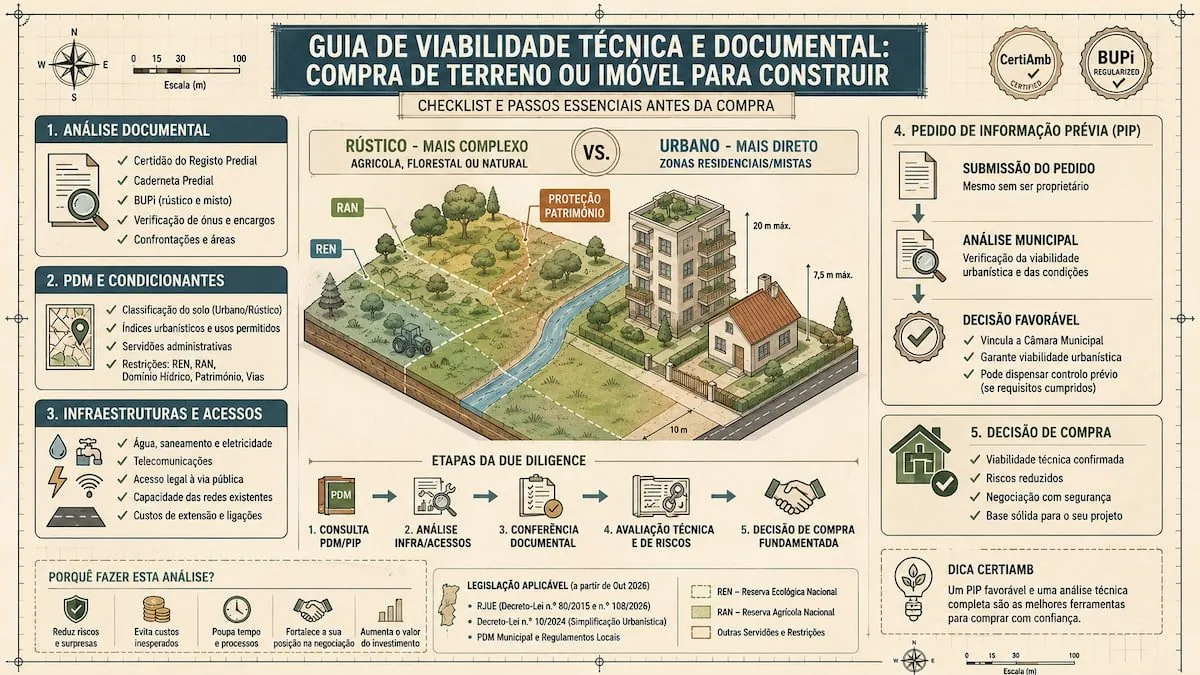
In Portugal, two land-protection regimes impose severe restrictions on building on classified land: the RAN (Reserva Agrícola Nacional, the national agricultural reserve) and the REN (Reserva Ecológica Nacional, the national ecological reserve). The starting point is restrictive, but it is not an absolute bar. In the RAN the areas are non aedificandi (Article 20(1) of Decree-Law 73/2009), with a closed list of admissible non-agricultural uses in Article 22, subject to a binding prior opinion from the regional RAN authority, to be issued within 20 days. In the REN, Article 20 of Decree-Law 166/2008 prohibits subdivisions, urbanisation works, construction and extension, but saves the uses compatible with the protection objectives listed in Annex II, some exempt from any procedure and others subject to prior notification to the CCDR. What does not exist is automatic buildability: each exception has its own conditions and procedure. That is what has to be checked before the purchase, whatever the seller may claim. The most common mistake among foreign buyers is to acquire "rustic land" advertised as developable without checking its classification in the PDM (Plano Diretor Municipal, the Municipal Master Plan) and in the town-hall records. Reclassification is extremely difficult and, under the 2025 legislation, obligatorily entails devoting 70% of any new construction to affordable housing, expressly excluding luxury projects.
For existing properties, it is essential to check the building's use documentation (for older buildings, the use licence or title issued at the time; after works subject to prior control, the start-of-use documentation under Article 62-A of the RJUE) and, where applicable, the Ficha Técnica da Habitação (the housing technical data sheet), required under Decree-Law 68/2004 for new homes or homes that underwent works covered by that regime. From 1 October 2026, with the RJUE revision by Decree-Law 108/2026, the transfer contract must also state, on pain of voidability (anulabilidade), whether an urban-planning title exists, or the seller's declaration that it has one or that it has none (Article 4-A(14)). Unlicensed extensions, undeclared alterations and buildings in an irregular situation can make bank financing impossible and generate significant regularisation costs after purchase. The Certidão de Teor (land-registry extract) from the property register reveals charges, liens and easements; the Caderneta Predial (tax register record) confirms the VPT, the area and the property's tax classification. The land-use classification itself comes from the PDM and the other territorial management instruments, not from the caderneta.
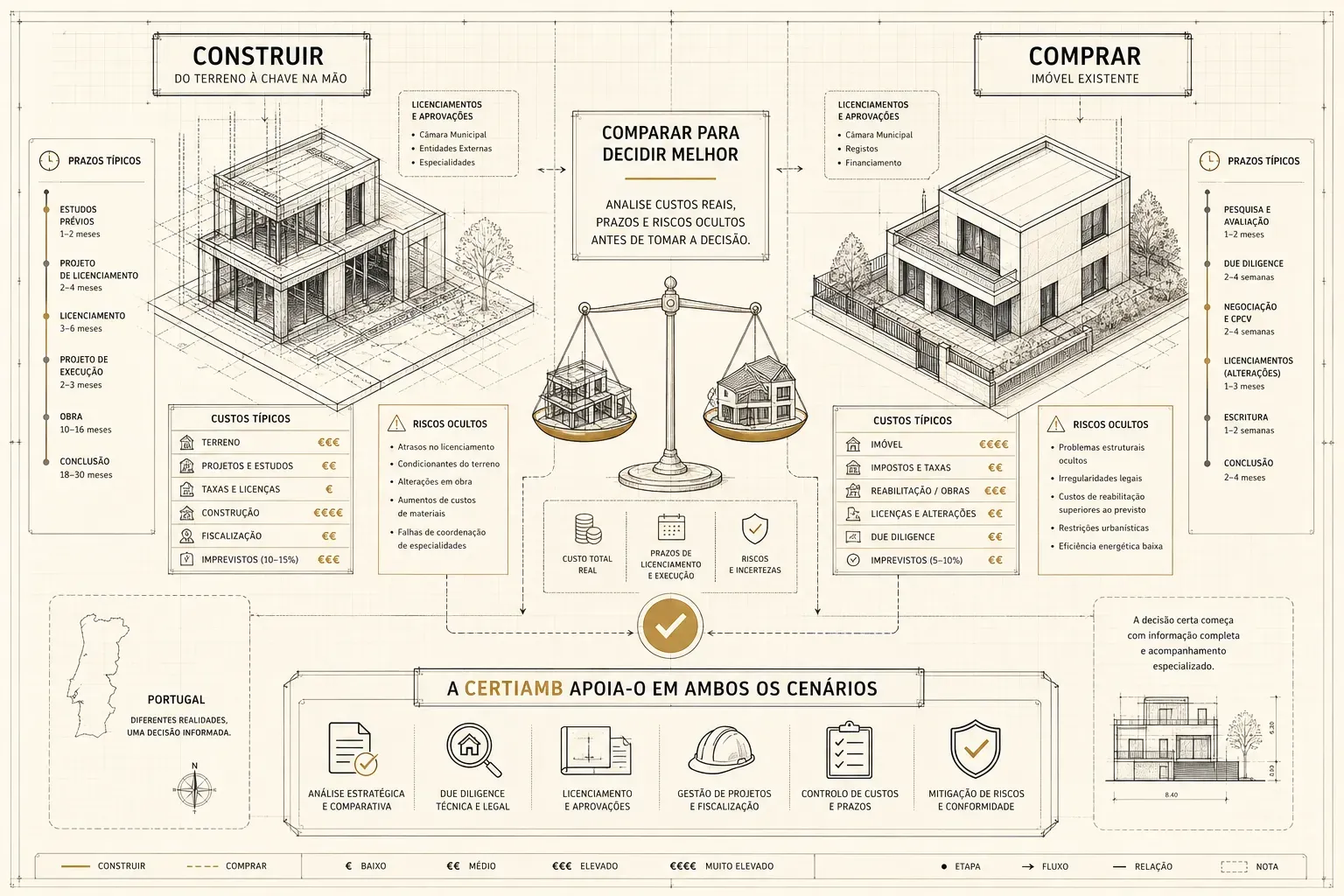
For a foreign buyer, navigating between the town hall (Câmara Municipal), the tax authority (Autoridade Tributária), the Land Registry and the specialist engineering designs is an opaque and time-consuming process, especially without a good command of Portuguese and without knowledge of the local administrative system. CertiAmb acts as an integrated technical team, with architects, engineers and consultants working in coordination from the very first assessment of the property. We carry out full technical due diligence before the purchase, identify concrete risks and, if the project moves ahead to construction or refurbishment, we manage the permitting process and construction coordination from start to finish. The result for the investor is an independent, well-founded analysis before any financial commitment. Find out more about our Technical Consulting, Site Supervision and Construction Management.
The essentials before you proceed
Investing in the property market in Portugal as a foreign investor is entirely feasible, provided the transaction is well prepared. Success rests on five pillars:
- Legal documentation correctly prepared: NIF, a bank account where needed, legal representation;
- Transaction costs properly budgeted, including taxes and fees;
- Tax management coordinated between Portugal and the country of residence, with specialist advice;
- Financing structured on the basis of Portuguese banks' actual criteria;
- Technical due diligence carried out before the deed, not after.
The difference between a good investment and a costly problem rarely lies in the purchase price. It lies in what was not checked before signing. An informed buyer, backed by a technical and legal team with in-depth local knowledge, drastically reduces both the risk and the time to completing the transaction.
If you are considering a purchase in Portugal and would like an independent technical assessment before proceeding, CertiAmb is available to support that process from the initial analysis stage. Get in touch for an initial, no-obligation conversation. Visit our home page to learn more about our story and capabilities, and take a look at our news as well.
This article is provided for information purposes only and does not constitute legal, tax or technical advice. Each situation should be assessed individually by a qualified professional.