Insights
Build or buy a house in Portugal: which pays off more?
Anyone weighing up whether to build or buy a house in Portugal tends to compare the sale price of a property with the estimated cost of construction, and to stop there. But this build-versus-buy analysis is, in most cases, incomplete. Between transaction taxes, slow permitting, undisclosed structural risks and customisation costs, there are variables that completely change the outcome of the equation.
Both paths are worth comparing with real figures and no beating about the bush, because that is what lets you move forward with confidence. The good news is that, with the right technical analysis from the outset, both options can work very well. The bad news is that, without it, either one can turn out far more expensive than expected. This is precisely why integrated technical teams with experience on both sides of this process tend to reduce risks and uncertainty, and to make a difference to the final outcome.
Build versus buy in Portugal: the real costs
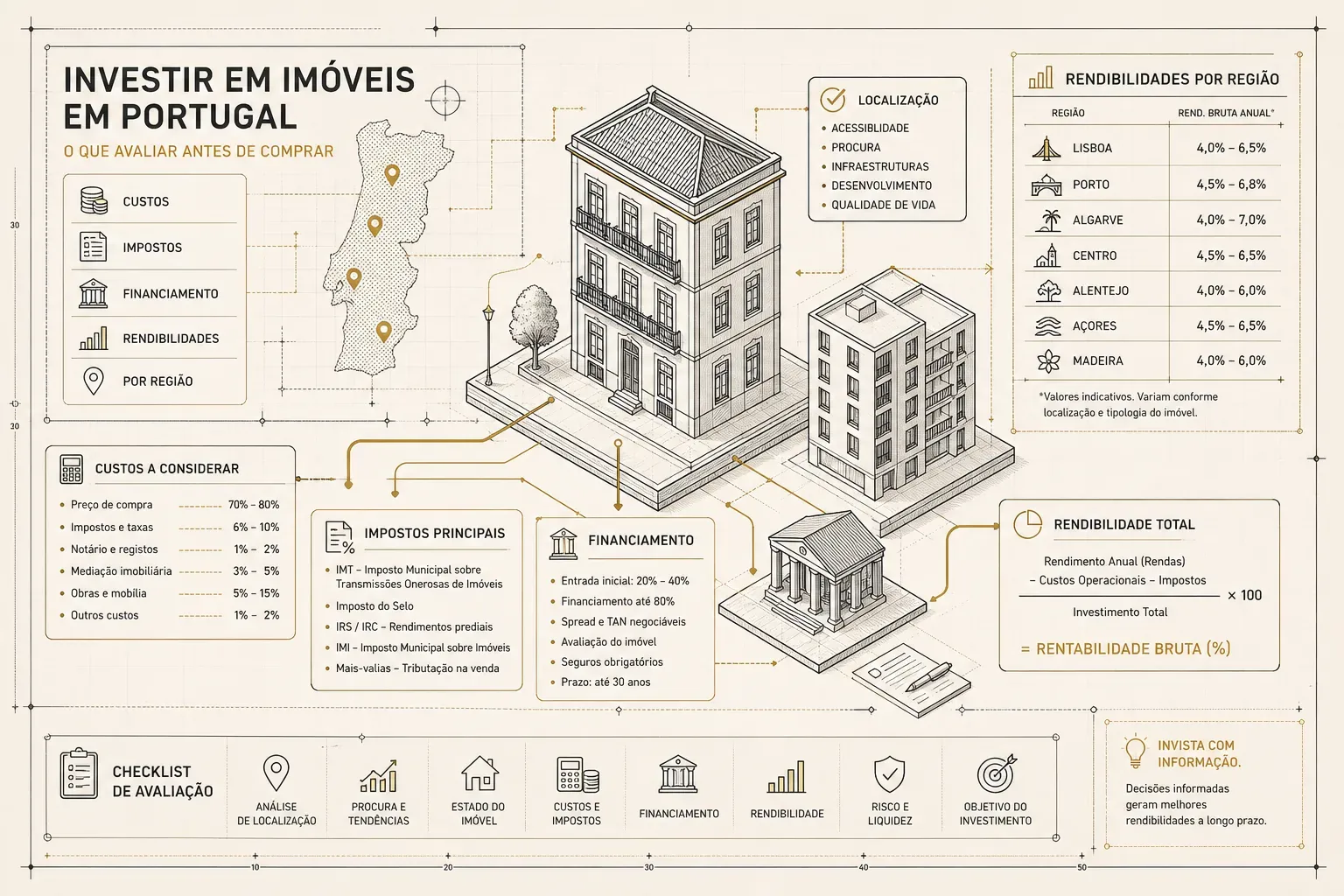
The most common mistake in this comparison is to take a home's sale price as the starting point and the construction cost as the only cost of building from scratch. Neither reflects the total cost. To make a well-founded decision about whether it pays off more to build or buy in Portugal, you need to calculate the total cost of ownership (TCO) over 10 to 15 years, including taxes, fees, adaptation works and operating costs.
What building from scratch really costs
As an order of magnitude, based on CertiAmb's project experience as of September 2026, construction costs in Portugal can range from about €950 to €2,200 per square metre, excluding land, depending on finishes and region. For a T3 (three-bedroom) house with an A energy rating, the budgets we see often fall between €1,450 and €1,850/m², and figures well below that range rarely include all the costs. Also as an indicative reference, land often represents 30% to 40% of the total budget and technical fees (architect, engineer, geotechnical studies) 8% to 12% of the construction cost. These ranges vary with location, the plot, the level of specification, the contractor market and the date of the quote, and are no substitute for an estimate made for the specific case.
On top of this come municipal licences and urban development charges, which vary by municipality but are never negligible, as well as the cost of connecting to public utility networks. Building can pay off in the long run, especially once adaptation and running costs over the years are counted, but that advantage depends on each case and is not guaranteed; it demands patient capital, a coordinated technical team and rigorous management of the process. Those without experience of dealing with municipal permitting in Portugal learn this lesson the most expensive way.
What buying an existing property really costs
The purchase price is only the tip of the iceberg. For a property costing €200,000, the transaction charges break down as follows:
- IMT (Imposto Municipal sobre Transmissões, the municipal property-transfer tax) for a permanent, owner-occupied home on the mainland: a progressive scale with exemption up to €106,346 and a maximum rate of 7.5% in the top band, according to the 2026 tables published by the Autoridade Tributária, the Portuguese Tax Authority (Ofício-Circulado 40129/2026); for a property of €200,000 this comes to €3,542.04 (€200,000 × 7% − €10,457.96). As a second home or a rental, the same property would pay €4,605.50; buyers aged 35 or under may benefit from a reduced table; and, with Decree-Law 97/2026, a purchase for housing by a non-resident buyer is, as a rule, taxed at 7.5%, subject to the exceptions provided for
- Imposto do Selo (Stamp Duty, 0.8%): approximately €1,600
- Deed (or authenticated private document) and registration: between €600 and €800, as an indicative figure
- Total transaction charges (permanent, owner-occupied home): approximately €5,742 to €5,942, before any works
And there are often works to do. In the cases we follow, immediate renovations can amount, as an indicative reference as of September 2026, to 10% to 15% of the purchase price, especially in properties more than 20 years old where the electrical wiring, plumbing and insulation are out of date; the real figure depends on the property's condition, its location and the intended level of finish. Once these costs are added to the acquisition price, the apparent price advantage of a second-hand property can shrink considerably.
Permitting timelines: build versus buy in Portugal
In Portugal, permitting is the factor most people underestimate and the one that most shapes the decision between building and buying. Knowing the real timelines of each scenario avoids surprises which, in decisions like these, always come at a high cost.
How long it takes to build from scratch
In CertiAmb's project experience, and as an indicative reference as of September 2026, the full process, from design to completion of the works and submission of the start-of-use documentation under the RJUE (Article 62-A), often takes between 12 and 18 months, and can exceed two years in municipalities with a higher volume of applications or on more technically complex projects; the actual duration depends on the municipality, the type of operation, how the application is prepared and the works themselves. The stages are sequential: preliminary study, permitting design, municipal review, specialist and detailed designs, construction and, finally, submission of the start-of-use documentation to the municipality. Until 30 September 2026, that documentation was the statement of responsibility (termo de responsabilidade) of the site director or site supervision director and, if the design was changed, the as-built drawings (telas finais); from 1 October 2026, with the RJUE revision by Decree-Law 108/2026, it is a prior notification on the official form, accompanied by the statement of responsibility. Each stage has its own documentary requirements and, if any item is missing or a revision is required, the schedule can slip.
Municipalities such as Lisbon have different approval dynamics from the Alentejo coastal municipalities such as Grândola, and Cartaxo has its own timelines and PDM (Municipal Master Plan) constraints. Knowing these local particulars is not optional; it is the difference between a process that runs to schedule and one that drags on with no apparent explanation.
Permitting when buying an existing property
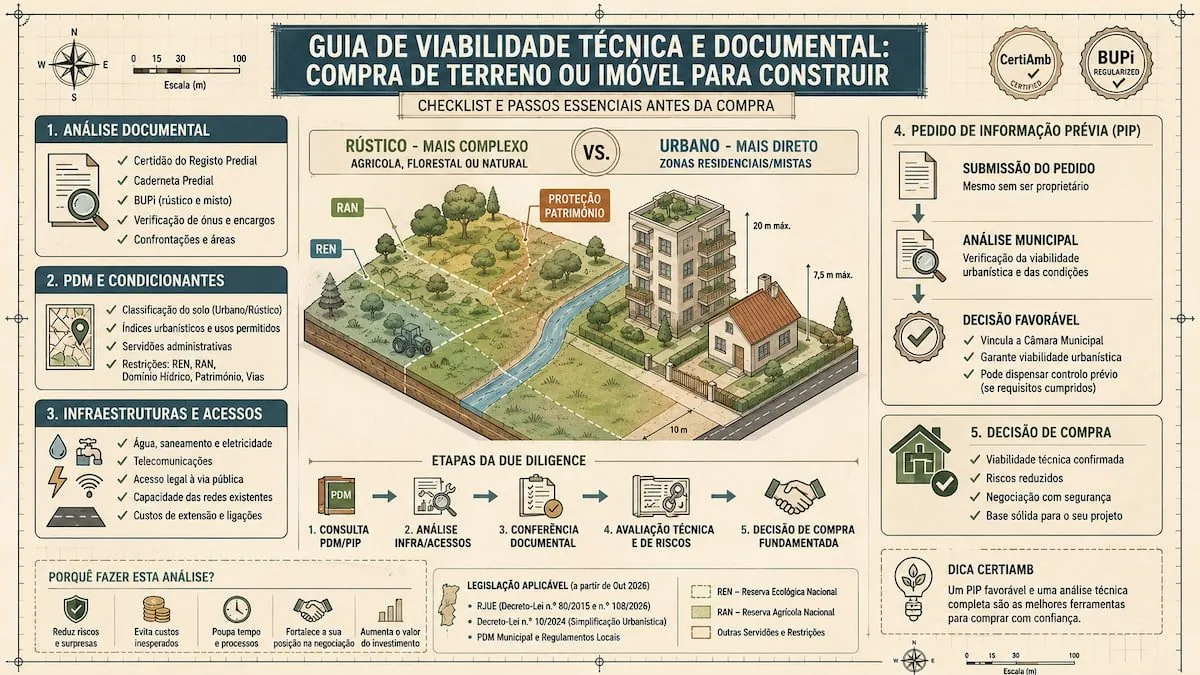
Buying a ready-built property looks like an immediate process, but the technical due diligence, strongly advisable, has its own requirements. It is important to check the land registry certificate (certidão predial), the up-to-date property tax record (caderneta predial), the planning titles and use documentation in the municipal file, the technical housing datasheet (ficha técnica da habitação) where applicable (it is required, under Decree-Law 68/2004, for new homes or homes that underwent works covered by that regime; many older properties do not have one) and compliance with the PDM in force. If the property has alterations that were never permitted or notified, or if the existing documentation does not match what was built, the buyer may have to bear the consequences after the deed: legalisation or reinstatement costs, and difficulties with financing or a future sale.
These situations can block bank financing and make a future resale complicated or even unviable. Pre-purchase technical due diligence is not an extra cost; it is the only way to know exactly what you are buying.
Full customisation or inevitable compromise
The qualitative dimension of this decision goes well beyond price. What you can achieve in terms of design, energy efficiency and fit with the real needs of the family or business differs radically between the two scenarios.
What you gain by building from scratch
New construction offers complete freedom of layout, solar orientation, materials and systems, from HVAC to home automation and water efficiency. More importantly, a home designed from scratch to nZEB (nearly zero-energy building) standards achieves high energy ratings that have a direct impact on annual operating costs over decades. Integrating solar panels, heat recovery, rainwater reuse systems or building automation is far simpler when designed in from the start than when added to an existing building.
Full customisation also removes the forced compromises that come with buying second-hand: a pre-set layout, unfavourable orientations, rooms that do not suit the way you live today. It is common to have to accept concessions on interior layout and solar exposure when acquiring an existing property.
The compromises of buying second-hand
An existing property rarely meets 100% of the buyer's needs. There are always adaptations to make, and in properties more than 20 years old the building systems are frequently out of date and no longer meet current standards. Old electrical wiring is a significant fire-risk factor, and replacing it is a major undertaking with considerable cost and duration.
When you move to a deep renovation, the total cost can approach that of a new build, without the benefits of a design conceived from scratch. In an intensive renovation, solar orientation is constrained by the existing structure, energy-efficiency systems must adapt to a pre-defined building envelope, and the energy rating rarely reaches the highest classes. Those who do not do this sum before the deed usually do it afterwards, with less room to negotiate.
The hidden risks in existing properties that cost dearly
This is probably the part of the decision that receives the least attention and costs the most money. The technical, legal and regulatory risks of an existing property are rarely explained to the buyer in detail.
Structural and compliance risks
Properties built before 1975 may not comply with the Eurocodes (the European structural design standards) or with current seismic requirements, with direct implications for insurance and future works. Damp and mould are among the problems frequently detected in properties for sale, but there are others that are equally relevant: structural cracks, foundation problems and informal alterations such as extensions, partitions or changes of use that were never permitted.
With the deed, the buyer takes the property as it stands, including any irregular works that went undetected. The buyer may have to legalise or reverse them, and may face restrictions on financing or a future sale. The seller's or builder's liability for defects depends on the contract and on the applicable law (the Civil Code and, where a professional sells to a consumer, consumer-protection rules), which sets time limits for reporting defects and taking action; enforcing it through the courts consumes time and money, with no guarantee of a result. That is why it pays to confirm the urban-planning title before the purchase and check that it matches what was built. From 1 October 2026, with the RJUE revision by Decree-Law 108/2026, contracts transferring building land, buildings or units must state, on pain of voidability (anulabilidade), whether an urban-planning title exists, or the seller's declaration that it has one or that it has none (Article 4-A(14)).
Less visible legal and regulatory risks
Beyond structural questions, there are regulatory risks that are invisible to the naked eye. Unregistered easements, outstanding mortgage charges or property-boundary disputes are normally discovered only after the purchase. Properties in restricted zones such as the RAN (Reserva Agrícola Nacional, the National Agricultural Reserve), the REN (Reserva Ecológica Nacional, the National Ecological Reserve) or easements and restrictions linked to water resources (the public water domain) severely limit what can be done with the property after acquisition, including extension works or a change of use.
Missing use documentation (for older buildings, the use licence or title issued at the time; after works subject to prior control, the start-of-use documentation under Article 62-A of the RJUE), or documentation that does not match what is on site, is another frequent risk, which can hinder bank loan applications and a future resale. None of these problems is visible during a viewing, however careful it may be.
How CertiAmb supports clients in both scenarios
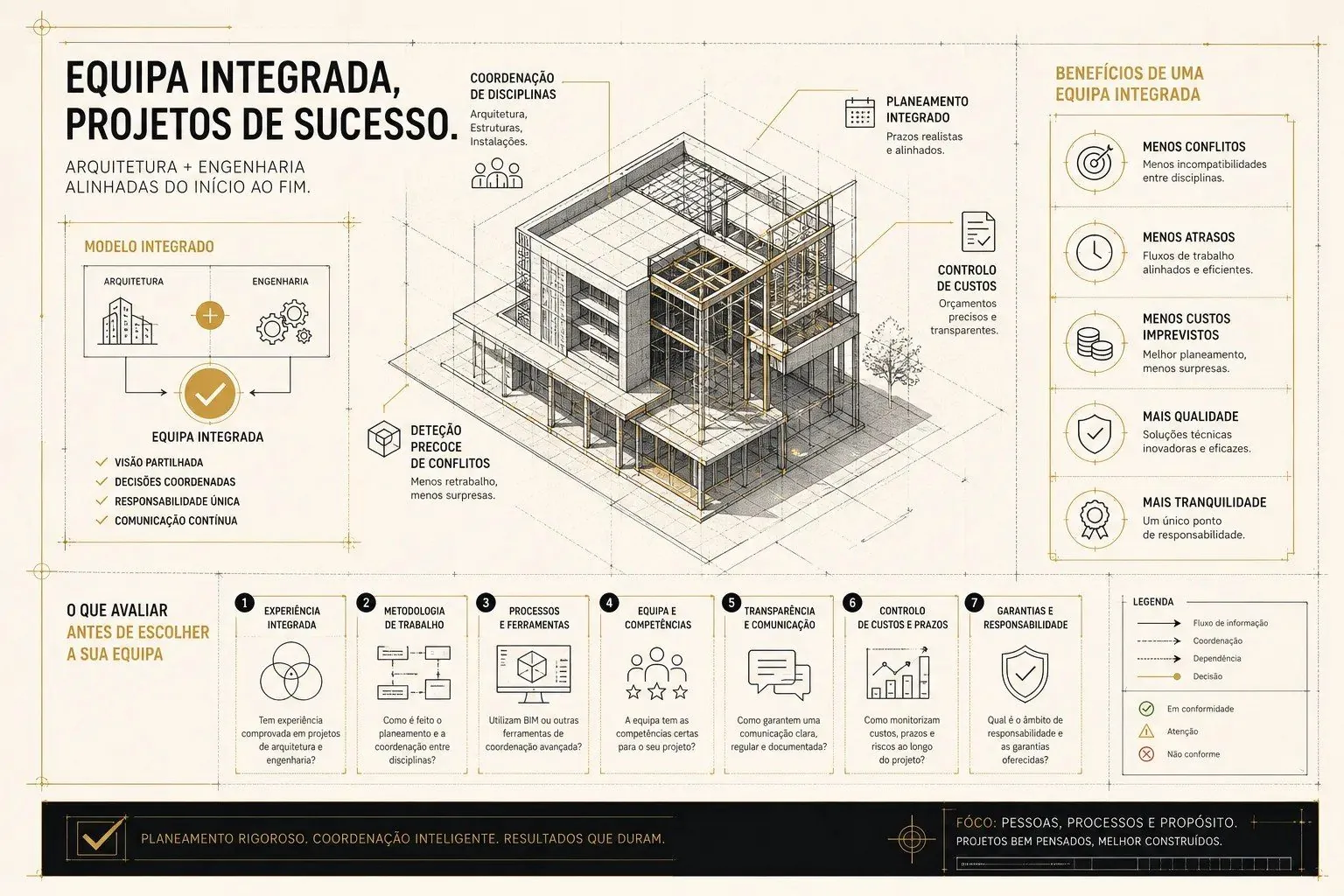
CertiAmb works with clients on both paths, with the same goal: to turn a complex decision into a clear, well-founded choice. The advantage of an integrated architecture, engineering and technical consulting team is precisely this, we cover the whole process, with no gaps between disciplines.
Feasibility studies for new construction
Before buying a plot, CertiAmb carries out feasibility studies that confirm what can be built, in how long and at what real estimated cost. This analysis includes checking the municipal PDMs, environmental constraints, available infrastructure and the building potential of the plot. The cost of a feasibility study varies with the size and complexity of the plot and covers the regulatory analysis, the reading of the spatial planning instruments and the construction cost estimate: a step that helps avoid land decisions with problems that only surface months later.
The integrated architecture, engineering and technical consulting team follows the project from the outset, avoiding late revisions that add cost and delay permitting. With experience of municipal processes in Lisbon, Grândola and Cartaxo, we apply our knowledge of local regulatory particulars to make timelines more predictable and reduce surprises over the course of the process.
Technical due diligence on second-hand properties
For clients considering the purchase of an existing property, we carry out a complete technical analysis before the deed: regulatory compliance, the condition of the electrical and plumbing systems, identification of structural pathologies and an estimate of renovation costs. This analysis turns a purchase decision from an emotional one into a well-founded one, with concrete data on what it will cost to bring the property to the desired condition.
The result is straightforward: the client knows exactly what they are buying, what the real total cost is and whether or not the property complies with the regulations in force. In Portugal, this clarity before the deed is worth far more than the cost of the technical analysis. To go deeper into the main decisions that influence a construction budget, see also our article on the five technical decisions that shape your construction budget.
Build or buy in Portugal: what determines the right answer
There is no universal answer to the decision, but there are clear factors that point in one direction. If you have a viable plot, time available and a life plan with a horizon of 15 years or more, building from scratch offers full customisation, energy efficiency and long-term savings potential. If you need a solution within a shorter timeframe and the right property comes up with clean technical due diligence, buying can be the smarter, more efficient choice.
What never makes sense is to proceed with either scenario without prior technical analysis. In the build-versus-buy equation in Portugal, the hidden costs of a poorly informed decision frequently exceed, and by a wide margin, the fees of any consulting team. Those who have been through it know this well; those who have not would do well not to find out.
If you are weighing up this decision for yourself, for your family or for an investment project, CertiAmb is available to carry out that analysis with you, in either scenario. Talk to our team before making any decision. You can also browse our news section for more articles and updates on the market and technical practice.
This article is provided for information purposes only and does not constitute legal, tax or technical advice. Each situation should be assessed individually by a qualified professional.