Insights
Water supply and drainage networks in projects: legal framework, technical requirements and best practice
Water supply and drainage networks are among the most critical components of any architecture and engineering project. Beyond their technical complexity, they are subject to a demanding legal framework that shapes the design, the sizing and the connection to public infrastructure. A mistake in this discipline is rarely resolved at the drawing board: it shows up on site, in the form of leaks, backflow or rejected permit applications.
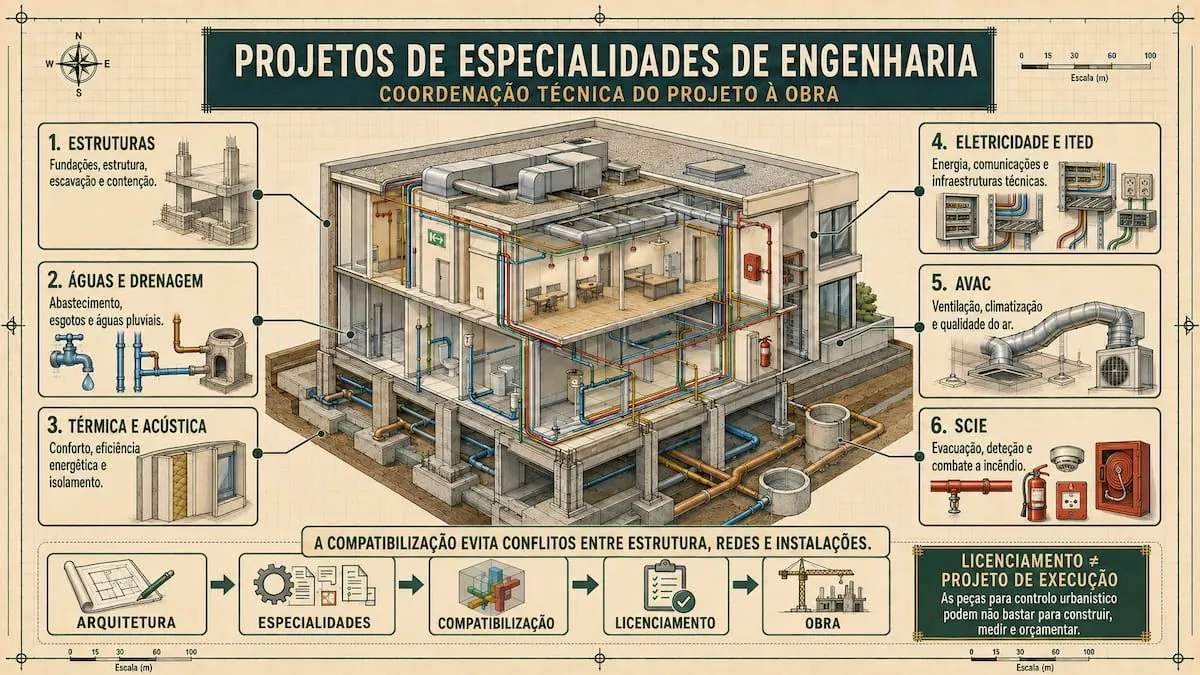
At CertiAmb, the development of these solutions forms part of our overall approach to engineering-discipline projects, which coordinates the different systems and keeps the whole in line with the legislation in force. Four things matter here: the applicable legal framework, the technical requirements for building networks, the process of connecting to the public networks and, because the framework is evolving, the legislative changes already approved that are worth anticipating.
What water supply and drainage networks include
This heading groups together the systems responsible for four distinct functions, each with its own design rules:
- Water supply for human consumption, with assured pressure, flow rate and protection against contamination (water backflow);
- Domestic wastewater drainage, with gravity flow, ventilation and sealing by water traps;
- Rainwater drainage, sized for local rainfall regimes;
- Water reuse and water-efficiency systems, for non-potable uses.
The correct design of these networks is decisive for the efficient operation of the building, the healthiness of its spaces and the durability of the construction solutions. It is a cross-cutting discipline: it interacts with the architecture, the structures and the HVAC systems, and its coordination should begin at the preliminary-study stage, not during execution.
The applicable legal framework
The central piece of legislation is Decreto Regulamentar n.º 23/95, de 23 de agosto, which approved the General Regulation for Public and Private Water Distribution and Wastewater Drainage Systems (RGSPPDADAR). This regulation sets out the fundamental criteria for the design, sizing, construction and operation of the networks, with particular emphasis on safety, public health and the reliability of the systems.
The RGSPPDADAR is complemented by a set of laws and standards that, in practice, the designer has to bring together:
- Decreto-Lei n.º 194/2009, de 20 de agosto: the legal regime for municipal water-supply and wastewater-sanitation services;
- Lei n.º 58/2005 (Lei da Água, the Water Law), which transposes the Water Framework Directive (2000/60/EC) and establishes the regime for managing water resources, and Lei n.º 19/2014 (Lei de Bases do Ambiente, the Environmental Framework Law), which sets out the principles for protecting water resources;
- Decreto-Lei n.º 152/97, concerning the treatment of urban wastewater (which transposed Directive 91/271/EEC);
- Decreto-Lei n.º 119/2019, de 21 de agosto and Portaria n.º 266/2019: the legal regime for the production of water for reuse (ApR);
- The drinking-water quality regime, currently Decreto-Lei n.º 69/2023, de 21 de agosto, which repealed Decreto-Lei n.º 306/2007;
- Applicable European standards, notably EN 806 (water installations for human consumption inside buildings), EN 1717 (protection against contamination by backflow) and EN 12056 (gravity drainage inside buildings).
To this national framework are added the municipal regulations and the technical guidance of the utility operators and the regulator (ERSAR), which set specific conditions for connection and operation.
A framework in transition: what is about to change
A significant part of this framework is being reshaped. A rigorous design should be conceived with these changes in view, or it risks being out of date from the outset:
- New Urban Wastewater Treatment Directive. Diretiva (UE) 2024/3019 (the revised Urban Wastewater Treatment Directive), in force since 1 January 2025, replaces Directive 91/271/EEC and must be transposed by Portugal by 31 July 2027. It strengthens the treatment requirements, extending secondary treatment, making tertiary treatment (nitrogen and phosphorus) mandatory and introducing quaternary treatment for the removal of micropollutants, and will entail the revision of Decreto-Lei n.º 152/97.
- Drinking-water quality. Decreto-Lei n.º 69/2023 (which transposed Directive (EU) 2020/2184) has already replaced the previous regime, introducing new parameters, such as Legionella, PFAS and bisphenol A, and more stringent values for chromium and lead, with an impact on the design of building systems.
- RGSPPDADAR. Decreto Regulamentar n.º 23/95 dates from 1995 and predates much of the current European framework; its modernisation has been the subject of technical debate within the sector, so it is worth keeping track of any updates.
Building networks: technical requirements and project coordination
Building networks play a central role within engineering-discipline projects. Beyond regulatory compliance, their feasibility depends on ensuring, simultaneously:
- adequate hydraulic sizing of the branch pipes and risers, with control of pressures and velocities;
- continuity and efficiency of the flow, with the minimum gradients of the collector pipes;
- correct ventilation of the drainage networks, to preserve the water seal of the traps;
- functional separation between wastewater and rainwater (the separate-system principle);
- protection against water backflow in the supply network (EN 1717).
Coordinating these networks with the other disciplines, structures, architecture and HVAC, is decisive for the feasibility of the works. Beam penetrations, suspended ceilings or gutters are often defined too late, creating conflicts that translate into revisions and delays. For this reason, project coordination should treat the water networks as a system, and not as an isolated drawing delivered at the end.
Connection to the public networks and municipal requirements
Connection to the public systems is mandatory, though not in absolute terms. The most direct rule, for anyone holding a building, is Article 69(1) of Decreto-Lei n.º 194/2009: all buildings, existing or to be built, with access to the public water-supply or wastewater service must have duly licensed internal systems and be connected to the corresponding public systems. Upstream of that, Article 4(3) sets the general duty of users to connect to the municipal systems. There are three ways out: a waiver by resolution of the municipal council on weighty grounds of public interest (Article 4(4)); simplified solutions accepted by the utility operator in exceptional cases (Article 69(2)); and buildings with their own duly licensed systems (Article 69(3)). On the drainage side, Article 150 of the RGSPPDADAR requires buildings covered by the public network to be connected by a service branch. As for availability, the law sets a criterion in the context of the right to be supplied: Article 59 treats the service as available where the operator's infrastructure lies 20 m or less from the property boundary. The municipal regulations and the utility operators then set the specific connection conditions, which must be taken into account from the design stage. In general terms, the process includes:
- a prior information request to the utility operator;
- preparation of the building-networks design;
- technical validation and definition of the connection conditions;
- execution of the works;
- formal connection to the public infrastructure and inspection.
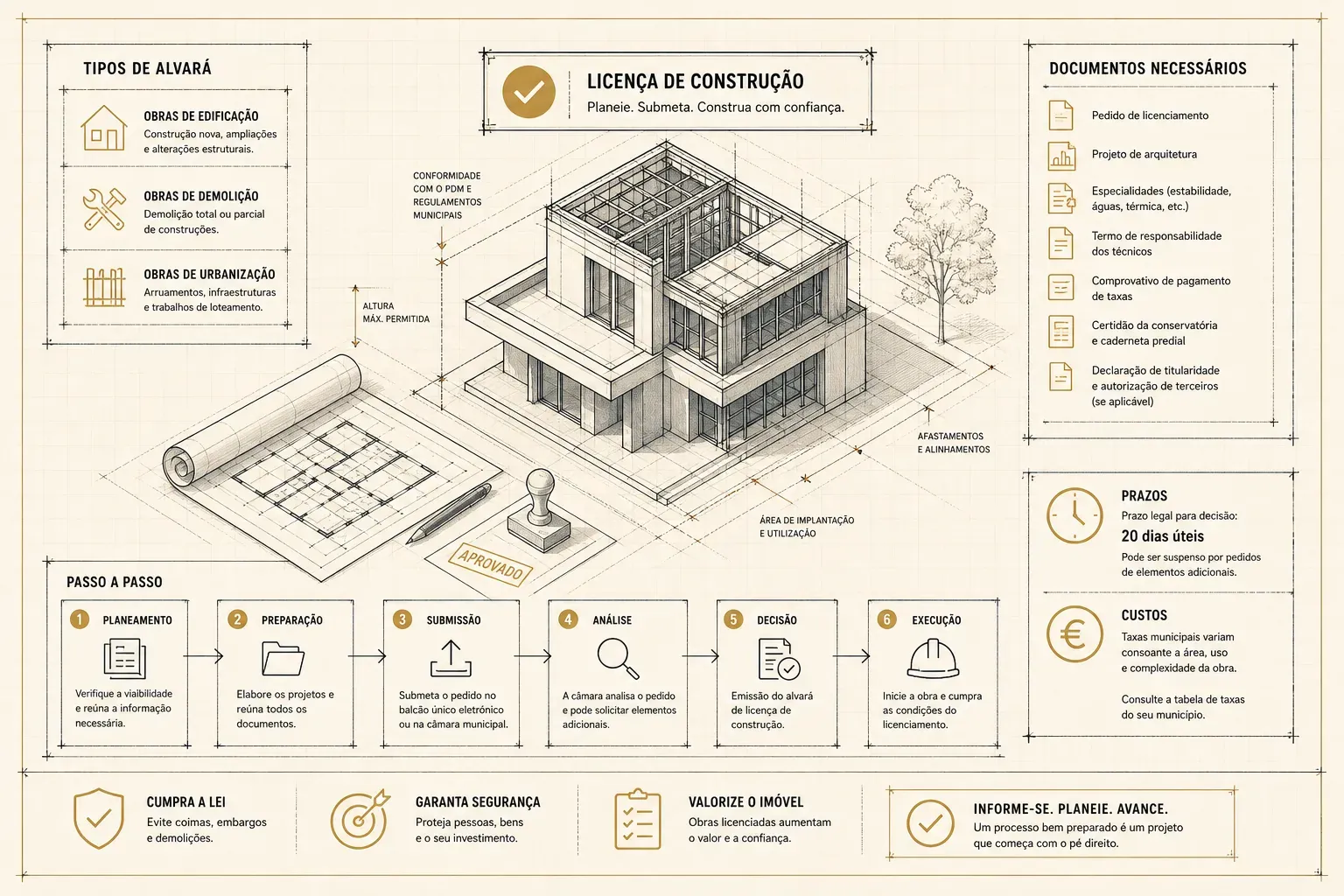
Technical support throughout these phases is essential to avoid delays, non-conformities or the need to rework the design once on site. These steps dovetail with the general urban-planning permitting process: which we cover in detail in the article How construction permitting works in Portugal.
Rainwater drainage and environmental requirements
Rainwater drainage is of growing importance, especially in urban settings, owing to the increased risk of flooding and the need to protect water resources. In addition to the RGSPPDADAR, designs must take into account the applicable European standards (such as EN 12056 and EN 752, for drainage outside buildings), the municipal regulations and the principles of the Water Law and the Environmental Framework Law.
There is an increasingly common requirement for source-control solutions, temporary retention, controlled infiltration and the reduction of peak flows, particularly in built-up urban areas where the downstream network is at the limit of its capacity. When integrated early in the design, these solutions avoid costly oversizing and reduce the risk of flooding.
Water reuse and water efficiency
The reuse of treated water is a structural trend in projects with sustainability concerns. Decreto-Lei n.º 119/2019 establishes the regime applicable to the production and use of water for reuse (ApR), allowing it to be integrated into non-potable uses, such as irrigation or washing, subject to the required permit. There is no single procedure: it depends on the source of the water, the intended use and the scale of the project, so it should be confirmed case by case. Where the ApR is intended for agricultural irrigation, Regulamento (UE) 2020/741 also applies, in force since 26 June 2023, which sets minimum quality requirements.
Incorporating these solutions, alongside rainwater harvesting, makes it possible to reduce the consumption of drinking water and improve the environmental performance of buildings, a factor that is increasingly valued both in permitting and in the market.
Decentralised solutions: septic tanks and local treatment
In the absence of a public network, standalone solutions may be adopted, such as septic tanks or packaged treatment systems. These solutions are subject to specific rules: the discharge of effluent without adequate treatment is prohibited, and their design must comply with the RGSPPDADAR and the urban-wastewater regime (Decreto-Lei n.º 152/97). Where the solution involves discharging the treated effluent into the ground or a watercourse, or where the building relies on its own water abstraction (a borehole or well), this is a use of water resources that requires a permit (título de utilização dos recursos hídricos) under Decreto-Lei n.º 226-A/2007. There is no single procedure: depending on the type and scale of the use, it may be a prior notification (comunicação prévia), an authorisation or a licence, and the specific framework should be confirmed with the Portuguese Environment Agency (APA) before the solution is finalised.
It is important to bear in mind that these solutions are, as a rule, transitional. It is worth being precise about the legal basis: no statute orders the septic tank to be decommissioned. What exists is the connection duty described above and, on the other side, the carve-out in Article 69(3) for duly licensed private systems. Decommissioning and periodic maintenance appear, in practice, in the utility operators' service regulations, approved under Article 62 of Decreto-Lei n.º 194/2009. Pointing the other way, Article 59(3) even requires the operator to provide septic-tank emptying where the network lies more than 20 m away and no extension of the service branch has been requested. This point should be weighed from the outset, so as not to jeopardise investments.
Main risks and mistakes to avoid
Experience on site shows that the most frequent problems stem from a small number of recurring causes:
- a lack of coordination between disciplines;
- inadequate sizing, whether under- or oversized;
- non-compliance with municipal regulations or with the utility operator's conditions;
- technical solutions ill-suited to the context (topography, level of the public network, type of soil).
Such situations can lead to leaks, backflow, structural damage and, at the permitting stage, rejections or administrative offences. The common denominator is almost always insufficient forward planning.
The advantage of an integrated approach
Water supply and drainage networks should be considered from the earliest stages of the design, in coordination with all the disciplines. An integrated approach makes it possible to reduce technical and legal risks, ensure compliance with the legislation, improve the efficiency and durability of the solutions and avoid additional costs during construction or operation.
At CertiAmb, each project is developed on this basis, bringing together architecture, engineering and consulting under a single coordination. You can find out more about our team and our method on the About CertiAmb page.
Frequently asked questions
Is connection to the public sanitation network mandatory?
As a rule, yes. Article 69(1) and Article 4(3) of Decreto-Lei n.º 194/2009, together with Article 150 of the RGSPPDADAR, require buildings covered by the public network to be connected. The duty admits exceptions: a waiver by resolution of the municipal council, simplified solutions accepted by the utility operator, and buildings with their own duly licensed systems.
Is it possible to use a septic tank?
Only in the absence of a public network and with an adequate treatment solution. Once the public network becomes available, connection becomes mandatory and the standalone system must be decommissioned.
Which legislation governs these networks?
The central technical instrument is Decreto Regulamentar n.º 23/95 (RGSPPDADAR), complemented, among others, by Decreto-Lei n.º 194/2009, the Water Law (Lei n.º 58/2005), Decreto-Lei n.º 119/2019 (reuse) and Decreto-Lei n.º 69/2023 (drinking-water quality).
Who should prepare the design?
The water supply and drainage networks design is one part of the engineering-discipline project and must be prepared by a qualified professional, holding a certificate of technical responsibility, in coordination with the other disciplines.
Closing notes
The correct design of water supply and drainage networks is decisive for the overall performance of the building. Compliance with the legal framework, today and in the light of the changes that lie ahead, and coordination between disciplines are the factors that separate a safe, durable solution from a costly problem. If you have a project in preparation and want to ensure the compliance of the water networks from the outset, talk to the CertiAmb team.
This article is provided for information purposes only and does not constitute legal, tax or technical advice. Each situation should be assessed individually by a qualified professional.