Insights
Fire safety in buildings (SCIE): from the design stage to self-protection measures
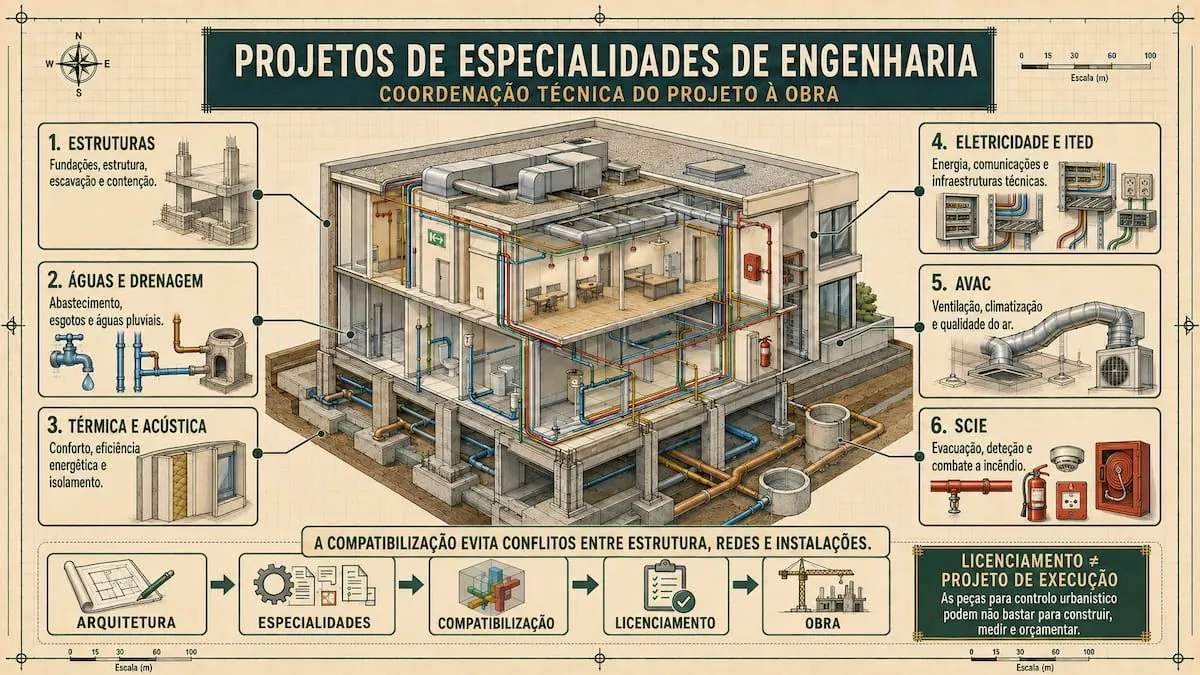
Fire safety in buildings, known in Portugal as SCIE, is, of all the engineering disciplines, the one where a mistake carries the most serious consequences: the protection of human life is at stake. It is also one of the most cross-cutting: it shapes the architecture (escape routes, compartmentation), the structures (fire resistance), the HVAC systems (smoke control), the electrical installations and even the choice of finishes. And it is a discipline that does not end with the works: it follows the building throughout its service life, through self-protection measures and regular inspections.
At CertiAmb, the SCIE design forms part of the coordinated development of the engineering-discipline projects, from the preliminary study to the handover of the works. The legal regime in force sets out when a dedicated fire safety design is required and when a simple fire safety form will do. It also imposes obligations that continue long after the building is occupied, with penalties for those who ignore them.
The legal regime: DL 220/2008 and Portaria 1532/2008
The legal framework rests on two complementary instruments:
- Decreto-Lei n.º 220/2008, de 12 de novembro, which establishes the legal regime for fire safety in buildings (RJ-SCIE). It was amended and republished by Decreto-Lei n.º 224/2015, de 9 de outubro, and further amended by Decreto-Lei n.º 95/2019, by Lei n.º 123/2019, de 18 de outubro, and by Decreto-Lei n.º 9/2021, de 29 de janeiro, which aligned the penalty regime with the Economic Offences Framework (RJCE);
- Portaria n.º 1532/2008, de 29 de dezembro, which approves the Technical Regulation on SCIE (RT-SCIE): the document that sets out the common external conditions, fire behaviour, evacuation, technical installations, safety equipment and systems, and self-protection requirements. Contrary to what is sometimes claimed, the RT-SCIE has not been replaced: it remains in force, as amended and republished by Portaria n.º 135/2020, de 2 de junho.
In concrete terms, the RT-SCIE details requirements such as the number and width of exits and escape routes, fire compartmentation, the fire resistance of structural elements and the detection, alarm, extinguishing and smoke-control systems.
The competent authority is the National Emergency and Civil Protection Authority (ANEPC) for buildings in the 2nd, 3rd and 4th risk categories; for the 1st risk category, appraisal, opinions and enforcement fall to the municipal councils. The regime applies to virtually every building and enclosure, from a single-family house to a shopping centre, with only limited exceptions defined in the RJ-SCIE, the framing always needing to be confirmed according to the use and the characteristics of the building.
Occupancy types and risk categories
The whole logic of the RJ-SCIE rests on two classifications. First, each building or unit is assigned to one of twelve occupancy types (utilizações-tipo, UT I to XII), according to its use: residential, car parks, offices, schools, hospitals and care homes, venues for shows and public gatherings, hotels and restaurants, retail, sports facilities, museums, libraries, and industrial premises or warehouses.
Second, each occupancy type is classified into one of four risk categories, reduced (1st), moderate (2nd), high (3rd) or very high (4th), based on factors such as the height of the occupancy, the number of occupants, the floor area, the number of storeys below the reference plane or, for industrial and storage buildings, the fire load. This classification is no bureaucratic detail: it determines the technical requirements of the RT-SCIE, how the file must be instructed, which authority reviews it, which self-protection measures are required and how often inspections are due.
Misclassifying an occupancy type or a risk category at the permitting stage compromises the whole process, and aggravating the risk category of a building in use, without upgrading its fire safety conditions, is an administrative offence.
A dedicated SCIE design or a fire safety form?
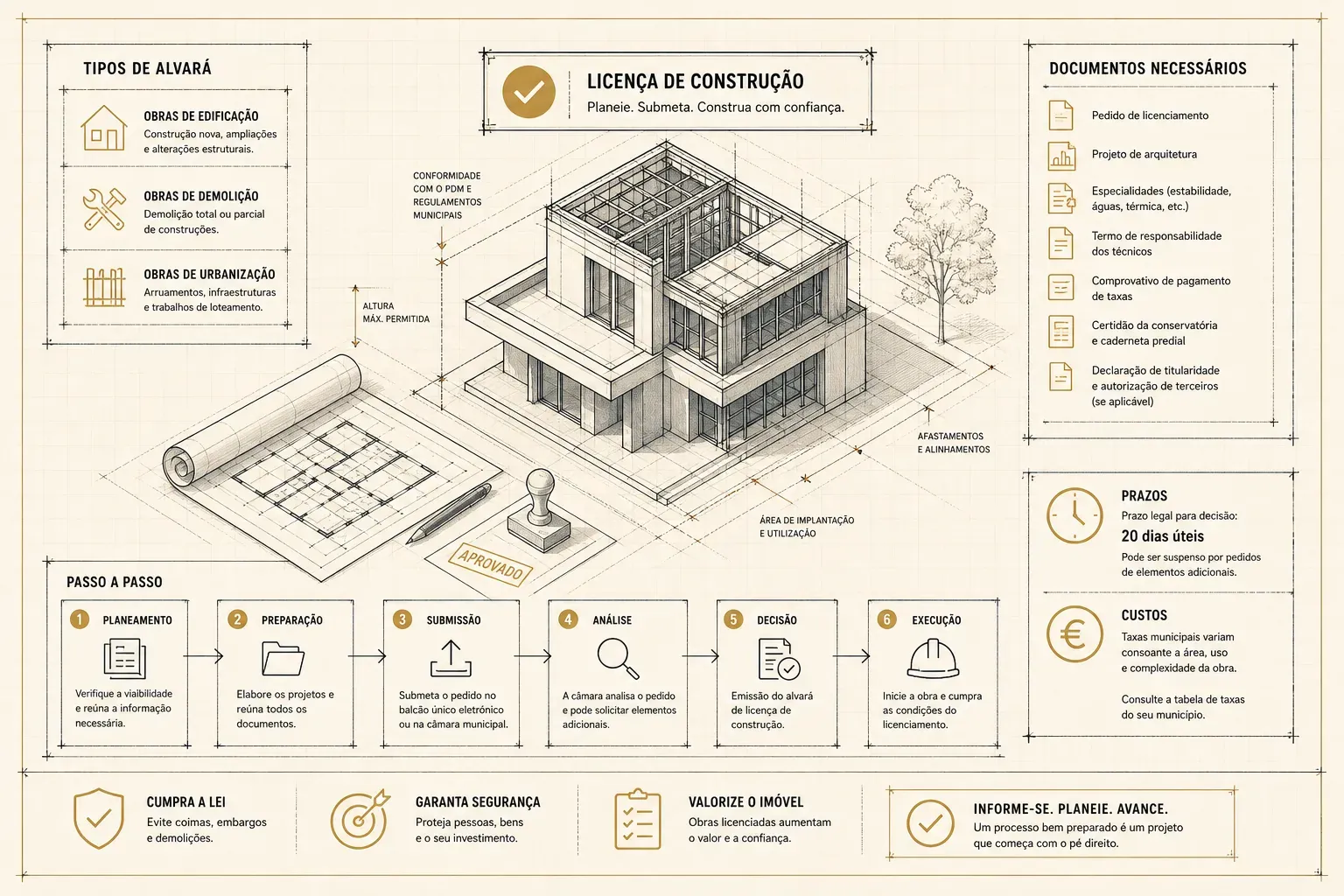
Under article 17 of the RJ-SCIE, administrative procedures for building works must be instructed with a dedicated SCIE design. There is, however, an important simplification: for works in the 1st risk category, the design is waived and replaced by a fire safety form (ficha de segurança) for each occupancy type, following the templates approved by ANEPC.
As to authorship, Lei n.º 123/2019 introduced a requirement worth knowing: for buildings in the 2nd, 3rd and 4th risk categories, SCIE designs and self-protection measures may only be prepared by architects, engineers or technical engineers holding a certified specialisation, recognised by their professional bodies under protocols with ANEPC, which keeps a public register of these authors (article 15-A). A generally qualified professional is, therefore, not enough.
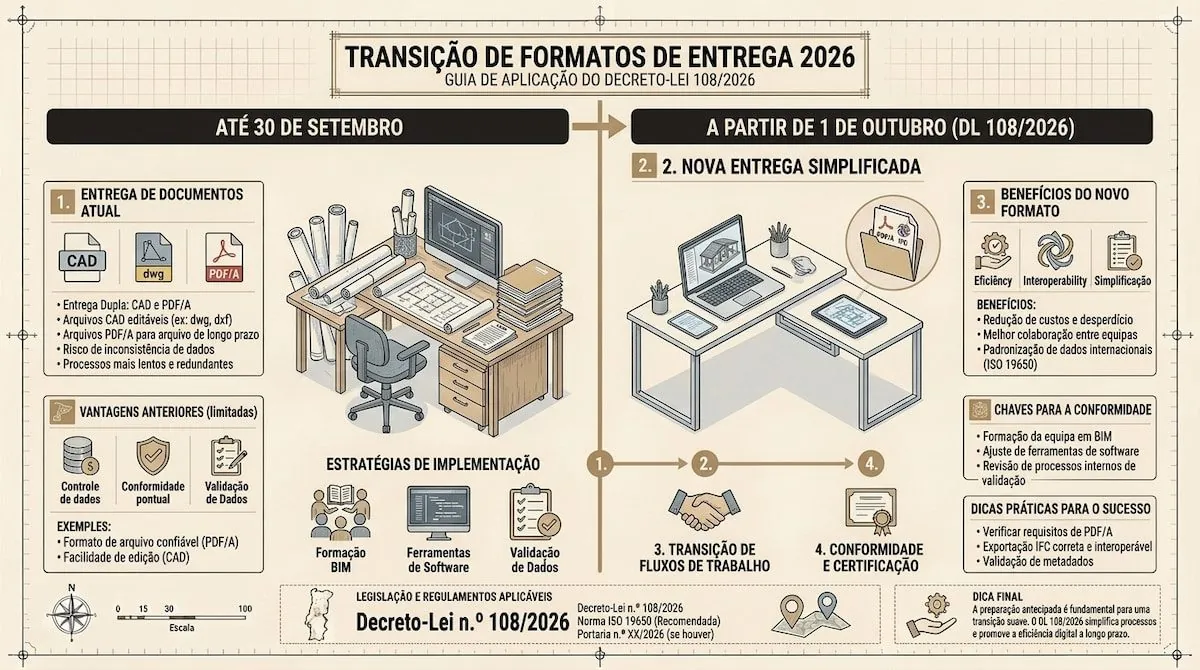
At the use stage, the RJUE mechanism for the start of use applies (Article 62-A), which does not provide for any “use permit” as a permissive act. Until 30 September 2026, under the wording introduced by Decreto-Lei n.º 10/2024, use of the building after works subject to prior control depended on delivering to the municipality the statement of responsibility (termo de responsabilidade) of the site manager or the site supervision manager, declaring that the works are finished and were carried out in accordance with the design (a statement which, under the RJ-SCIE, also had to confirm compliance with the SCIE conditions), together with the as-built drawings (telas finais) if the design was changed; the building could be used as soon as these were submitted. From 1 October 2026, under Decreto-Lei n.º 108/2026, use depends on submitting a prior notification (comunicação prévia) on the official form, with the elements set out in the implementing portaria and the statement of responsibility; use is possible immediately after submission, followed by subsequent control. Under either regime, where an inspection takes place, for the 2nd to 4th risk categories it includes a representative of ANEPC or of an accredited entity.
Self-protection measures: the obligation that outlives the works
This is the most neglected side of the regime. Self-protection measures (articles 21 and 22 of the RJ-SCIE) apply to all buildings and enclosures in use, including those built before 2009, with the exception of residential buildings (UT I) in the 1st and 2nd risk categories. They comprise:
- preventive measures, prevention procedures or prevention plans, depending on the risk category;
- intervention measures: emergency procedures or an internal emergency plan;
- safety records, containing the inspection reports and all maintenance actions;
- SCIE training for staff and collaborators, and specific training for the safety officers;
- drills, at the maximum intervals set in the RT-SCIE.
Self-protection measures are subject to an opinion from ANEPC, or from the municipality, for the 1st risk category, and the file must be submitted up to 30 days before the building enters into operation, in the case of new builds, alterations, extensions or changes of use. The responsible entity must also appoint a safety officer, who oversees the training and drills, checks that the procedures are actually applied and acts as the point of contact for enforcement. For anyone operating hotels, schools, clinics, shops or warehouses, keeping these measures approved, up to date and implemented is not optional: it is a permanent, verifiable legal obligation. And an initial approval is not enough, self-protection measures must be updated whenever there are relevant changes in occupancy, internal organisation or technical installations.
Regular inspections and penalties
Buildings in use are subject to regular inspections, requested by the responsible entity, at maximum intervals of six years for the 1st risk category, five for the 2nd, four for the 3rd and three for the 4th. Several occupancy types in the 1st risk category and exclusively residential buildings in the 2nd category are exempt; the higher-risk uses, schools, hospitals and care homes, for instance, are always covered. Extraordinary inspections may also be carried out on the initiative of ANEPC or of another enforcement authority.
Non-compliance has concrete consequences. Enforcement falls to ANEPC, to the municipalities (1st risk category) and to ASAE, and the infringements, from obstructing escape routes to failing to maintain detection and alarm systems, or signing designs without the required qualification, constitute economic offences punishable under the RJCE, with fines that scale with the seriousness of the infringement and the size of the company, reaching, in serious cases and for larger companies, amounts in the order of tens of thousands of euros, without prejudice to the civil and criminal liability of the safety-responsible entity.
What is about to change (and what has already changed)
Unlike other areas of construction law, the SCIE regime has been relatively stable since 2021, to date, no diploma replacing it has been approved. There are, even so, three developments worth following:
- The effect of the Simplex urban-planning reform. Decreto-Lei n.º 10/2024 did not amend the RJ-SCIE, but it transformed the context in which it applies: with less prior municipal control and more statements of responsibility, compliance with the SCIE conditions now rests even more heavily on the designers and site managers, who answer for what they sign. The revision of the RJUE approved by Decreto-Lei n.º 108/2026, de 29 de maio, whose entry into force was postponed to 1 October 2026 by Decreto-Lei n.º 155-B/2026, likewise does not amend the RJ-SCIE and reinforces the same logic of professional accountability. We covered this reform in our article on construction permitting in Portugal;
- A revision of the regime, under discussion in the sector. The professional bodies and industry associations have put forward proposals to amend the RJ-SCIE and the RT-SCIE; any future revision is likely to strengthen the articulation with the simplified planning regime. No diploma has yet been approved, so the framework described in this article is the one that applies;
- The new European Construction Products Regulation, Regulation (EU) 2024/3110, which will gradually replace Regulation (EU) No 305/2011, while keeping, with adjustments, the European classification system for reaction and resistance to fire used in SCIE designs to specify materials and products.
Common mistakes that make projects and works more expensive
In our site supervision and project management practice, the SCIE problems we encounter repeat themselves:
- incorrect classification of the occupancy type or risk category, which taints the whole process;
- an SCIE design developed too late, in conflict with an architecture already frozen: undersized escape openings, poorly positioned stair cores, compartmentation impossible to build;
- changes on site that degrade the compartmentation or fire resistance without the design being reassessed;
- buildings handed over without approved self-protection measures, preventing or significantly delaying the opening to the public until the situation is put right;
- regular inspections forgotten, and discovered only when an insurer, a business transfer or an enforcement action demands them.
CertiAmb's integrated approach
SCIE is not an annex to the file: it is a discipline that must be born with the preliminary study and coordinated with all the others. That is the logic of CertiAmb's integrated approach: architecture, engineering and consulting under a single coordination, from Lisbon to Grândola and Cartaxo, with close support in the Lisbon region. From framing the risk category to preparing the design or the fire safety form, from self-protection measures to accompanying final inspections and periodic inspections, the team ensures that fire safety is treated as what it is: a design requirement, not a last-minute obstacle. You can meet the team and the method on the About CertiAmb page.
SCIE and the other disciplines
In practice, SCIE interacts with almost every discipline: it conditions the type and position of the stairs and escape routes, the reaction-to-fire class of the finishes, the routing of the installations, which must not cross structural or compartmentation elements without proper protection, and the HVAC solutions, with fire dampers and compartmentation for smoke control. Ignoring these interactions at the start of the design is the main cause of failed inspections and costly corrections.
Frequently asked questions
When is a dedicated fire safety (SCIE) design required?
As a rule, planning and building procedures must be instructed with a dedicated SCIE design. For works in the 1st risk category, the design is waived and replaced by a fire safety form for each occupancy type, following the ANEPC templates.
Who may prepare SCIE designs and self-protection measures?
For the 2nd, 3rd and 4th risk categories, only architects, engineers or technical engineers holding a certified specialisation in SCIE and registered with ANEPC, under article 15-A of the RJ-SCIE.
What are self-protection measures and who reviews them?
They are the safety organisation and management measures for the building in use: prevention and emergency plans or procedures, records, training and drills. They are subject to an opinion from ANEPC (or from the municipality, for the 1st risk category) and the file must be submitted up to 30 days before the building enters into operation.
How often are regular inspections mandatory?
At most every six years for the 1st risk category, five for the 2nd, four for the 3rd and three for the 4th, with exemptions for several occupancy types in the 1st category and for exclusively residential buildings in the 2nd.
Is Portaria n.º 1532/2008 still in force?
Yes. The RT-SCIE remains in force as amended and republished by Portaria n.º 135/2020. It has not been replaced.
Checklist for building owners and operators
The CertiAmb team has prepared a practical checklist for building owners and operators, covering the classification (occupancy type and risk category), the design or fire safety form, the self-protection measures, the regular inspections and the most common mistakes to avoid. To receive it, write to us at geral@certiamb.com or fill in our contact form.
Closing notes
Fire safety follows the building from the first sketch to the last inspection. Addressing it early, with certified professionals and in coordination with the other disciplines, is the most economical, and the safest, way to comply. If you are preparing a permit application, need self-protection measures for a building in operation or have an inspection on the horizon, talk to the CertiAmb team.
This article is provided for information purposes only and does not constitute legal, tax or technical advice. Each situation should be assessed individually by a qualified professional.