Insights
Structures: from the RSA and REBAP to the Eurocodes. What has changed in design and what lies ahead
For almost four decades, structural design in Portugal rested on two national regulations published in 1983: the Regulamento de Segurança e Ações para Estruturas de Edifícios e Pontes (RSA, the safety and actions regulation for building and bridge structures) and the Regulamento de Estruturas de Betão Armado e Pré-Esforçado (REBAP, the regulation for reinforced and prestressed concrete structures). That era has come to an end: since September 2022, building structural designs must be prepared in accordance with the Structural Eurocodes. And the transition did not stop there: the second generation of these European standards has already been adopted in Portugal and will replace the current one by 2028.
At CertiAmb, the structural design is developed within the framework of our engineering-discipline projects, in close coordination with the architecture and the remaining disciplines. The transition from the RSA/REBAP to the Eurocodes is already complete, yet it still raises questions: which legal framework is in force, which seismic assessment requirements apply in rehabilitation and what changes with the second generation.
From the RSA and REBAP to the Eurocodes: half a century of regulation
Decreto-Lei n.º 235/83, de 31 de maio approved the RSA, which defined the actions to be considered in structural sizing, self-weight, imposed loads, wind, earthquakes, and Decreto-Lei n.º 349-C/83, de 30 de julho approved the REBAP, devoted to reinforced and prestressed concrete structures. They were joined in 1986 by the Regulamento de Estruturas de Aço para Edifícios (REAE, the regulation for steel structures for buildings). These were landmark instruments in their day, but they stood still in time. They followed neither the evolution of knowledge nor European technical harmonisation.
In parallel, the European Commission launched, as early as the 1970s, the Structural Eurocodes programme, whose development passed in 1990 to the European Committee for Standardization (CEN/TC 250). The first generation, 58 European Standards, completed in May 2007, was progressively transposed in Portugal as Portuguese Standards (NP EN), each with its own National Annex, which sets the Nationally Determined Parameters (NDPs), such as the seismic zoning. The first set of 16 NP EN, published between December 2009 and March 2010, already allowed the design of ordinary building structures in concrete and steel.
The legal framework in force: Decreto-Lei n.º 95/2019 and Despacho Normativo n.º 21/2019
Legal enshrinement of the Eurocodes came with Decreto-Lei n.º 95/2019, de 18 de julho, which, in addition to establishing the regime applicable to building rehabilitation, repealed the RSA and the REBAP as regards building structures, keeping them in force for other works, such as bridges, along with the REAE and the 1958 Regulamento de Segurança das Construções Contra os Sismos (the earthquake safety regulation for constructions). Article 16 referred the conditions for applying the Eurocodes to a ministerial order, given effect by Despacho Normativo n.º 21/2019, de 17 de setembro, which defines the standards to be complied with:
- Annex I: NP EN 1990 (basis of design), NP EN 1991 (actions), NP EN 1997-1 (geotechnical design) and NP EN 1998-1, 1998-3 and 1998-5 (earthquake resistance), applicable to all building structural designs;
- Annex II: NP EN 1992-1-1 and 1992-1-2, for concrete structures;
- Annex III: the applicable parts of NP EN 1993, for steel structures.
The three-year transitional period, during which it was still possible to submit designs prepared under the RSA, the REBAP and the REAE, ended on 17 September 2022. Since then, the Eurocodes have been the mandatory reference for building structures, and the case-by-case use of the two regulatory frameworks within the same design is not permitted. The lists of standards have since been updated by Avisos n.º 963/2020 and n.º 6653/2022, published by the LNEC in the Diário da República.
Rehabilitation and seismic assessment: Portaria n.º 302/2019
Decreto-Lei n.º 95/2019 also introduced, in Article 8, a requirement of great practical reach: in rehabilitation operations, extension, alteration or reconstruction works, on wholly or predominantly residential buildings, a seismic vulnerability assessment report may be required, regardless of the date of the original construction. The obligation is not automatic: under Article 1(1) of Portaria n.º 302/2019 it is enough that one of these conditions is met, clear signs of structural deterioration, works that change the structural behaviour of the building, an intervention area, including demolitions and extensions, above 25 per cent of the gross floor area, or a construction cost exceeding by at least 25 per cent that of an equivalent new building. For buildings in importance classes III and IV those two thresholds drop to 15 per cent. If the report concludes that the building does not meet 90 per cent of the seismic action of NP EN 1998-3, a seismic strengthening design becomes mandatory. Portaria n.º 302/2019, de 12 de setembro defines the terms of that assessment and the situations in which a seismic strengthening design is required, drawing on NP EN 1998-3, on the assessment and retrofitting of existing buildings. The revision of this portaria has been under discussion within the sector, so its evolution is worth following.
Why this matters: seismic risk in Lisbon and the Tagus valley
Seismic hazard in mainland Portugal is highest precisely in the region of Lisbon, the Tagus valley and the Algarve, as the earthquake of 1755 and the Benavente earthquake of 1909 remind us. Yet a substantial share of the building stock in these regions was built before the RSA (1983), and much of it before the 1958 seismic regulation, without adequate seismic design. That is why, in any intervention on an existing building, a rigorous structural assessment is not a formality: it is the difference between rehabilitating a building and perpetuating its fragility. This issue is particularly sensitive in the territories where CertiAmb works daily, from Lisbon to the Ribatejo and the Alentejo coast.
What is going to change: the second generation of the Eurocodes
While Portugal was consolidating the application of the first generation, in March 2026 CEN completed the development of the second generation of the Eurocodes, 60 standards, complemented by 12 specifications and 4 technical reports, begun in 2015. Headed by the new EN 1990, published by CEN in 2023, these standards were adopted by the IPQ as Portuguese Standards in April 2026, as announced by the LNEC. The milestones to keep in mind:
- official date of publication (DOP) of all second-generation standards: 30 September 2027;
- withdrawal of the first-generation standards (DOW): 30 March 2028, with a coexistence period until then;
- main new features: rules for the assessment, reuse and strengthening of existing structures, stronger robustness requirements, a new Eurocode for glass structures, greater ease of use and fewer national parameters;
- it is not appropriate to mix first- and second-generation standards in the same design.
For now, the mandatory reference remains the one set by Despacho Normativo n.º 21/2019, based on the first generation, until the regulatory conditions are updated. But anyone promoting a development today with a long execution horizon should take this transition into account, and choose designers who are following it closely.
The structural design in the permitting process
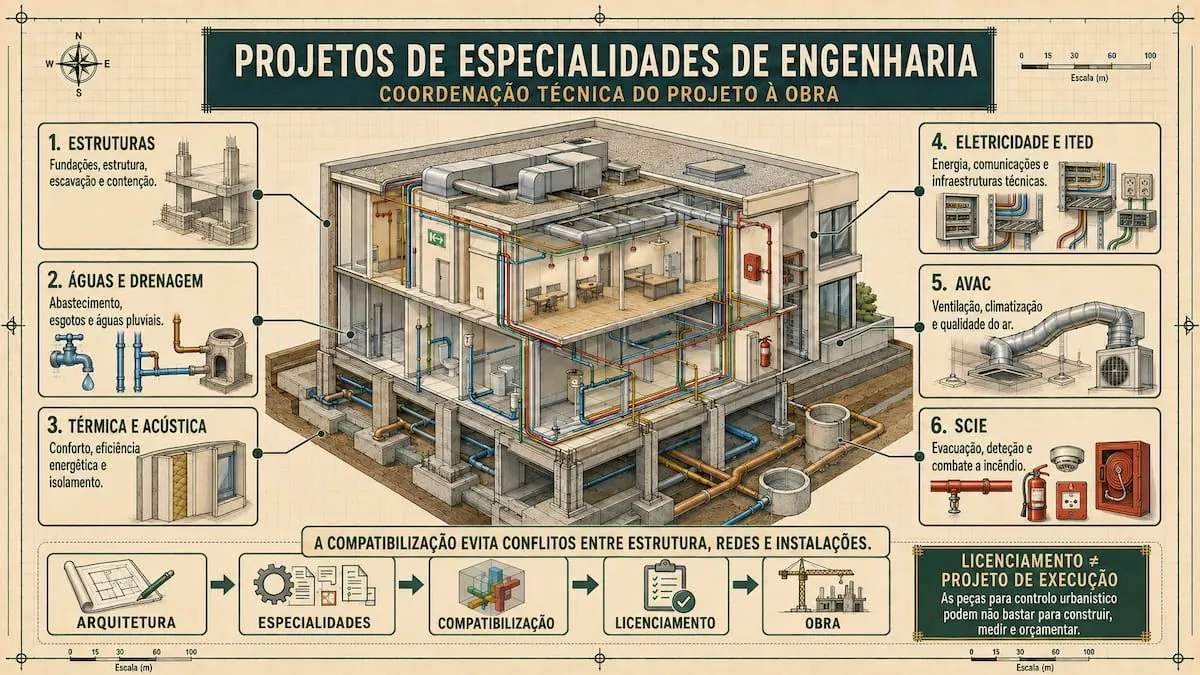
In municipal permitting, the structural design, including, where applicable, peripheral retaining works and excavations, is one of the central pieces of the set of engineering-discipline projects, signed by a qualified professional under a certificate of technical responsibility. In practice, responsibility for regulatory compliance rests with the designer, which makes the choice of team all the more critical. Coordination between structure and architecture should begin at the preliminary-study stage: a structural grid defined too late produces columns in impossible places, beams that clash with openings and costly revisions. We explain the general framework of the process in the article How construction permitting works in Portugal.
Mistakes and risks to avoid
Experience shows that the most serious problems in this discipline stem from a small set of recurring practices:
- reusing old designs or calculation spreadsheets, prepared under the RSA/REBAP, in applications submitted today;
- mixing regulatory frameworks, or, in the near future, generations of Eurocodes, within the same design;
- ignoring the seismic vulnerability assessment in extension, alteration or reconstruction works;
- carrying out structural alterations (opening up spans, removing walls) without a structural design or technical supervision;
- a lack of coordination between structure, architecture and building services, with holes and chases in structural elements decided on site.
The consequences range from the rejection of the permit application to the civil and criminal liability of those involved, and, at the limit, to structural unsafety. Competent technical supervision and works inspection avoid most of these scenarios.
CertiAmb's integrated approach
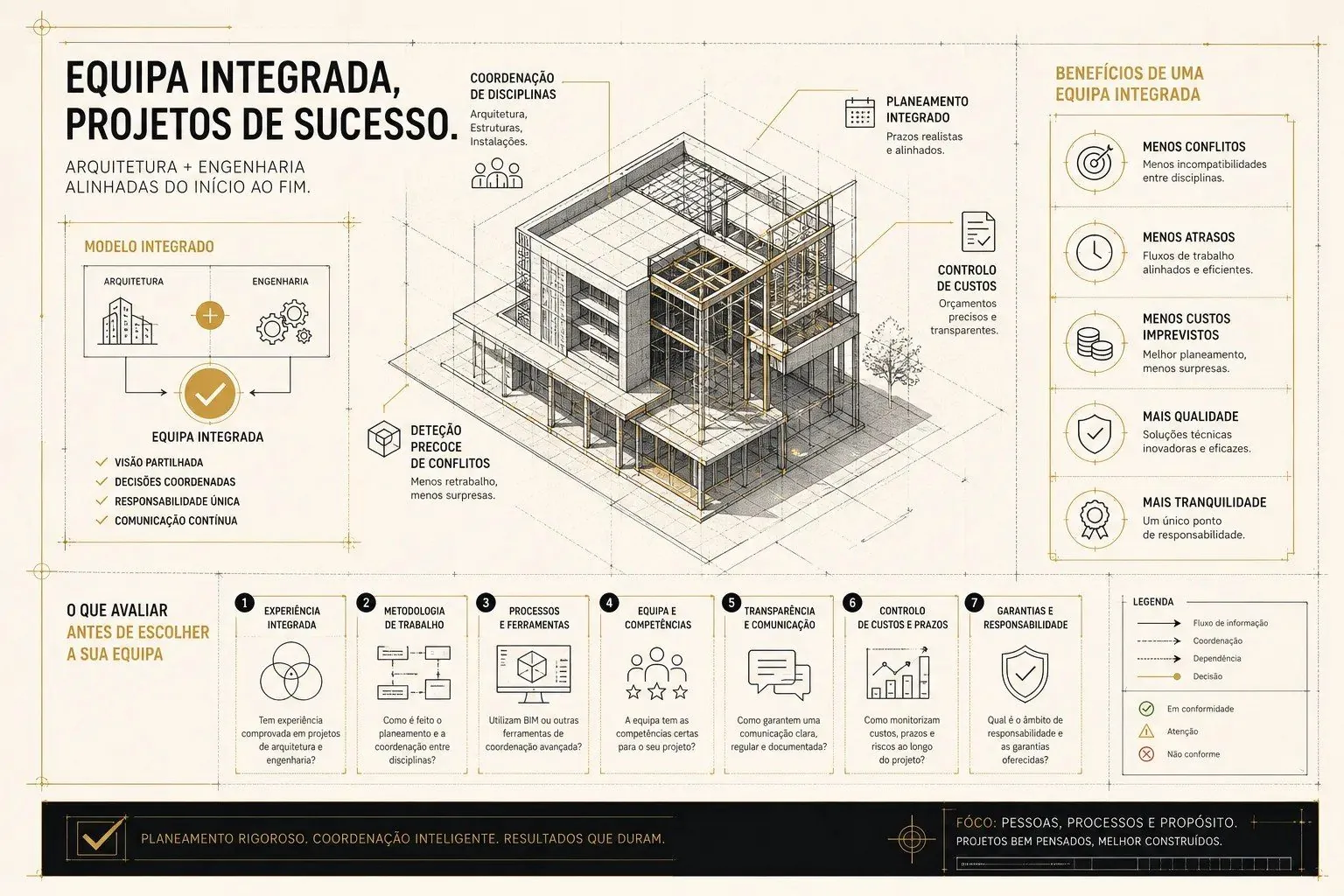
Structural stability is not an isolated discipline: it shapes, and is shaped by, the architecture, the building services and the thermal and acoustic behaviour of the building. An integrated approach, with all the disciplines under the same coordination, ensures that the structural model, the construction sequencing and the regulatory requirements, from the Eurocodes to the seismic assessment, are addressed from the very first sketch. You can find out more about our team and our method on the About CertiAmb page.
Frequently asked questions
Can the RSA and REBAP still be used in building designs?
No. Decreto-Lei n.º 95/2019 repealed them as regards building structures and, once the transitional period ended in September 2022, designs must follow the Structural Eurocodes, under the conditions set by Despacho Normativo n.º 21/2019.
What are the National Annexes to the Eurocodes?
They are the part of each NP EN that sets the Nationally Determined Parameters (NDPs), for example, the seismic zoning or the wind action, adapting the European rules to Portuguese conditions. They are drawn up by CT 115, coordinated by the LNEC.
When is a seismic vulnerability assessment mandatory?
In rehabilitation operations, extension, alteration or reconstruction, on wholly or predominantly residential buildings, under Article 8 of Decreto-Lei n.º 95/2019 and Portaria n.º 302/2019, regardless of the date of the original construction.
Do the second-generation Eurocodes already apply in Portugal?
They are not yet the mandatory reference. They were adopted by the IPQ as NP EN in April 2026, have an official date of publication of 30 September 2027, and the first generation will be withdrawn on 30 March 2028. Generations should not be mixed in the same design.
Who may prepare the structural design?
A qualified professional, licensed under the legal terms, who signs the design under a certificate of technical responsibility, in coordination with the architecture and the remaining disciplines.
Closing notes
The move from the RSA/REBAP to the Eurocodes was the biggest change in Portuguese structural engineering in forty years, and the second generation, already adopted as NP EN, will bring a further leap by 2028. In a country with Portugal's seismic risk, designing structures rigorously, to the right reference framework and with the disciplines properly coordinated, is an investment in safety and in asset value. If you have a new-build or rehabilitation project in preparation, talk to the CertiAmb team.
This article is provided for information purposes only and does not constitute legal, tax or technical advice. Each situation should be assessed individually by a qualified professional.