Insights
Urban rehabilitation: legal regime, ARU, tax incentives and what changes in 2026
Urban rehabilitation has stopped being a niche: between an ageing building stock, the pressure on housing and a substantial package of tax and financial incentives, rehabilitating has become, in many municipalities, the preferred route to creating value in property. But the framework is scattered, a dedicated legal regime, benefits spread across the Tax Incentives Statute and the VAT Code, specific technical requirements, and it is, once again, changing: May 2026 saw the publication of Decreto-Lei n.º 108/2026, which amends both the RJUE (the general urban planning and building regime) and the urban rehabilitation regime.
At CertiAmb we support rehabilitation operations from end to end: from establishing how the property is framed within the ARU (área de reabilitação urbana, urban rehabilitation area) to the architectural design and permitting, through the engineering-discipline projects, stability, water networks, thermal performance, acoustics, HVAC and fire safety. Three things are best kept apart: the regime that applied until 30 September 2026, the incentives you can take advantage of and the changes that took effect on 1 October.
The RJRU: urban rehabilitation areas and operations
The central piece of legislation is Decreto-Lei n.º 307/2009, de 23 de outubro, which approved the Legal Regime for Urban Rehabilitation (Regime Jurídico da Reabilitação Urbana: RJRU). It has been amended several times: notably by Lei n.º 32/2012 and, more recently, by Decreto-Lei n.º 10/2024 (the Simplex Urbanístico) and by Decreto-Lei n.º 108/2026, whose amendments took effect on 1 October 2026. The RJRU rests on two concepts worth mastering:
- ARU: urban rehabilitation area: a territory delimited by the municipality (by resolution of the municipal assembly, on a proposal from the council, or through a detailed urban rehabilitation plan) where the deterioration of the buildings, the infrastructure or the public spaces justifies an integrated intervention;
- ORU, urban rehabilitation operation: the articulated set of interventions for that area, which may be simple (directed essentially at rehabilitating the building stock) or systematic (coupled with the upgrading of infrastructure and public space, with a public investment programme), led by a managing entity, the municipality or, for example, an urban rehabilitation company.
Delimiting an ARU has immediate effects: it obliges the municipality to define the tax benefits associated with the municipal property taxes and gives owners access to support and incentives for rehabilitation. It also comes with deadlines: the delimitation lapses if the corresponding ORU is not approved within three years, and each ORU runs for a maximum of 15 years. Knowing whether a property sits within an ARU, and at what stage the respective ORU stands, is therefore one of the first steps of any feasibility study, alongside its framing within the construction permitting process.
Tax benefits: IMI, IMT and IRS in 2026
The core of the benefits now sits in article 45.º of the Estatuto dos Benefícios Fiscais (EBF, the Tax Incentives Statute), applicable to urban buildings or units completed more than 30 years ago or located in an ARU, provided the rehabilitation raises the property's state of conservation by at least two levels (to no less than "Good", on the scale of Decreto-Lei n.º 266-B/2012) and meets the applicable energy-efficiency requirements:
- IMI (Imposto Municipal sobre Imóveis, the municipal property tax): a three-year exemption from completion of the works, extendable for a further five years, on the owner's application, where the property is used as the owner's permanent home or for residential letting; the extension, however, depends on a resolution of the municipal assembly on a proposal from the municipal council (article 45.º(6) of the EBF);
- IMT (Imposto Municipal sobre as Transmissões Onerosas de Imóveis, the property transfer tax) on acquisitions for rehabilitation: an exemption on the purchase of properties intended for rehabilitation works, provided the works begin within three years;
- IMT on the first transfer: an exemption on the first sale after the rehabilitation, for permanent residential letting or, within an ARU, also for use as the buyer's own permanent home, an exemption that falls away if the intended use is not fulfilled within the statutory deadlines;
- Fees: a 50% reduction in the fees due for the assessment of the state of conservation.
One decisive procedural detail: recognition of the intervention must be requested together with the prior notification or the permit application, after which the municipal council certifies the state of conservation before and after the works and notifies the tax office of the recognition. Those who only think about the benefits at the end of the works risk losing them. Added to this is the IRS (personal income tax) credit of 30% of the rehabilitation costs, up to 500 euros, provided for in article 71.º of the EBF: an article which, incidentally, was heavily cut back by Lei n.º 56/2023 ("Mais Habitação"), which repealed most of the other incentives it contained. Each municipality may also define incentives of its own in the strategy for the respective ARU.
6% VAT on rehabilitation works contracts
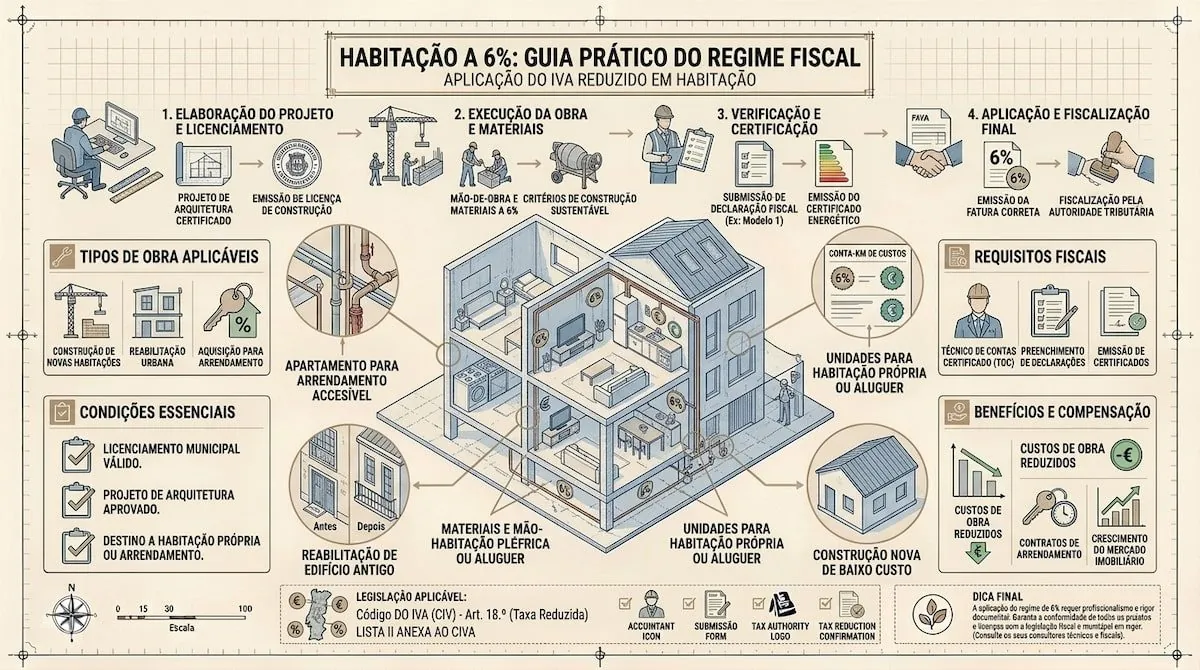
Item 2.23 of List I annexed to the VAT Code applies the reduced 6% rate to works contracts for the rehabilitation of buildings located in an ARU (and to contracts for the construction or rehabilitation of public collective-use facilities). Under the wording introduced by Lei n.º 56/2023, in force since 7 October 2023, there is no reference to an approved ORU. As to buildings, the item expressly refers to rehabilitation works and does not, as a general matter, include new construction there; works for the construction or rehabilitation of public collective use facilities remain expressly covered. Location alone is not enough: it is necessary to check whether the specific operation is a works contract covered by the item, and to analyse the remaining tax and planning conditions of the case. Standalone design, consultancy, professional fees or site supervision services are not covered by the item merely because the building sits inside an ARU.
Mind the transitional regime: article 50(9) of Lei n.º 56/2023 kept the earlier wording of the item for permit applications, prior notifications and prior information requests filed with the municipal council before 7 October 2023, and for permit applications and prior notifications filed after that date under a favourable prior information decision still in force. Until August 2026 that wording was read as requiring a previously approved ORU, the meaning the Supreme Administrative Court settled in its case-law harmonisation ruling n.º 3/2026. Article 2 of Lei n.º 48/2026, of 17 August says the opposite, by authentic interpretation: urban rehabilitation works contracts are all those carried out on buildings or public spaces located in urban rehabilitation areas delimited under the law, regardless of whether an urban rehabilitation operation has been approved. Article 3 gives it effect from the entry into force of Lei n.º 64-A/2008 and article 4 sets entry into force on the day after publication. The law settles the ORU question. It does not remove the need to check whether the operation is a works contract covered by the item, nor the analysis of the remaining tax and planning conditions of the specific case. And there is news in 2026. Item 2.24 covers works contracts for the rehabilitation of properties which, whatever their location, are contracted directly for the Fundo Nacional de Reabilitação do Edificado by its management company, by the IHRU, by the IHM or by the Azores Regional Housing Directorate. And item 2.42 was created: sub item 2.42.1 covers works contracts for the construction or rehabilitation of properties intended for sale as the buyer's own permanent home, or exclusively for residential letting, within the sale price and rent limits set by Decreto-Lei n.º 97/2026, of 20 May. The terms and conditions of application are set out in special legislation, and the item ceases to be in force on 31 December 2032.
DL 95/2019: technical requirements tailored to the existing building
Rehabilitating is not building from scratch, and the law recognises it. Decreto-Lei n.º 95/2019, de 18 de julho, establishes the regime applicable to rehabilitation operations carried out on buildings or autonomous units intended wholly or predominantly for residential use, meaning those where at least 50% of the area is for housing and complementary uses. The scope of each discipline depends on the date of the original building control procedure, under article 2. It rests on the principle of proportional and progressive improvement: the technical requirements must be suited to the existing building, rather than blindly applying rules devised for new construction. The statute is regulated by a set of implementing orders: accessibility (Portaria n.º 301/2019), seismic vulnerability (Portaria n.º 302/2019), standard costs (Portaria n.º 303/2019), functional requirements for housing (Portaria n.º 304/2019) and acoustics in existing residential buildings (Portaria n.º 305/2019).
The seismic component deserves particular attention. Article 8 of DL 95/2019 refers the matter to a ministerial order, and it is Portaria n.º 302/2019 that sets the rules. In extension, alteration or reconstruction works a seismic vulnerability assessment report is required where one of the situations in its article 1(1) occurs, among them the intervened area exceeding 25% of the gross floor area of the building. And where the report concludes that the building does not meet the safety requirements relating to 90% of the action defined in NP EN 1998-3:2017, a seismic strengthening design is mandatory, a particularly sensitive matter in Lisbon and the Tagus valley. Note also a frequent misconception: the RERU, the exceptional regime of Decreto-Lei n.º 53/2014, which waived the application of several technical standards, is no longer in force. It was repealed precisely by DL 95/2019, in November 2019. Projects that still invoke it are out of date.
What is about to change: DL 108/2026 and "Construir Portugal"
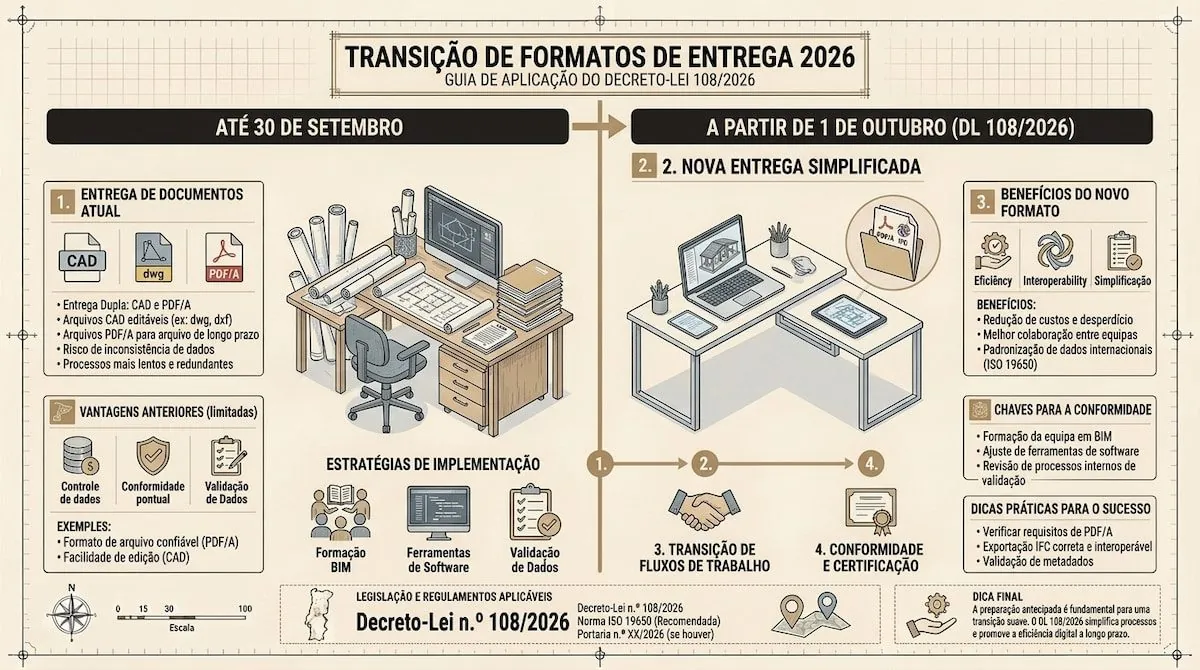
Within the framework of the "Construir Portugal" strategy, Decreto-Lei n.º 108/2026, de 29 de maio, was published, revising the urban planning permitting regime and amending both the RJUE and the RJRU. Among its main thrusts: reinforcing prior notification as the central mechanism for controlling urban planning operations, clarifying concepts, guaranteeing legally more secure titles and disciplining the phases of instruction, procedural vetting and prior hearing. The new rules took effect on 1 October 2026, with the exception of the amendments to Decreto-Lei n.º 10/2024 (the Simplex Urbanístico), which have applied since 1 June 2026.
For anyone with rehabilitation operations in preparation, this means two things: the timing of the submission may determine the applicable procedural regime (the new regime applies to procedures started from 1 October 2026 and to those still at the screening and preliminary assessment stage on that date), and the municipal regulations on urbanisation, building and fees will be adjusted over the coming months. It pays to plan with a team that follows these changes in real time.
Financing: IFRRU 2020
Beyond the tax incentives, dedicated financing is available. IFRRU 2020, the Financial Instrument for Urban Rehabilitation and Revitalisation, managed with the IHRU, provides loans on terms more favourable than the market's for the full rehabilitation of buildings, whether for housing or for other activities, including the associated energy-efficiency solutions. Public and private entities, including condominium associations, may apply through the participating banks; as at this update, September 2026, applications are open (official information at ifrru.ihru.pt/candidaturas). A well-prepared technical dossier, design, budget, timetable, is decisive for approval.
Frequent mistakes and risks
Experience shows that the value of the incentives is almost always lost at the same points:
- failing to request tax recognition together with the permit or prior notification, forfeiting the IMI and IMT exemptions;
- not requesting the survey to determine the state of conservation before the works begin, without the "before", there is no way to prove the two-level improvement;
- not checking which wording of item 2.23 applies to the file, which depends on the filing date with the council and on the planning title, under article 50(9) of Lei n.º 56/2023;
- assuming the transitional VAT regime does not apply, when the municipal file predates October 2023;
- underestimating the requirements of DL 95/2019, seismic, acoustic, accessibility, and discovering strengthening costs mid-works;
- proceeding without a rigorous survey of the existing building, the foundation of any serious rehabilitation design.
Rehabilitating with an integrated team
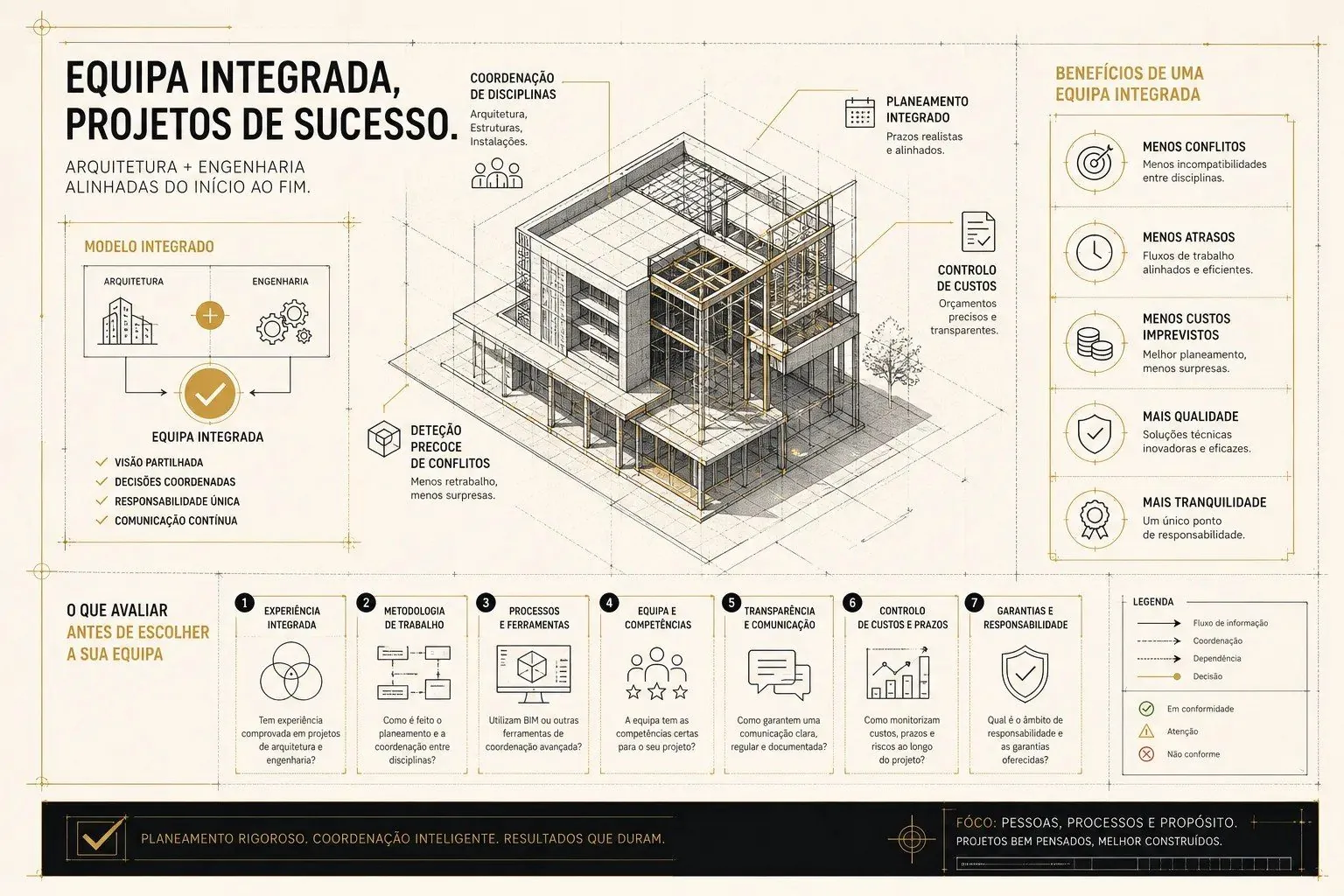
A rehabilitation operation cuts across urban planning, taxation, structure, building services and heritage, and the decisions of each discipline condition the rest. Working with a team that brings together architecture, engineering and consulting under a single coordination makes it possible to verify the ARU framing and the tax benefits as early as the preliminary study, to shape the intervention to the measure of DL 95/2019 and to steer the municipal process without surprises: an advantage we explained with regard to foreign investors in Portugal and which applies equally to developers and families. Find out more about our team and our method on the About CertiAmb page.
Frequently asked questions
How do I know whether my property is in an ARU?
ARUs are delimited by the municipalities and published in the Diário da República (the official gazette), with plans available from the urban planning departments and on the municipal councils' websites. This check should be one of the first steps of the preliminary study.
What tax benefits are available for rehabilitation in 2026?
A three-year IMI exemption (extendable for a further five, subject to a municipal assembly resolution), IMT exemptions on the acquisition for rehabilitation and on the first transfer after the works, reduced assessment fees, an IRS credit of 30% of the costs up to 500 euros and 6% VAT on eligible works contracts, always subject to conditions and municipal certification.
Does the 6% VAT apply to any works in an ARU?
No. It requires a building rehabilitation works contract (as to buildings, new construction is excluded) covered by the item, with the remaining tax and planning conditions of the case verified. For files predating October 2023 the old wording of item 2.23 applies, which Lei n.º 48/2026, of 17 August, has interpreted as not requiring an approved ORU.
Is the RERU still in force?
No. Decreto-Lei n.º 53/2014 was repealed by Decreto-Lei n.º 95/2019, in force since 15 November 2019, which is now the regime applicable to building rehabilitation.
What changes with Decreto-Lei n.º 108/2026?
It revises urban planning permitting and amends the RJUE and the RJRU, reinforcing prior notification and clarifying procedures and titles. It took effect on 1 October 2026 (the amendments to the Simplex Urbanístico have applied since 1 June 2026).
Closing notes
Rehabilitation pays off, but only when the legal, tax and technical framework is treated from day one as part of the project, not as a final formality. With DL 108/2026 in effect since 1 October and new VAT rules in place since July, 2026 is a year in which the timing of the process makes a real difference to the outcome. If you are considering rehabilitating a building or unit, to live in, let or sell, talk to the CertiAmb team: we help turn the regime and the incentives into concrete design decisions.
Update note (17 August 2026): Lei n.º 48/2026, of 17 August gives an authentic interpretation of item 2.23 of List I annexed to the VAT Code, in the wording of Lei n.º 64-A/2008: for the 6% rate, urban rehabilitation works contracts are those carried out on buildings or public spaces located in urban rehabilitation areas delimited under the law, whether or not an ORU has been approved. It takes effect from the entry into force of Lei n.º 64-A/2008 (article 3) and enters into force on the day after publication (article 4). This changes how files predating 7 October 2023 are read.
Update note (1 August 2026): the postponement has been published. Decree-Law no. 155-B/2026 of 31 July amended article 13(1) of Decree-Law no. 108/2026 and set the entry into force of the RJUE revision at 1 October 2026. Until 30 September 2026 the previous regime applied; from 1 October the new one applies. Details in our article on DL 108/2026.
This article is provided for information purposes only and does not constitute legal, tax or technical advice. Each situation should be assessed individually by a qualified professional.