Insights
Legalising existing buildings: how to regularise works built without a licence
An annexe built "just for storage", an extension carried out twenty years ago, a garage converted into a bedroom, a glazed enclosure that closed in the balcony: Portugal's building stock is full of structures that do not match what is licensed at the câmara municipal (the municipal council), or that never had any licence at all. While nothing happens, the problem goes unnoticed. But the moment you want to sell, finance, let or carry out new works, the non-conformity becomes a real obstacle, bringing fines, an embargo (stop-work order) and, ultimately, demolition.
The good news is that the law provides a route to regularisation: the legalisation procedure under article 102.º-A of the RJUE, Portugal's planning and building framework law. At CertiAmb, legalisation processes are handled as part of our architecture and permitting projects, in conjunction with the engineering-discipline projects whenever these are required. What decides the outcome is the regime applicable at each point in time (until 30 September 2026, the RJUE as amended by Decreto-Lei n.º 10/2024; from 1 October 2026, the revision introduced by Decreto-Lei n.º 108/2026), the municipal procedure, the risks of not acting and the impact on selling the property.
Unlawful works: what the RJUE says
The Legal Regime for Urbanisation and Building (RJUE: Decreto-Lei n.º 555/99, as currently worded) requires municipalities to adopt measures to safeguard and restore urban planning legality whenever urban development operations are carried out without the necessary prior-control acts, in breach of them or in violation of the applicable legal and regulatory rules (article 102.º). These measures may consist of:
- an embargo on works;
- the administrative suspension of the effects of prior-control acts;
- an order for corrective or alteration works;
- the legalisation of the urban development operations;
- total or partial demolition and reinstatement of the land;
- the cessation of use of buildings or units.
The order is no accident: demolition is the measure of last resort. Under article 106.º, demolition can be avoided if the works are capable of being licensed or if their conformity can be secured through corrective works. Whenever the building is compatible with the rules in force, legalisation is the route the law itself favours.
The legalisation procedure (article 102.º-A)
Article 102.º-A, added to the RJUE in 2014 (Decreto-Lei n.º 136/2014) and retained by the Simplex Urbanístico reform (Decreto-Lei n.º 10/2024, de 8 de janeiro), structures the procedure. The essential points:
- Initiative, once the illegality is detected, the câmara municipal notifies the interested parties to legalise, setting a deadline; nothing prevents the owner, however, from taking the initiative before any enforcement action, much the most favourable scenario;
- Right to information, the interested party may ask the câmara for information on the terms under which the legalisation should proceed, to be provided within a maximum of 15 days;
- Tailored documentation: the file is prepared with the elements required for the specific case; the câmara may demand the engineering-discipline designs and the respective certificates of responsibility, or certificates from the competent bodies, to safeguard public safety and health;
- Waivers: where no extension or alteration works are to be carried out, there is no need to submit a works schedule, cost estimate, bond, insurance policies, the contractor's permits, a site logbook or a health and safety plan (list that applied until 30 September 2026; see below for what changed on 1 October);
- Technical standards of the period, compliance with current technical standards may be waived where it has become impossible or cannot reasonably be required, provided it is shown that the technical requirements in force at the date of the works were met, the burden of proving that date falling on the applicant.
Each municipality approves its own regulation implementing the procedure, so the required elements and criteria vary from câmara to câmara: one more reason to prepare the file with someone who knows local practice.
Ex officio legalisation: useful, but limited
If the interested party does not take the necessary steps, the câmara may proceed with the legalisation ex officio, charging the fees set in the municipal regulation. This route has significant limits, however: it is only admissible where the works involve no structural stability calculations, and its sole effect is the acknowledgement that the works comply with the urban planning parameters of the applicable plans, being granted without prejudice to third-party rights. For the owner, voluntary legalisation, with a design, as-built drawings and certificates of responsibility, is almost always the more complete solution and the only one that genuinely adds value to the property.
Fines, embargo and demolition: the cost of not regularising
Keeping an unregularised building carries concrete risks, which the RJUE escalates in sequence:
- Administrative offences: carrying out urban development operations without the necessary prior control is punishable by fines from €500 up to €200,000 for individuals and from €1,500 up to €450,000 for legal persons (article 98.º), in addition to ancillary sanctions;
- Embargo: the mayor may embargo works under way without a licence or in non-conformity (article 102.º-B); the embargo requires the immediate suspension of the works, bars the supply of electricity, gas and water to the site and is recorded at the land registry, where it is visible to any buyer or bank;
- Crime of disobedience: failure to comply with the enforcement measures, including the embargo, constitutes the crime of disobedience (article 100.º);
- Demolition and enforced execution: where legalisation is not possible, total or partial demolition may be ordered, with administrative possession and execution at the offender's expense;
- Joint and several liability: the RJUE holds developers, project owners, those responsible for the existing uses, contractors and site managers jointly and severally liable (article 100.º-A); the owner is presumed to be aware of the unlawful works where he or she has allowed access to the property.
Sale and deed: what changed with the Simplex
For 25 years, Decreto-Lei n.º 281/99, de 26 de julho barred the execution of deeds transferring urban buildings without presentation of the use permit (or the building licence). The Simplex Urbanístico repealed that statute: since 2024, showing the permit to the notary is no longer a condition of the deed. From 1 October 2026, however, the new paragraph 14 of article 4.º-A of the RJUE, introduced by Decreto-Lei n.º 108/2026, requires whoever formalises the transaction (registrar, notary, lawyer, solicitador or other legally competent entity) to state, on pain of the deed being voidable (anulabilidade), either that the urban planning title exists, where it is shown, or the seller's declaration that they hold it or that they do not.
It would be a mistake to conclude that urban planning legality no longer matters. The illegality does not lapse with the sale: the enforcement measures can still be applied to the property, and the buyer joins the ranks of those responsible for the existing uses. In practice, banks still require the property's documents to be in order before granting credit, valuers mark down unlicensed floor areas and insurers may refuse cover on unlawful structures. For buyers, foreign investors in particular, a subject we explore in a dedicated article, checking urban planning conformity before the deed has become all the more important, precisely because the deed no longer depends on a use title being produced. And for sellers, legalising before putting the property on the market avoids renegotiations and price cuts. On how prior control works in general, see how construction permitting works in Portugal.
What changes with Decreto-Lei n.º 108/2026
On 29 May 2026, Decreto-Lei n.º 108/2026 was published, once again amending the RJUE (and the RJRU, the urban rehabilitation regime). It entered into force on 1 October 2026 (the date set by Decreto-Lei n.º 155-B/2026) and applies to procedures started after that date, and to pending ones still at the screening and preliminary assessment stage. The statute keeps the essential structure of the legalisation procedure, but it repeals subparagraphs g) and h) of paragraph 4 of article 102.º-A: from 1 October 2026 the site logbook and the health and safety plan are no longer listed among the documents that are waived where no extension or alteration works are to be carried out. This does not mean they automatically become mandatory in every legalisation file: the automatic waiver disappears, but whether these documents are required depends on the specific request (paragraph 2 of article 102.º-A), on the instruction elements set by the applicable portaria and on the municipal regulation (paragraph 7), and the municipality may ask for whatever documents prove necessary (paragraph 3). It also changes the context in which urban planning legality is controlled:
- the period for the subsequent review of prior notifications is cut from 10 years to 1 year;
- the period within which the administration may declare licences and favourable prior information notices null and void falls from 10 to 3 years;
- it is clarified that administrative inspection covers both the exterior and the interior of buildings, with new administrative offences;
- permits for urban development operations are reintroduced, strengthening the legal certainty of the acts carried out;
- the concept of the "last valid antecedent" appears: reconstruction works that reinstate that situation are exempt from prior control, relevant for buildings with documented historic licensing.
The legislature itself stresses that compressing the periods for subsequent review does not remove the municipalities' inspection powers or the measures protecting urban planning legality. In other words: permits become more stable, but buildings without one remain exposed.
Typical cases and the role of a rigorous survey
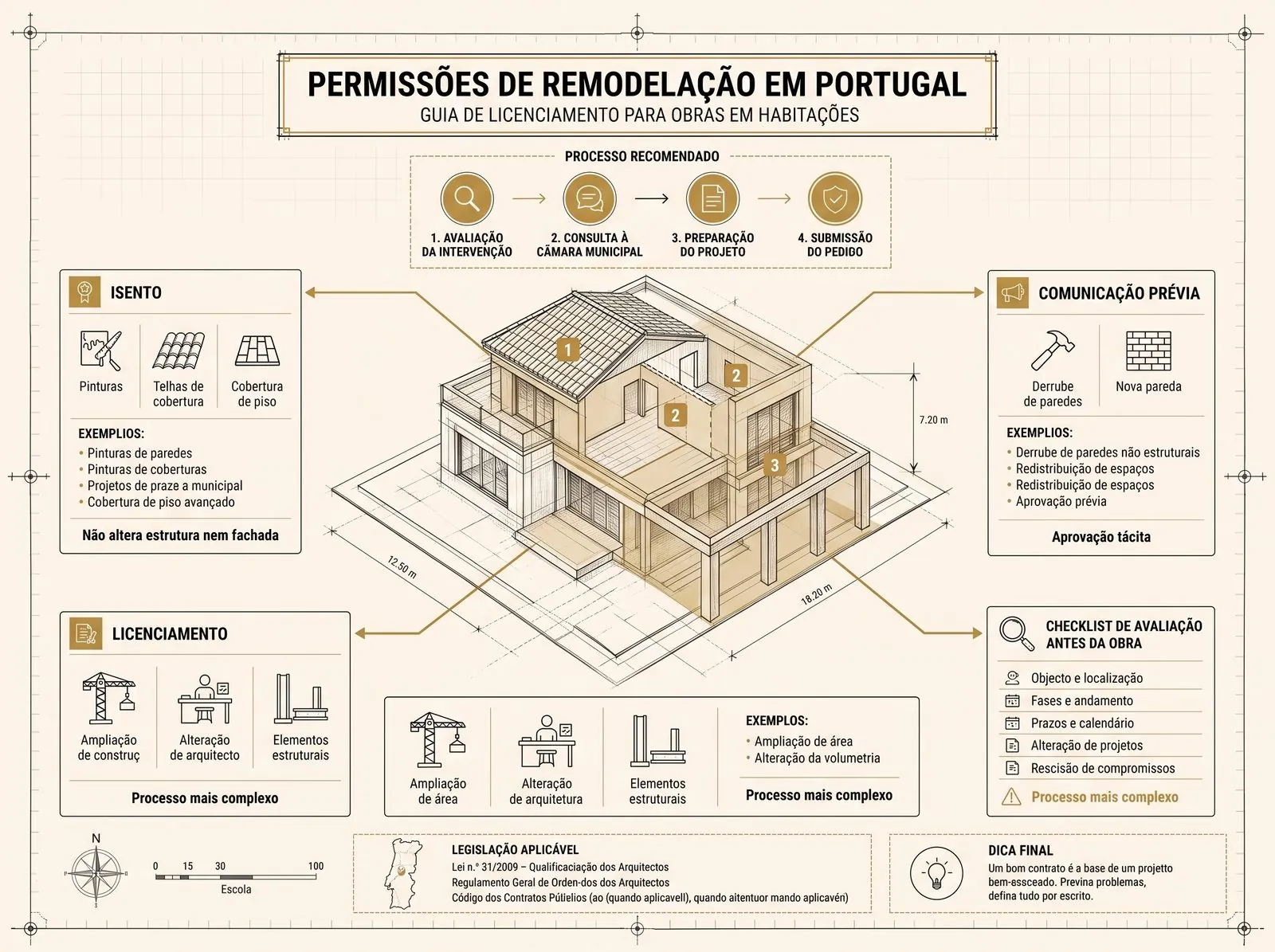
In practice, the most frequent legalisation applications involve:
- annexes and garages converted into habitable spaces;
- old extensions never recorded in the municipal file;
- glazed enclosures and porches that closed in balconies or terraces;
- discrepancies between what was built and the approved as-built drawings;
- changes of use without the proper procedure.
Very old buildings are a case apart: buildings predating the entry into force of the RGEU (1951), or, in many municipalities, predating the date on which licensing became required in that location, may have no use title at all because none was required when they were built, with their age evidenced by a municipal certificate. The analysis is made case by case, in the light of the municipal regulation.
In any scenario, the process begins with a rigorous survey of the existing building: a complete measured survey, cross-checking against the municipal file and the PDM (the municipal master plan), and identification of what can be legalised and what requires correction. Then comes the architectural legalisation design and, where applicable, the engineering-discipline designs, including the verification of structural stability for extensions, with the respective certificates of responsibility. In the municipalities where we work daily, from Lisbon to the Alentejo Litoral and the Lezíria do Tejo (see, for example, architecture and engineering in Grândola), knowledge of municipal practice frequently makes the difference between a swift process and one that drags on.
Frequently asked questions
Is it always possible to legalise works carried out without a licence?
No. Legalisation presupposes that the building can be brought into conformity with the rules in force, notably the PDM and the other territorial management instruments. The law allows current construction standards to be waived where compliance would be impossible or disproportionate, on proof that the rules of the period were met; but it does not waive the urban planning rules.
What sanctions apply to works carried out without a licence?
Fines from €500 up to €200,000 (individuals) and from €1,500 up to €450,000 (legal persons), under article 98.º of the RJUE, in addition to an embargo, corrective works, cessation of use and, as a last resort, demolition. Failure to comply with the enforcement measures constitutes the crime of disobedience.
Must a use title still be shown for the deed of sale?
As a rule, no: Decreto-Lei n.º 281/99 was repealed by the Simplex Urbanístico. From 1 October 2026, whoever formalises the transaction must, on pain of voidability, state that the urban planning title exists or record the seller's declaration that they hold it or do not (article 4.º-A, paragraph 14, of the RJUE). But the illegality does not lapse with the sale: the buyer inherits the risk and banks still require the property's documents to be in order.
What is ex officio legalisation?
It is legalisation carried out by the câmara itself, with fees charged, when the interested party fails to act. It is only possible for works involving no structural stability calculations, and its effect is limited to acknowledging that the works comply with the applicable urban planning parameters, without prejudice to third-party rights.
Does Decreto-Lei n.º 108/2026 change the legalisation regime?
It does not change its essential structure: article 102.º-A remains in place, but from 1 October 2026 the automatic waiver of the site logbook and the health and safety plan ends. That does not make them mandatory in every file: whether they are required depends on the specific request, the applicable portaria and the municipal regulation. The periods for subsequent review and for declarations of nullity also change, as do administrative inspection and the permits for urban development operations.
Closing notes
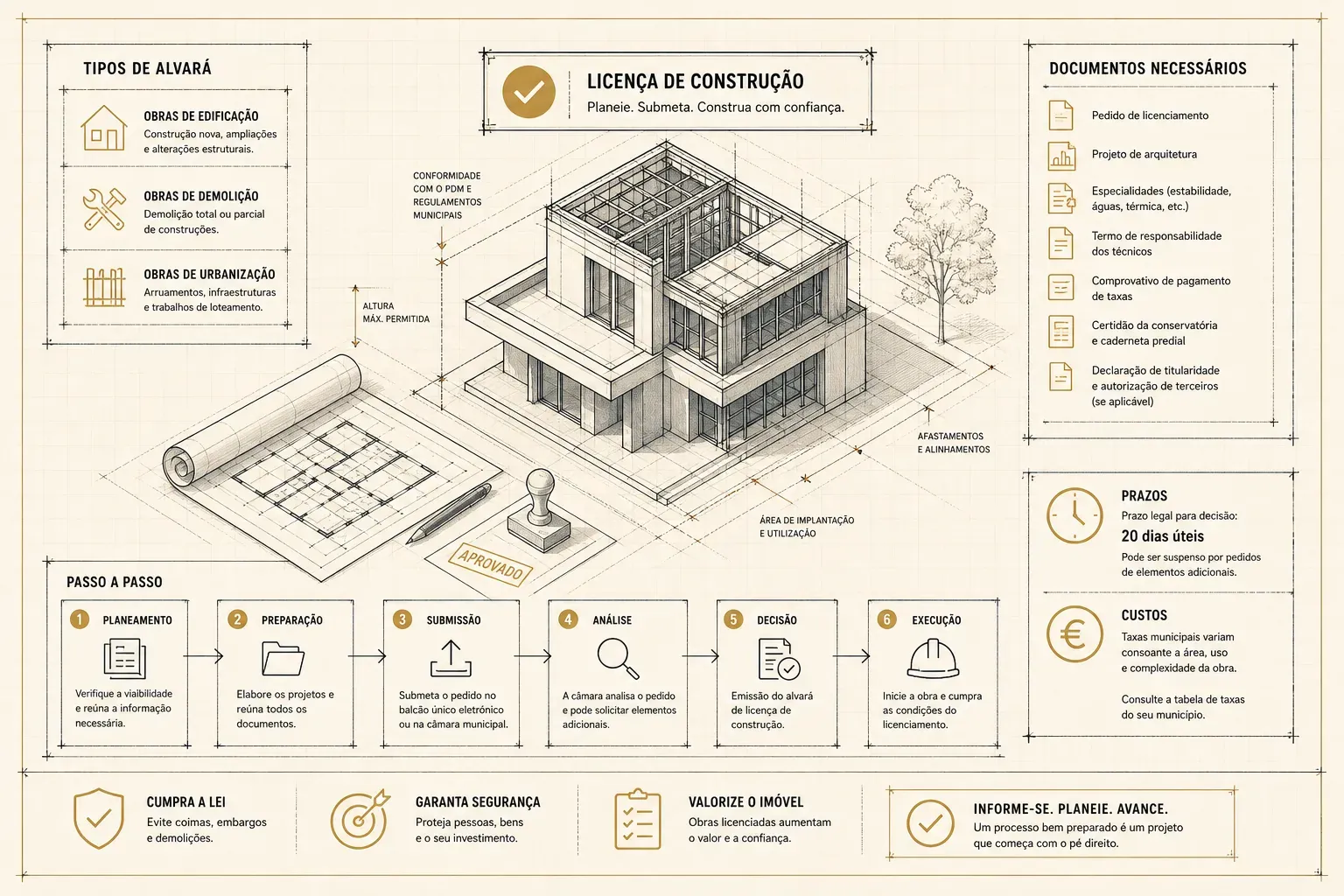
Legalising an existing building is almost always simpler and cheaper than living with the risk, and it is a precondition for selling well, obtaining finance and carrying out new works safely. The procedure under article 102.º-A provides the framework; the rest depends on a rigorous survey, a well-prepared application and knowledge of municipal practice. If you have an annexe, an extension or a property in need of regularisation, talk to the CertiAmb team.
Update note (1 August 2026): the postponement has been published. Decree-Law no. 155-B/2026 of 31 July amended article 13(1) of Decree-Law no. 108/2026 and set the entry into force of the RJUE revision at 1 October 2026. Until 30 September 2026 the previous regime applied; from 1 October the new one applies. Details in our article on DL 108/2026.
This article is provided for information purposes only and does not constitute legal, tax or technical advice. Each situation should be assessed individually by a qualified professional.