Insights
The end of the RGEU: what the postponed repeal means and the road to Portugal's Building Code
Few statutes have shaped Portuguese construction as much as the General Regulation for Urban Buildings (RGEU), approved by Decreto-Lei n.º 38382, de 7 de agosto de 1951. For more than seven decades, it was where designers and municipal councils found the minimum habitability standards: ceiling heights, room areas, daylight and ventilation. The Simplex urban-planning reform provided for the repeal of the RGEU, and some readings brought the repeal forward to 1 June 2026. The legal reality is different: on 1 October 2026, the RGEU remains in force, and will remain in force until the entry into force of the statute that defines the technical rules applicable to buildings, on the road to Portugal's future Building Code (Código da Construção).
On a subject where contradictory information abounds, precision matters. So it pays to separate what was actually decided, what Decreto-Lei n.º 108/2026 changed in May 2026, which technical rules apply to projects today, including the NZEB requirements for new buildings, and where the preparation of the Building Code stands. This permanent tracking of the legislation is what CertiAmb provides in its architecture and permitting projects.
A 1951 regulation that shaped Portuguese construction
The RGEU was created to guarantee minimum conditions of safety and health in urban buildings, following a prescriptive logic that is simple to check: comply with the rule and the building is compliant. Its best-known provisions include:
- a minimum floor to floor height of 2.70 m in buildings intended for housing, with a clear ceiling height of no less than 2.40 m (article 65.º);
- minimum areas for habitable rooms (article 66.º);
- window openings connecting directly to the outside, with a total area of no less than one tenth of the floor area of the room and never less than 1.08 m2 (article 71.º);
- general rules on ventilation, courtyards, setbacks and site salubrity.
Over the decades, however, the RGEU was progressively narrowed in its practical scope by more demanding and technically more advanced sectoral regulations: thermal performance moved to the energy certification system, acoustics to the Buildings Acoustic Requirements Regulation (RRAE), fire safety to the SCIE regime, building water supply and wastewater drainage to the General Regulation for Public and Building Water Supply and Wastewater Drainage Systems (RGSPPDADAR) and structural design to the world of the Eurocodes, an evolution we describe in our article on structures. What remained was, above all, the habitability core, and it is precisely that core that the future regulation intends to rethink.
The repeal decreed by the Simplex reform
Decreto-Lei n.º 10/2024, de 8 de janeiro, which implemented the so-called Simplex Urbanístico and profoundly changed the permitting regime: changes we analysed in our article on works exempt from prior planning control, decreed, in its article 25.º, the repeal of the RGEU with effect from 1 June 2026. Until that date, the competent professional associations would define, within the development of the Building Code, the technical rules they considered adequate for the preparation of urban building designs.
The legislator's intention was clear: to replace a prescriptive regulation dating from 1951 with modern, performance-oriented rules consolidated into a single code. The problem was the timetable, the deadline was approaching without the new technical regulation in existence, which would have removed the habitability benchmark with nothing to replace it.
May 2026: the repeal postponed by Decreto-Lei n.º 108/2026
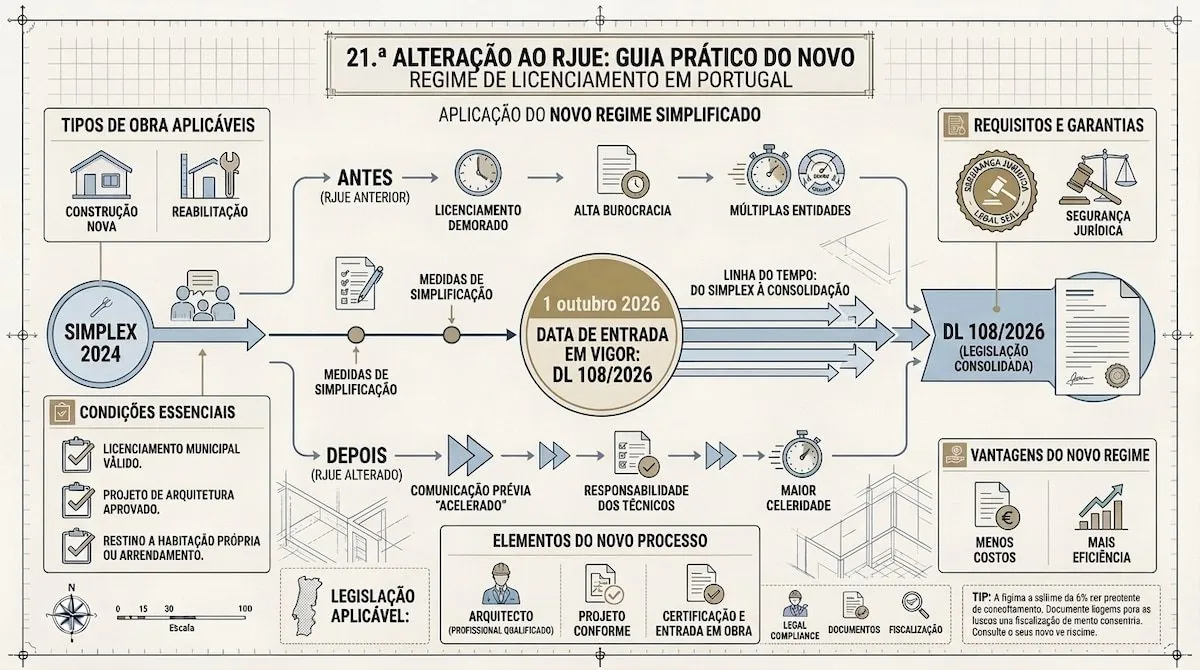
The answer came with Decreto-Lei n.º 108/2026, de 29 de maio: the statute that makes the 21st amendment to the RJUE and which, less widely reported, also makes the 17th amendment to the RGEU itself and the first amendment to Decreto-Lei n.º 10/2024. Article 25.º of the latter now provides that the repeal of the RGEU takes that the RGEU is repealed with effect from the date of entry into force of the statute that defines the technical rules applicable to buildings, and that those rules must be drawn up with the collaboration of the competent professional associations (article 25(1) and (2)).
The decisive detail lies in the commencement rules. While the bulk of Decreto-Lei n.º 108/2026 only entered into force on 1 October 2026, the amendments to Decreto-Lei n.º 10/2024 took effect on 1 June 2026, precisely the day on which the repeal of the RGEU was due to start producing effects. In practice, the RGEU remained applicable: the repeal is still on the statute book, but its effects now depend on the entry into force of the statute that defines the technical rules applicable to buildings.
What is in force today
For anyone with projects in preparation or under municipal assessment, the picture is as follows:
- the RGEU remains in force in the provisions that have not been expressly repealed or replaced by sector-specific legislation, mainly habitability, health and general construction provisions;
- the sectoral technical regimes remain in place: energy certification (Decreto-Lei n.º 101-D/2020), acoustics (RRAE), fire safety (SCIE), building water networks (RGSPPDADAR) and structural regulation;
- the RJUE kept its previous wording until 1 October 2026, when the procedural amendments made by Decreto-Lei n.º 108/2026 entered into force, including the new wording of article 129.º of the RGEU, which requires, for extensions or alterations that increase the loads transmitted to the untransformed elements of the building or to its foundations, a structural stability design accompanied by a certificate of technical responsibility signed by a qualified professional;
- as for pending applications, the new regime applies to procedures started after 1 October and to those which, on that date, are still at the preliminary screening and assessment stage (article 12.º of Decreto-Lei n.º 108/2026).
A further note of relevance to practitioners: the list of legal and regulatory provisions to be observed in designs will be published on the SILUC platform, the Information System on Urban Planning and Construction Legislation, adopted by Decreto-Lei n.º 108/2026 as the reference base.
The road to the Building Code
Despacho n.º 12528/2026, published on 15 October and signed on 7 October 2026, establishes a working group to prepare a proposal for a Building Code. The Building Code is intended to bring together, in codified form, the currently scattered rules applicable to the different stages of the life cycle of a construction project.
The group reports to the Office of the Secretary of State for Housing and is chaired by a representative of that Office. It also includes one representative from each of the following bodies: Instituto dos Mercados Públicos, do Imobiliário e da Construção, I. P. (IMPIC), Laboratório Nacional de Engenharia Civil, I. P. (LNEC), and Construção Pública, E. P. E. It may request collaboration and participation from other services and bodies, sectoral and business associations, or experts in their respective fields.
The order organises the preparatory work. It does not approve the Building Code, set a deadline for the proposal or establish when the future code will enter into force. Nor does it replace the technical rules applicable to building projects. Establishing this group does not provide grounds for setting aside current requirements when planning building work.
The energy dimension: NZEB today, ZEB buildings on the horizon
While the habitability core awaits the new regulation, the technical bar for new buildings is today increasingly set by energy legislation. Since 1 July 2021, new buildings have had to meet the NZEB standard, nearly zero-energy buildings, under Decreto-Lei n.º 101-D/2020. And Directive (EU) 2024/1275, whose transposition deadline expired on 29 May 2026, sets the objective that new buildings owned by public bodies be zero-emission buildings (ZEB) from 1 January 2028 and that all new buildings be so from 1 January 2030. In Portugal the transposition is still under way: Decreto-Lei n.º 11/2025, of 19 February, transposed only part of the directive, so the national framework for ZEB buildings remains to be completed. We analyse this timetable in detail in our article on energy certification and the new EPBD.
Practical impact: how to run projects in 2026
Recent experience shows that the confusion surrounding the "end of the RGEU" is already producing avoidable mistakes. The main risks to keep under control:
- assuming the RGEU is "gone" and designing below the minimum habitability standards: the shortest route to a refusal or, worse, to a building needing corrections or legalisation;
- omitting the RGEU from certificates of technical responsibility and design justifications while it remains fully applicable;
- overlooking the changes that entered into force on 1 October 2026: both the procedural ones and the new wording of article 129.º of the RGEU, relevant for extensions;
- treating the sectoral regulations as static, when the energy strand is in full transition towards the ZEB standard;
- failing to track the implementing ministerial orders provided for in the new RJUE framework, which will detail application instruction and platforms.
For projects with permitting under way, we recommend checking the rules applicable at each stage and planning for future requirements that have already been established, taking account of their dates and transitional provisions. The content of the Building Code has yet to be defined and provides no basis for anticipating new technical requirements. That is the logic we apply in coordinating architecture and the engineering disciplines, from the overall construction permitting framework to the detail of each engineering-discipline design.
Frequently asked questions
Has the RGEU already ceased to apply?
No. The repeal was decreed by Decreto-Lei n.º 10/2024, with effect scheduled for 1 June 2026, but its effects were made dependent on the entry into force of the statute that will define the technical rules applicable to buildings. As of 1 October 2026, the RGEU remains in force in the provisions that have not been expressly repealed or replaced by sector-specific legislation.
Which technical rules apply to a project submitted today?
The RGEU, in the matters it still governs, together with the sectoral regulations in force, SCE, RRAE, SCIE, RGSPPDADAR and structural regulation, plus the municipal master plan (PDM) and applicable municipal regulations.
What changes on 1 October 2026?
The bulk of Decreto-Lei n.º 108/2026 entered into force: the procedural amendments to the RJUE and the 17th amendment to the RGEU, whose article 129.º, in its new wording, requires a structural stability design, with a certificate of technical responsibility, for extensions or alterations that increase the loads transmitted to the untransformed elements of the building or to its foundations.
What is the Building Code and when will it enter into force?
The Building Code is intended to bring together, in codified form, the currently scattered rules applicable to the different stages of the life cycle of a construction project. Despacho n.º 12528/2026, published on 15 October 2026, establishes a group to prepare a proposal for a Building Code. It is chaired by a representative of the Office of the Secretary of State for Housing and includes one representative each from IMPIC, LNEC and Construção Pública, E. P. E. The order does not approve the code, set a deadline for the proposal or establish when the future code will enter into force. It also does not change the technical requirements for building projects.
Are pending applications at municipal councils affected?
Decreto-Lei n.º 108/2026 applies to procedures started after its entry into force and to those which, on that date, were still at the preliminary screening and assessment stage. The RGEU remains applicable with the amendments in force, including the revised Article 129.º since 1 October 2026.
Closing notes
The "end of the RGEU" is a process, not an event: the repeal has been decreed, but it will only operate with the entry into force of the statute that defines the technical rules applicable to buildings, and, until then, the 1951 regulation remains in force in the provisions that have not been expressly repealed or replaced by sector-specific legislation. Between the changes that entered into force on 1 October 2026 and the energy transition towards ZEB buildings, the essential thing is to keep pace with the dates and requirements applicable at each stage of a project. If you have a project in preparation and want to be certain it complies with the technical and regulatory framework: today's and the one on its way, talk to the CertiAmb team.
Update note (1 August 2026): the postponement has been published. Decree-Law no. 155-B/2026 of 31 July amended article 13(1) of Decree-Law no. 108/2026 and set the entry into force of the RJUE revision at 1 October 2026. Until 30 September 2026 the previous regime applied; from 1 October the new one applies. Details in our article on DL 108/2026.
This article is provided for information purposes only and does not constitute legal, tax or technical advice. Each situation should be assessed individually by a qualified professional.