Insights
Works exempt from prior planning control: what the Simplex reform changed, and what changed in October 2026
The idea that certain works "do not need a licence" is one of the most widespread, and most misunderstood, in the Portuguese construction sector. It is true that the Legal Regime for Urban Development and Building (RJUE) exempts a set of works from a licence and from prior notification, and that the Simplex Urbanístico reform extended that logic of simplification. But exemption from prior control does not mean exemption from the rules: whoever carries out an "exempt" work remains bound by the municipal plans, the technical building standards and the heritage-protection regime, and answers for that compliance whenever the municipality inspects.
The subject has become doubly topical: Decreto-Lei n.º 108/2026, de 29 de maio, carried out a fresh revision of the RJUE, correcting the implementation difficulties of the Simplex, and its amendments came into force on 1 October 2026. It is worth separating what was exempt until 30 September, what the Simplex changed, what changed on 1 October and the risks of going ahead without technical support.
What "prior control" means, and where the exemption sits
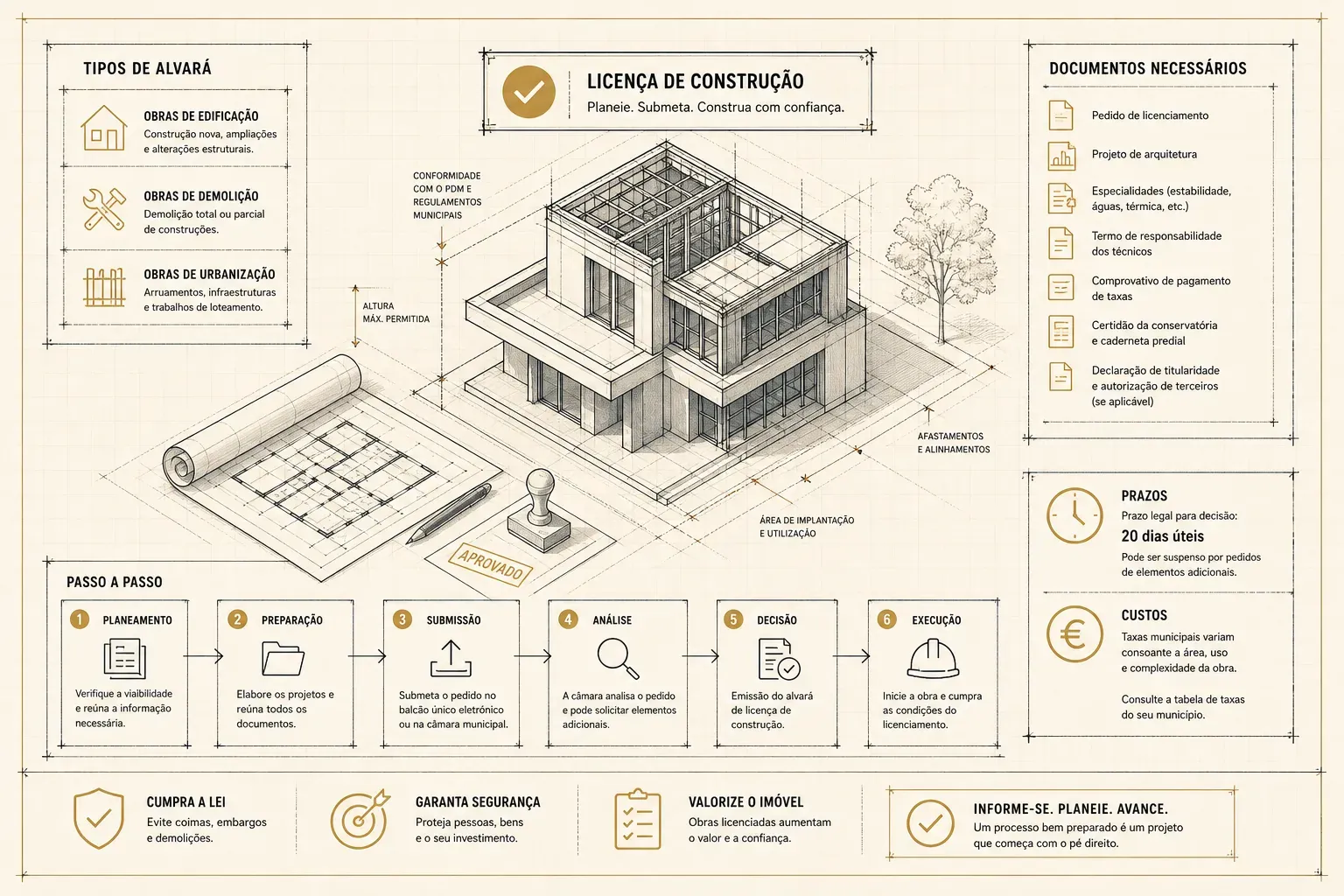
Prior control of urban operations is the mechanism through which the municipality assesses works before they are carried out. Under Article 4 of the RJUE (Decreto-Lei n.º 555/99, de 16 de dezembro, as currently worded), it takes, as a rule, the form of a licence or of prior notification (comunicação prévia). The exemption is set out in Article 6 (exemption from prior control, a heading that became exemption from licensing and prior notification on 1 October 2026), Article 6-A (works of minor urban relevance) and Article 7 (operations promoted by the public administration or for public-interest purposes).
Being exempt merely means that the works may be carried out without a permitting or notification procedure. Not that they escape the legal order. This apparently obvious point is the source of most of the problems we encounter on site and, later, when the property is sold.
Which works were exempt from a licence and prior notification until 30 September 2026
Under the wording in force until 30 September 2026, the following, among others, dispensed with prior control:
- Conservation works, maintenance and restoration that do not alter the structure, the shape of the façades or the type of cladding materials;
- Alteration works inside buildings or units, provided they do not modify the load-bearing structure, the façades, the building height or the shape of the roofs;
- Works of minor urban relevance (Article 6-A), for example, small annexes and storage structures of reduced size (as a rule, up to 2.2 m in height and 10 m² in area), boundary walls up to 1.8 m not fronting the public road and retaining walls up to 2 m, garden greenhouses, leisure equipment associated with the main building, and the replacement of window frames with more energy-efficient solutions that keep the original design;
- Photovoltaic panels, solar thermal collectors and wind generators associated with the main building, within dimensional limits set by law (for example, panels may not exceed the roof area or its height by more than 1 m);
- Plot severance (destaque), where the legal conditions are met;
- Operations preceded by a favourable prior information decision issued under Article 14(2) and (3) and containing the particulars of Article 14(2)(a) to (f), in which case the prior information has the effect of exempting the operation from prior control (Article 17(2)). The works must begin within two years of the favourable decision, accompanied by a declaration from the design authors and the design coordinator. From 1 October 2026, Decree-Law 108/2026 renames this effect exemption from licensing and prior notification and expressly excludes use and change of use.
Municipal regulations may specify other works of minor urban relevance, so the specific framing must always be confirmed municipality by municipality: one of the reasons why permitting support begins before it is even decided whether there is a procedure to prepare. Note: for listed buildings or buildings undergoing classification, and within their protection zones, the regime is stricter and most of these exemptions do not apply.
What the Simplex Urbanístico (DL 10/2024) changed
Decreto-Lei n.º 10/2024, de 8 de janeiro, the so-called Simplex Urbanístico, reformed the RJUE and several related regimes under a "zero licensing" logic. The changes with the greatest practical impact:
- Prior notification without assessment: prior notification became a mere communication, with no screening or municipal decision, once the elements are submitted and the fees paid (by self-assessment), the works may proceed;
- Effective tacit approval: the administration's silence within the legal deadline came to count as approval, with a certificate issued to ensure legal certainty;
- The works permit (alvará) dispensed with: replaced by proof of payment of the fees;
- Simplified use authorisation: the use licence gave way, in most cases, to a communication supported by the designers' statements of responsibility, with an inspection only in specific situations;
- A strengthened prior information procedure, valid for two years;
- Standardised supporting elements under Portaria n.º 71-A/2024, de 27 de fevereiro, which revoked Portaria n.º 113/2015 and approved the templates for the statements of responsibility; it was applicable until 30 September 2026 and has been revoked by Portaria n.º 320/2026/1;
- The Electronic Platform for Urban Procedures: the law initially set 5 January 2026 as the reference date for its mandatory use by municipalities, but its actual application depends on the platform being made available and regulated. The new wording of Article 8-A of the RJUE, in force from 1 October 2026, ties that obligation to the moment the platform becomes available, and Portaria n.º 320/2026/1 still describes it as a platform “to be implemented”; in the meantime, existing municipal electronic systems remain in use.
In practice, the Simplex shifted a large part of public control onto private responsibility: that of the owner and, above all, of the professionals who sign the designs and the statements of responsibility. It is a faster regime, but one far less tolerant of error.
What changed on 1 October 2026: DL 108/2026
The application of the Simplex revealed coordination difficulties and disparities between municipalities. To correct them, Decreto-Lei n.º 108/2026, de 29 de maio, made the 21st amendment to the RJUE, also amending the RGEU, the urban rehabilitation regime and DL 10/2024 itself. The amendments to the RJUE came into force on 1 October 2026 and apply to procedures started after that date and to pending ones still at the screening stage. The highlights:
- Three procedural routes: licence, prior notification (mere communication) and the new prior notification with deadline, with prior notification becoming the general rule in areas whose planning parameters are already defined (detailed plan, execution unit, subdivision permit or consolidated urban area);
- Reconstruction works exempt: reconstruction that restores the building's "last valid state", reproducing the formal composition of the façades and the roof, becomes exempt from a licence and from prior notification, including within the protection zones of listed buildings;
- Interior works involving the structure: these may now benefit from the exemption provided they are accompanied by a structural design and a statement of responsibility from a qualified engineer: and by a seismic strengthening design, where required, filed with the information on the start of works;
- The urban-planning title reintroduced: a documentary set that formalises the operation (summary application, proof of payment and proof of approval or submission), whose existence must now be mentioned in property transfer contracts, on pain of voidability;
- Successive control time-limited: the municipal verification of the legal conformity of prior notifications lapses after one year, without prejudice to inspection, at any time, of the works' conformity with the designs;
- Intermediate deadlines restored: 30 days for assessing the architectural design, 20 days for the final decision on building works, with tacit approval at the end of each deadline;
- Administrative offences restored and adjusted, including carrying out urban operations without a valid title and executing works without the information on the start of works;
- The RGEU remains in force: the repeal provided for in the Simplex will only take effect once the future technical building regulation is published.
Renewable energy: an exemption that does not come from the RJUE
There is one case where the exemption from prior control does not come from the RJUE. Installing renewable power plants, storage facilities and self consumption production units is governed by Decree-Law 15/2022, amended by Decree-Law 130/2026 of 29 June, in force from 28 August 2026.
The rule in article 48 is prior communication under the RJUE. Paragraph 3 of that article sets prior control aside in three situations:
- solar photovoltaic panels on pre existing built structures that are not buildings, or installed directly on the ground within delimited areas: shopping complexes, large retail surfaces, industrial parks or subdivisions, logistics platforms, campsites and car parks;
- projects with an installed capacity of 1 MW or less;
- renewable energy projects located in a ZAER.
The first situation has an express limit. Paragraph 4 excludes listed properties and properties undergoing listing, those forming part of listed complexes or sites, and those located in the corresponding protection zones.
Falling outside prior control does not mean carrying out the work without telling the council. Where the project is subject to registration or prior communication under that decree-law, article 48(6) requires the interested party to notify the competent municipal council beforehand and to upload proof of that notification to the DGEG platform.
Paragraph 5 closes the reasoning along the same lines as article 6 of the RJUE: territorial plans, the cultural heritage protection regime and technical building standards continue to apply.
A note on dates. Article 9 of Decree-Law 130/2026 limits its application in time: the amendments apply only to prior control procedures for renewable energy projects and for Public Electricity Service Network infrastructure started after its entry into force. A procedure opened before 28 August 2026 is not covered by them.
The limits of the exemption: what continues to apply
Article 6(8) of the RJUE is clear: the exemption does not dispense with compliance with the applicable legal and regulatory rules. In an exempt work, the following continue to apply, among others:
- the municipal and inter-municipal plans (PDM, urbanisation and detailed plans) and the public-utility easements and restrictions;
- the RGEU and the technical building standards: structural stability, thermal performance, acoustics, fire safety, building services networks;
- the cultural heritage protection regime, in classified areas and protection zones;
- the obligation to submit the information on the start of works (Article 80-A), from which conservation works carried out exclusively indoors are exempt as of 1 October 2026, and to pay the fees due;
- municipal inspection, which covers both the exterior and the interior aspects of buildings.
Beyond the planning framework, there are civil-law limits that no one dispenses with: in buildings under horizontal property, interventions touching common parts or the façade require the condominium's authorisation, and the works may not endanger the safety of neighbouring buildings.
The risks of carrying out an "exempt" work without technical support
Experience shows that problems almost always stem from an initial classification error. The most frequent:
- Misclassifying the works: an "interior alteration" that touches a load-bearing wall, or a "reconstruction" that increases area or volume, is no longer exempt. It becomes an illegal work, subject to an embargo, to measures restoring legality and to a legalisation procedure;
- Ignoring the technical standards: the works may comply with the RJUE and yet fail the RGEU, the acoustic requirements or fire safety, with liability falling on whoever carried them out;
- Omitting the information on the start of works, which from 1 October 2026 is expressly an administrative offence (Article 98(1)(c)), or failing to pay the fees due, with consequences that depend on the specific operation and the applicable municipal regulation;
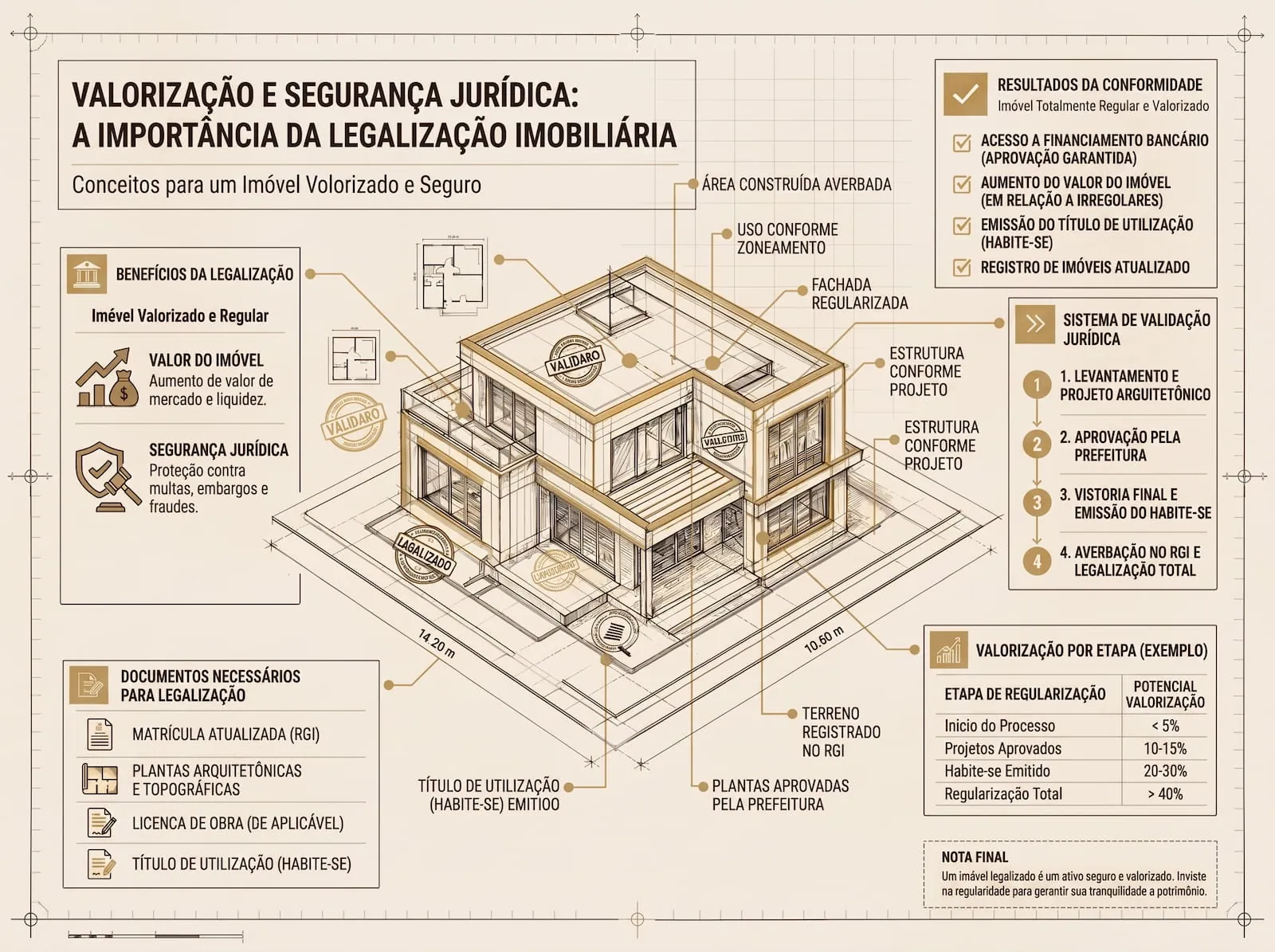
- Jeopardising a future sale: under DL 108/2026, the existence (or not) of an urban-planning title must be stated in transfer contracts, poorly framed works become visible at the moment of the deed and depreciate the property;
- Intervening in the structure without a design: from 1 October 2026, the exemption for interior works with structural impact depends on a structural design and a statement of responsibility, without them, there is neither exemption nor safety.
The fines provided for in Article 98 of the RJUE can reach very significant amounts, and the demolition of what was built in non-conformity is the limit scenario. The cost of a prior technical check is marginal by comparison.
How CertiAmb frames these works
At CertiAmb, any intervention, however simple it may appear, begins with a framing check: are the works exempt? Under which provision? Which technical standards apply? Which elements must accompany the information on the start of works? This analysis brings together the architectural design and permitting work with the engineering-discipline designs, including the structural design, increasingly central under the new regime, and, where necessary, with site supervision and project management.
It is the same integrated approach we apply to full permitting processes, described in our article on how construction permitting works in Portugal. The difference lies in the scale. Not in the rigour.
Frequently asked questions
Do I need a licence for works inside my home?
As a rule, no. Interior alteration works are exempt as long as they do not modify the structure, the façades, the building height or the roof. From 1 October 2026, interior works involving the structure may keep the exemption, provided they are accompanied by a structural design and a statement of responsibility from a qualified engineer.
Does an exempt work dispense with compliance with the municipal plan and the RGEU?
No. The exemption does not dispense with compliance with the municipal plans, the easements, the technical building standards or the heritage regime, and the works may be inspected at any time.
Do I have to notify the municipality before starting an exempt work?
Yes, as a rule. Exempt works are subject to the information on the start of works, no later than five days before they begin (Article 80-A of the RJUE), and to the payment of the fees due. From 1 October 2026, conservation works carried out exclusively indoors no longer require that information, and executing works without it becomes an expressly defined administrative offence.
What changed on 1 October 2026?
The RJUE revision made by Decreto-Lei n.º 108/2026 came into force: three procedural routes, exemption of reconstruction works restoring the last valid state of the building, reintroduction of the urban-planning title, with mandatory mention in contracts, and lapse of the successive control of prior notifications after one year.
What if the works do not fall within any exemption?
They become subject to a licence or to prior notification, with the supporting elements of Portaria n.º 71-A/2024 (until 30 September 2026) or Portaria n.º 320/2026/1 (from 1 October 2026), architectural and engineering designs and statements of responsibility. We explain the process in our article on construction permitting.
Closing notes
The regime for exempt works is today more generous, and more demanding, than ever: the Simplex Urbanístico and DL 108/2026 have traded the administration's prior control for the accountability of those who design and build. For the owner, this means the right question is not "do I need a licence?" but "who can assure me that these works comply with everything the law requires?". If you are planning an intervention and want a sound framing before going ahead, talk to the CertiAmb team.
Update note (1 August 2026): the postponement has been published. Decree-Law no. 155-B/2026 of 31 July amended article 13(1) of Decree-Law no. 108/2026 and set the entry into force of the RJUE revision at 1 October 2026. Until 30 September 2026 the previous regime applied; from 1 October the new one applies. Details in our article on DL 108/2026.
This article is provided for information purposes only and does not constitute legal, tax or technical advice. Each situation should be assessed individually by a qualified professional.