Insights
The 21st amendment of the RJUE: what changes in building licensing from 1 October 2026
Portuguese building licensing is about to change again, and this time the change is structural. Decree-Law 108/2026, of 29 May, enacts the 21st amendment of the Legal Regime of Urbanisation and Building (RJUE) and took effect on 1 October 2026. Its declared purpose is to fix the implementation problems of the 2024 «Simplex Urbanístico»: more flexible procedures, shorter deadlines, clearer concepts and legally secure titles for applicants.
For anyone preparing a project, or with an application pending at the municipal council, the implications are immediate. What changes in practice, without unnecessary legalese: prior notification as the default procedure, the end of the screening phase in notifications, the new deadlines, the return of urban planning titles and the reduction of the nullity period to three years. Everything that follows describes the regime that took effect on 1 October 2026: until 30 September 2026 the RJUE as worded before the amendments introduced by Decree-Law 108/2026 applied.
Where this reform comes from
Decree-Law 10/2024 (the Simplex Urbanístico) deeply reshaped the prior control of urban development operations, but its application revealed practical difficulties: interpretative doubts, fragile titles, municipalities with diverging readings. DL 108/2026, adopted under the legislative authorisation of Law 9-B/2026, answers those problems by amending four instruments at once: the RJUE (which is republished), DL 10/2024 itself, the Urban Rehabilitation Regime and the General Regulation of Urban Buildings (RGEU), whose repeal, note, was postponed, a topic we covered in our article on the end of the RGEU and the future Building Code.
The new rules apply to procedures started from 1 October 2026 and, in addition, to certain categories of applications submitted before that date, namely those still at an early stage (screening and preliminary assessment), under the decree's transitional regime, meaning many pending files may have changed rules mid-course.
Prior notification as the rule, without screening
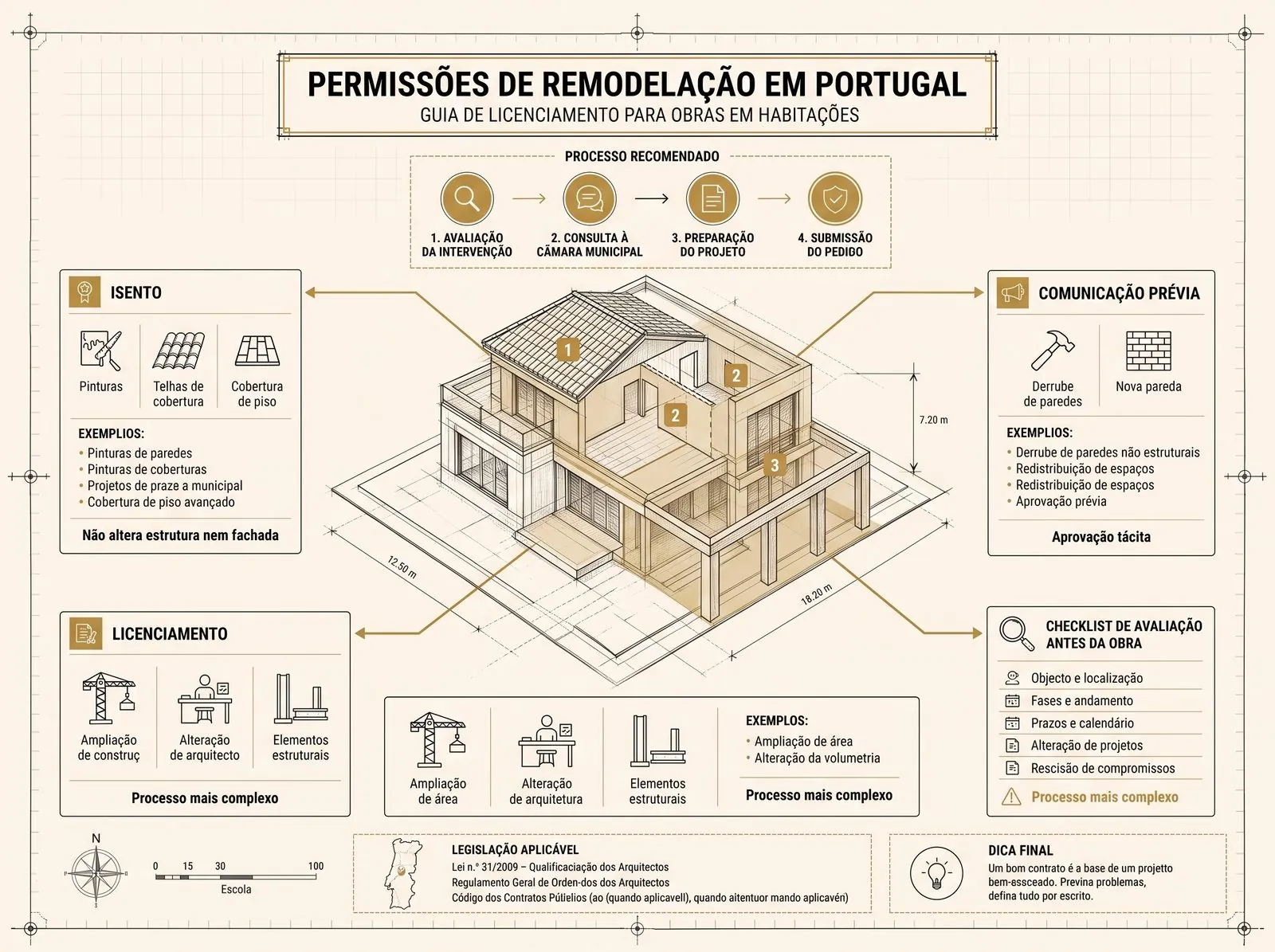
The legislator's central choice is clear: whenever the planning parameters are already defined, in particular where there are detailed plans, execution units or subdivision operations fixing alignments, building footprint, height, number of floors and uses, or in a consolidated urban area where the works respect the plans and do not exceed the most frequent height of the street front, the operation follows the prior notification procedure («comunicação prévia»). Licensing remains essentially for subdivisions and urbanisation works, interventions on listed buildings (or buildings undergoing listing) and their protection zones, and demolitions not integrated in a reconstruction. Construction, alteration or extension works that do not meet the legal requirements for prior notification also remain subject to a licence (article 4(2)(c)).
The most impactful novelty is in how prior notification works: prior notification no longer has a screening and preliminary assessment phase. Once the notification is submitted, works may start on the date previously communicated to the municipality, after the applicable formalities have been completed, including payment of the fees and other charges due (article 34(2)); the information on the start of works must be given no later than five days before they begin (article 80-A(1)). In the prior notification procedure, the municipality can no longer make the start of works conditional on handing over additional elements beforehand. Successive control remains, however, and so does the screening and preliminary assessment phase in the licensing procedure (article 11 of the RJUE). Control becomes successive: the municipality has one year to verify the project's compliance with legal and regulatory norms, while keeping, at any time, the power to check that the works match the submitted designs. Within that successive control the municipality may also notify the applicant, once only, to supply missing designs, elements or information within 10 days. If that does not happen, the prior notification is treated as inept, the operation is blocked and the measures needed to restore urban planning legality follow.
It is an enormous gain in speed, and an equivalent transfer of responsibility. The quality and compliance of the design now rest, almost entirely, on the specialty engineering designs and the technical designers' terms of responsibility. An error that used to be caught at screening will now be caught with the works under way, or finished.
Shorter deadlines and tacit decisions
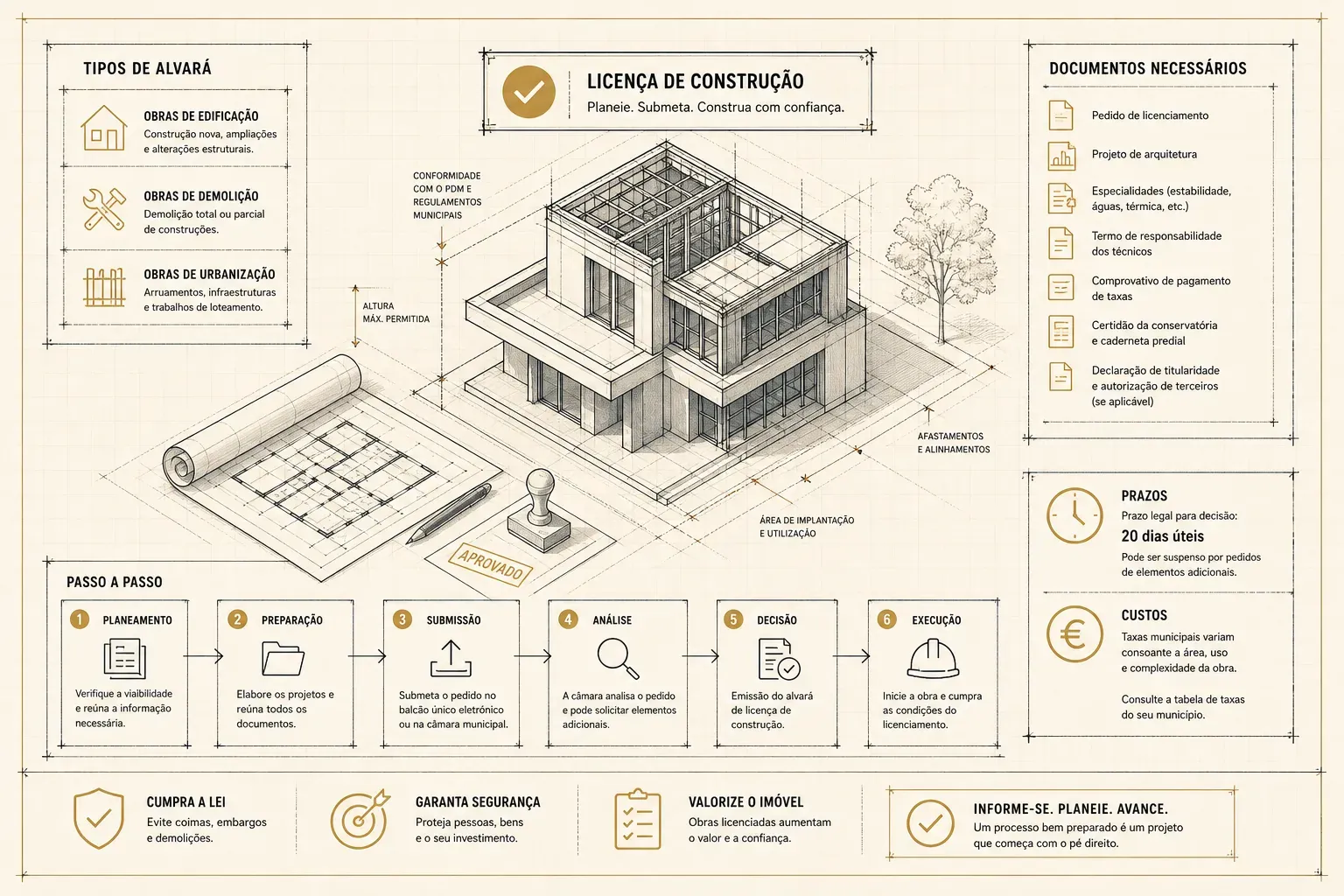
In general terms, in the licensing procedure the deadlines are shortened and disciplined, with typical deadlines such as:
- Screening and preliminary assessment: 20 days, with 10 days for the applicant to correct or complete the application, the deadline being suspended meanwhile (article 11(2) and (3));
- Architectural design assessment: 30 days, extendable only once, with tacit approval if the administration stays silent (article 20(3), (9) and (12));
- Final decision: 20 days for building and demolition works, 45 days for subdivisions and 30 days for urbanisation and land remodelling works, failing which approval is tacit (article 23(1));
- Specialty designs, submission within 6 months of the architectural approval, extendable once by up to 3 months;
- Partial licence: the possibility of a partial licence for the structure right after the architectural design is approved is kept.
The deadlines above follow from the new wording of the RJUE and should be confirmed against the consolidated text of the decree and the applicable municipal regulation.
Tacit approval stops being an uncertain figure: the decree clarifies the document that evidences it, integrating it into the new system of urban planning titles.
The return of urban planning titles
One of the strongest criticisms of the 2024 Simplex was documentary fragility: with the traditional permit gone in many cases, developers, banks and notaries no longer knew with certainty which document titled the operation. The new regime of urban planning titles, set out in the RJUE as republished by DL 108/2026, responds to this criticism with a defined set of documents (article 4.º-A of the RJUE): the completed application or notification form, which carries the summary of the operation, proof of payment of the fees and charges and, depending on the case, the notice of express approval, the proof of submission (for tacit approval) or the declaration of conformity. This is not a return to the alvará: the title stops being a single document and becomes this set. For anyone buying, financing or insuring a property, it is a welcome return of legal certainty: a topic we develop in our pre-purchase feasibility checklist.
Application file, external consultations and the PIP
On the instruction side, the decree splits consultations of external entities into two groups: those related to location (agricultural and ecological reserves, easements) continue to be promoted by the case manager, through the regional coordination commission; those not related to location must now be obtained beforehand by the applicant and delivered with the initial application or the notification. In practice, part of the administrative work moves to the preparation phase: one more reason for rigorous instruction, along the lines of our article on the documentary elements of Ministerial Order 71-A/2024, which applied until 30 September 2026 and has been revoked by Portaria 320/2026/1 since 1 October.
In the prior information request (PIP), the binding nature of the information provided is reinforced, the application of the «qualified» PIP to subdivision operations is clarified, and it is no longer possible to change the design after the prior hearing. For works exempt from control based on a favourable PIP, the specialty designs and terms of responsibility must now be submitted with the communication of the start of works.
Reconstruction: the «last valid precedent»
The decree revises the concepts of building, reconstruction, alteration and extension, and introduces the notion of the «last valid precedent». Reconstruction works may be exempt from licensing and prior notification, provided they amount to restoration of the last valid precedent of the building or unit and meet the applicable legal definition: restoring the formal composition of every façade, in its dimensions and the relations between openings, keeping cantilevered and recessed volumes and the roof, with structural material changes and corrections strictly necessary for safety and salubrity allowed. If volume or floor area increases, this is no longer reconstruction but extension, subject to its own procedure. Reconstruction of listed buildings themselves, of buildings undergoing listing and of those within listed ensembles or sites still requires a licence, under article 4(2)(d), without prejudice to the special legislation applicable to cultural heritage. In certain cases the exemption may also cover works in protection zones of listed buildings or buildings undergoing listing. For the rehabilitation of older building stock, including in urban rehabilitation areas, it is a simplification with real impact, provided the legal situation of the property is documented, which is not always the case in buildings with a history of unlicensed works.
Nullity and lapsing: shorter windows, tougher rules
Two movements in opposite directions deserve attention:
- More certainty for those who build: the period for the administrative declaration of nullity of licences and PIP decisions is reduced to 3 years, with administrative and popular actions lapsing within the same period (except for national monuments and protection zones, and criminal cases). The successive control of prior notifications lapses after one year;
- More demands on subdividers: the subdivision licence or notification now lapses if the building works foreseen in the subdivision are not started within the deadline set in the title, which may only exceptionally exceed 10 years. Holding plots «in waiting» stops being neutral.
The transitional regime further determines that the new lapsing periods apply to situations already constituted, for prior notifications submitted before entry into force, the one-year successive control period counts from 1 October 2026, unless under the previous law it would expire sooner, under the terms set out in the transitional regime.
What to do if you have a pending application
- check which stage your file is at, those pending at an early stage (screening and preliminary assessment) may have changed rules on 1 October, under the transitional regime;
- reassess the procedural framing of the project: operations that followed licensing may switch to prior notification;
- anticipate the external consultations not related to location, which become the applicant's responsibility;
- reinforce the rigour of the designs and the application file, with successive control, errors are no longer filtered by the municipality before the works;
- keep and organise the new urban planning titles, essential in future sales and financing.
Frequently asked questions
When does Decree-Law 108/2026 take effect?
On 1 October 2026. It applies to procedures started after that date and to certain applications submitted before it, under the transitional regime, in particular those still at the screening and preliminary assessment stage.
Does prior notification become the standard procedure?
Yes, whenever planning parameters are already defined: detailed plan, execution unit, subdivision or consolidated urban area. Licensing remains essentially for subdivisions, urbanisation works, listed buildings and protection zones, as well as for construction, alteration or extension works that do not meet the legal requirements for prior notification.
What does it mean that prior notification loses its screening phase?
Once the notification is submitted, works may start on the date previously communicated to the municipality (with the start-of-works information given at least five days in advance), after the fees and other charges due have been paid. The municipality controls afterwards: one year to verify the project's legal compliance and, at any time, whether the works match the designs.
What are the new decision deadlines?
Screening: 20 days. Architectural design: 30 days, with tacit approval. Final decision: 20 days for building and demolition, 45 for subdivisions, 30 for urbanisation. Specialty designs: 6 months, extendable by up to 3.
What changes in the nullity regime?
As a rule, the period for declaring nullity and for challenges is reduced to 3 years, more legal certainty for those who build and those who buy, except for national monuments and criminally relevant cases.
Closing notes
The 21st amendment of the RJUE trades prior control for speed, and speed for responsibility. In a system where the municipality checks less and later, the design, the application file and the terms of responsibility become the owner's real guarantee. That is exactly where an integrated architecture and engineering team makes the difference. If you are preparing a licensing application or have a pending file and want to understand how these rules affect you, talk to the CertiAmb team, we analyse the framing and run the process end to end.
This article is provided for information purposes only and does not constitute legal, tax or technical advice. Each situation should be assessed individually by a qualified professional.