Insights
Buying land or property to build in Portugal: what to check before you buy
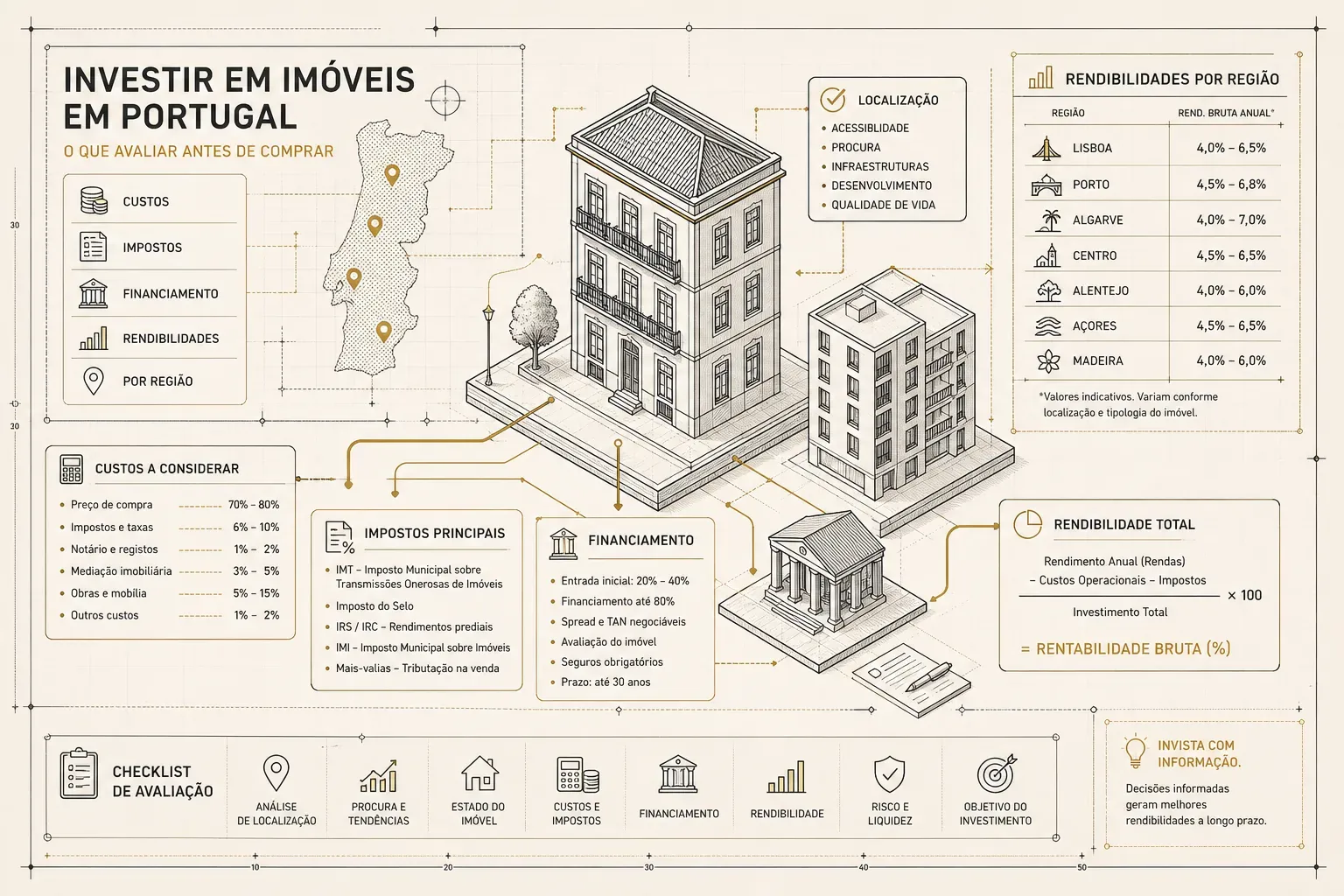
When buying land to build on, or a property to transform, the costliest mistakes are made before any design work begins: at the moment of choosing. A cheap plot where nothing can be built, a house with outbuildings that were never licensed, or a parcel with no access to utilities can turn an apparent bargain into a process that remains blocked for years.
That is why the preliminary assessment, documentary, planning-related and technical, matters as much as negotiating the price. The feasibility checklist that CertiAmb applies when supporting private buyers and investors at this stage completes the analysis we made in building from scratch or buying ready-made. The aim is simple: to know, before signing, what can actually be done with the property.
Land registry and tax record: the documentary starting point
The first check focuses on two sources that do not always match: the land registry and the tax record. The permanent land registry certificate (certidão permanente), which can be requested online and is valid for six months, identifies the owner, the property's description (areas and boundaries) and, above all, the charges and encumbrances: mortgages, attachments, usufructs, registered easements or pending court actions. It should be up to date at the time of the transaction, and any unexpected entry deserves clarification before proceeding.
The tax record (caderneta predial), issued by the Tax Authority, describes the property for tax purposes: matrix article, areas, use and taxable value. In practice, discrepancies between the registry, the tax record and physical reality are common: differing areas, buildings that appear in neither document, imprecise boundaries. For rustic and mixed properties, georeferenced identification has gained weight under the BUPi regime (the single land-registration desk): in municipalities without a cadastral system in force, the georeferenced graphic representation (RGG) is now a central element for identifying and regularising the property. Since the amendment made by Decree-Law 87/2026, Article 19 of Law 78/2017 requires the RGG number to be stated in the documents that record a transfer of ownership and in registrations of acquisition, annexation and disannexation of rustic and mixed properties, except where BUPi confirms of its own motion that the RGG has already been filed or that the property is already on the cadastral map, and in acquisitions arising from enforcement or insolvency proceedings or where a prior declaration of public utility exists. Resolving them may be necessary before the purchase can be registered. Discrepancies left unresolved before the deed become, after it, the buyer's problem.
BUPi: allow for costs before buying
The free period provided for in Article 14 of Lei n.º 65/2019 ended on 30 September 2026, subject to that provision's scope, area limits and exceptions. Since 1 October, paragraph 7 has provided for €15 per RGG up to the ninth and €10 per RGG from the tenth onwards. These amounts apply to qualified municipal or intermunicipal staff, or technicians providing services to those bodies, registered in BUPi to assist citizens.
When estimating regularisation costs, distinguish the RGG from land registration fees and privately commissioned technical work. Ask for the acts covered by the quotation to be listed; the RGG charge is not the total price of every registration.
If an RGG is validated with a geometry reservation (reserva de geometria) because boundaries overlap, clarify the discrepancy before relying on that boundary for the purchase. Conciliation does not guarantee agreement. Decreto Regulamentar n.º 8/2026, in force since 22 September, updated the conciliation procedure. See our news item on BUPi boundaries and costs.
Since 2024, the deed no longer requires proof of a use title
This is a decisive and still little-known point. Until 31 December 2023, Decreto-Lei n.º 281/99 required proof, before the notary, of the building's use title (the former use licence or use permit, licença or autorização de utilização) whenever urban property changed hands. The Simplex reform (Decreto-Lei n.º 10/2024) repealed that regime with effect from 1 January 2024: today, an urban property can be bought and sold without its planning status being verified at all during the transaction.
The practical consequence is clear: the filter, imperfect as it was, is gone: the transfer no longer works as a mandatory moment for producing that title, which makes the buyer's prior check of the planning situation all the more important. The property remains subject to the planning-enforcement measures provided for in the RJUE (embargo, corrective works, demolition, cessation of use); the absence of the title no longer prevents the transfer, but the planning risk has not gone away. Article 19 of Decree-Law 10/2024 required the registrar, the notary, the lawyer or the solicitador to inform the parties that the property may lack the planning titles needed for its use or construction; that article was repealed by Decree-Law 108/2026 (Article 10(c)). For a land buyer, the key rule is the one that applies from 1 October 2026: under Article 4-A(14) of the RJUE, as worded by Decree-Law 108/2026, in deeds transferring land for urban construction, buildings (completed or under construction) or units, the registrar, notary, lawyer, solicitador or other legally competent entity must state, on pain of the transaction being voidable (anulabilidade), either that the planning title exists (where it is shown), or the seller's declaration that it holds one, or the seller's declaration that it holds none. That statement makes the declared position visible, but it is not a check of whether the intended development is lawful. Even so, the problem tends to show its full consequences only after the purchase. Note also that, where bank financing is involved, lenders may still require, for their own protection, documentation on the property's use (the use title, for older buildings, or the documentation relating to the start of use under Article 62-A of the RJUE).
The PDM and land classification: what may be built
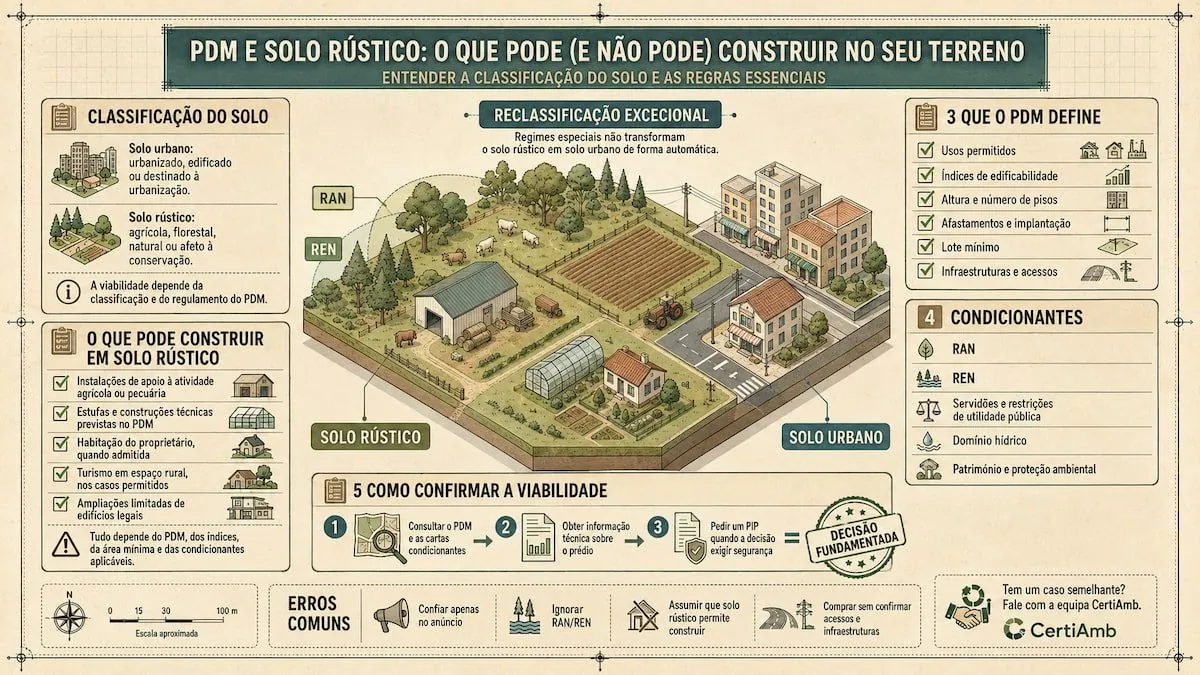
No documentary analysis replaces the central question: what does the municipal master plan (PDM) allow on that particular property? The classification of the land (urban or rustic) and its zoning category determine the permitted uses, the building indices, the maximum heights and the setbacks. On top of these rules come the constraints: the National Agricultural Reserve (RAN), the National Ecological Reserve (REN), the water domain, administrative easements for roads, power lines or gas pipelines, and heritage protection zones.
The zoning and constraints plans are available on municipal websites and on the national territorial-information platforms, but reading them takes practice: the same parcel may fall under several overlapping categories and restrictions. On rustic land, building is the exception rather than the rule, we examine this subject in detail in our article on the PDM and rustic land.
The PIP: greater planning certainty before you buy
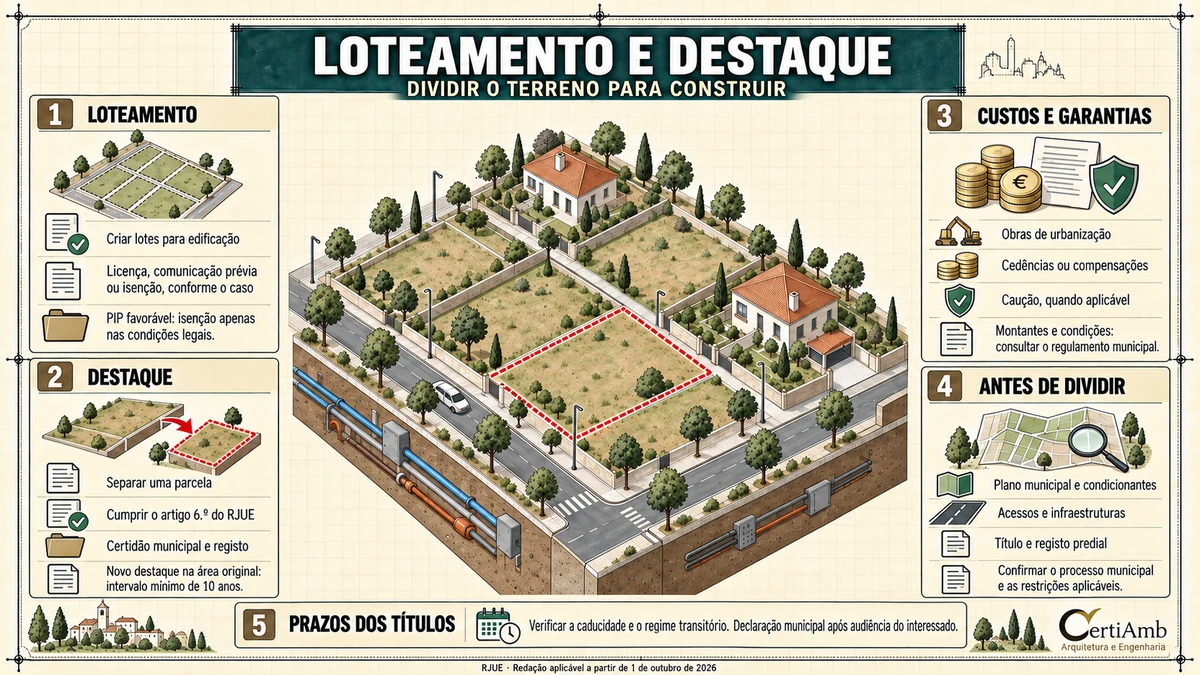
For those who want more than a technical reading of the PDM, the appropriate instrument is the prior information request (PIP), provided for in Articles 14 to 17 of the RJUE. Any interested party may submit a PIP concerning any property, even without owning it, which makes it particularly useful at the negotiation stage. One consequence is worth anticipating: where the applicant is not the owner, the request must identify the owner and the other holders of rights in rem through a certificate from the land registry, and the municipal council notifies them that the procedure has been opened (Article 14(3) and (4)). The municipal council decided on the request, under the wording in force until 30 September 2026, within 20 days or, where the request includes the detailed specifications of Article 14(2), within 30 days (Article 16). From 1 October 2026, Decree-Law 108/2026 replaces these with 15 days for requests under Article 14(1) and, for those under Article 14(2), 30 days for other development operations and 45 days for subdivisions, counted from the end of the screening and preliminary assessment or, where consultations take place, from receipt of the last opinion, authorisation or approval, or expiry of the period for issuing it, whichever occurs first (Article 16(2)).
A favourable prior information decision binds the competent authorities when they decide on the future application. Its practical effects, however, depend on the type of PIP. For anyone buying now, the main reference is Article 17 of the RJUE as worded by Decree-Law 108/2026, which applies from 1 October 2026 (paragraphs 5 to 7) and draws an express distinction:
- Ordinary PIP (Article 14(1)): the licence application or prior notification must be submitted within two years of notification of the favourable decision or of tacit approval;
- Qualified PIP (Article 14(2), with all the applicable particulars in points (a) to (f)): it exempts the operation from licensing and prior notification and dispenses with new external consultations, but the operation must be started within the same two years; this effect expressly excludes use and change of use;
- After the two years: once only, the interested party may ask for a declaration that the factual and legal assumptions still hold, to be decided within 20 days; if they are confirmed, or if there is no reply, there is one year to submit the application or notification or, for a qualified PIP, to start the operation.
Until 30 September 2026, the wording introduced by Decree-Law 10/2024 applied: a favourable PIP issued under Article 14(2) and (3), containing the particulars of Article 14(2)(a) to (f), exempted the operation from prior control (Article 17(2) and Article 6(1)(h)); such works had to begin within two years of the favourable decision and were accompanied by a declaration from the design authors and the design coordinator that they comply with the prior information; once that period has passed, the mayor could be asked to declare that the underlying assumptions still held (decision within 20 days), after which one year ran to file the licence application or the prior notification. Under either regime, a favourable PIP significantly reduces the planning uncertainty of the purchase: the decision no longer rests on an expectation alone, and there is a binding municipal ruling, on its own terms and within its period of validity.
Utilities and access: the invisible cost
A plot that is viable in planning terms can be economically unviable if the utilities are far away. Before buying, it is important to confirm the existence and capacity of the public water, sewerage, electricity and telecommunications networks at the property's frontage. Where the networks do not reach the site, it may be necessary to bear significant costs of extension, reinforcement or connection, the framework for which depends on the infrastructure, the managing entity and the specific conditions of the site. In areas without a public network, standalone solutions such as a private water abstraction, a sealed tank or local wastewater treatment are subject to demanding technical requirements and may call for a notification, an authorisation or a licence, depending on the type of use, the installed capacity, the location and the applicable regime, as we explain in our article on water supply and drainage networks.
Access is another critical check: there must be legally secured access, compatible with the planning requirements applicable to the operation. A track used "since forever", but with no title or clear legal basis, can become a problem at the licensing stage.
Existing buildings: use title, unrecorded works and areas
Where the purchase concerns an existing building to be extended or refurbished, the checks widen: beyond the documentation relating to use, it should be confirmed whether the building was, at the date of construction and in that specific location, subject to a use licence or permit. That check should not rest on the date of 7 August 1951 alone, since the historical framework varies from place to place and later works may remove the waiver. In any case, the actual construction should be checked against the municipal file and the as-built drawings. Annexes, extensions or attic conversions that were subject to prior control when they were built and do not appear in the municipal file may amount to unlawful urban operations, and their legalisation can be slow, costly or, in some cases, impossible.
Areas deserve particular attention: discrepancies between the actual area, the registered area and the tax-record area affect the value, bank financing and the building capacity available for a future extension. A rigorous architectural survey before the purchase costs a fraction of what it costs to discover the problem after it.
What changed: a new amendment to the RJUE on 1 October
The legal framework for permitting is still on the move. Decreto-Lei n.º 108/2026, the 21st amendment to the RJUE, entered into force on 1 October 2026, continuing the reform of urban-planning procedures begun with the Simplex. For anyone assessing a purchase, the practical implication is twofold: confirm which regime applies to your process and make sure the feasibility analysis is based on up-to-date information, not on rules that no longer apply. Note that the applicable regime does not depend only on when the procedure started: under Article 12 of Decree-Law 108/2026, the new regime also covers earlier procedures which, on 1 October, are still at the vetting and initial-appraisal stage, and the parties may take the steps needed to adapt to it.
Typical mistakes to avoid
- buying on the basis of the tax-record areas, without a topographic or architectural survey;
- assuming that rustic land "with good access" can be built on;
- ignoring registered charges, or de facto rights of way that do not appear in the registry;
- acquiring a building with unrecorded works while counting on a "quick" legalisation;
- underestimating the cost of extending the utilities to the property;
- skipping the PIP "to save time", and losing years to a refused application.
CertiAmb's integrated approach
A serious feasibility study crosses all these dimensions: documents, the PDM and its constraints, utilities, access and a preliminary architectural study demonstrating what the property can actually yield. At CertiAmb, the technical check before a purchase is carried out through our Safe Purchase service. Where the goal calls for a deeper analysis of building scenarios, constraints and applicable parameters, the work is developed as a Planning Feasibility Study, which may include preparing a prior information request where a binding municipal position is needed.
For foreign investors, this support is even more critical: distance, language and differences in the legal regime make local technical and planning due diligence an essential protection against surprises, especially now that the deed no longer requires proof of a use title.
Frequently asked questions
Can I submit a prior information request (PIP) without owning the land?
Yes. Under Article 14 of the RJUE, any interested party may submit a prior information request concerning any property, even without owning it, in which case the owner and the other holders of rights in rem must be identified through a land-registry certificate and are notified by the municipal council that the procedure has been opened: the ideal instrument for assessing feasibility before purchase.
Does the deed guarantee that the property is legal from a planning perspective?
No. Since 1 January 2024, under the Simplex reform (Decreto-Lei n.º 10/2024), proof of a use title is no longer required when urban property is transferred. From 1 October 2026, deeds transferring land for construction, buildings or units must state the position regarding the planning title, on pain of voidability, but that statement is not a check of lawfulness. The deed does not replace planning due diligence: it is for the buyer to check the property's situation beforehand, without prejudice to the legal responsibilities that may fall on other parties.
Which documents should I review before buying?
The permanent land registry certificate (owner, areas, charges and encumbrances), the tax record (caderneta predial), for existing buildings, the documentation on use (the use licence or permit for older buildings, or the documentation relating to the start of use under Article 62-A of the RJUE), the municipal file and the property's status under the PDM, including constraints such as RAN, REN and easements.
How long is a favourable PIP valid?
It depends on the type of PIP and on the applicable regime. From 1 October 2026 (Decree-Law 108/2026), after an ordinary PIP (Article 14(1)) the licence application or prior notification must be submitted within two years of notification of the favourable decision or the formation of tacit approval; after a qualified PIP (Article 14(2)), which exempts the operation from licensing and prior notification, the operation itself must be started within that same period. Once the period has run, the interested party may, once only, ask for a declaration that the assumptions still hold, to be decided within 20 days; if they are confirmed, or if there is no reply, there is one more year to submit the application or notification or, for a qualified PIP, to start the operation. Until 30 September 2026, under the wording of Decree-Law 10/2024, the two-year period concerned the start of operations exempted from prior control by a qualified PIP, followed, after the declaration that the assumptions still hold, by one year to submit the application or notification.
The land is classified as rustic: can I build?
As a rule, rustic land is subject to strong restrictions on building, which is admitted only in exceptional cases defined by the PDM and by law. Feasibility must be confirmed case by case, ideally through a prior information request.
Closing notes
Buying to build is, first and foremost, buying a legal and technical framework, and that framework is verified, not presumed. A well-executed feasibility checklist turns uncertainty into an informed decision: it confirms what can be built, what it will cost to service the property with utilities and which planning liabilities come with the deal. If you are assessing a plot or a property and want to decide with confidence, ask us for a planning feasibility study.
Update note (1 August 2026): the postponement has been published. Decree-Law no. 155-B/2026 of 31 July amended article 13(1) of Decree-Law no. 108/2026 and set the entry into force of the RJUE revision at 1 October 2026. Until 30 September 2026 the previous regime applied; from 1 October the new one applies. Details in our article on DL 108/2026.
This article is provided for information purposes only and does not constitute legal, tax or technical advice. Each situation should be assessed individually by a qualified professional.