Insights
The PDM and rural land: what you can (and cannot) build on your plot
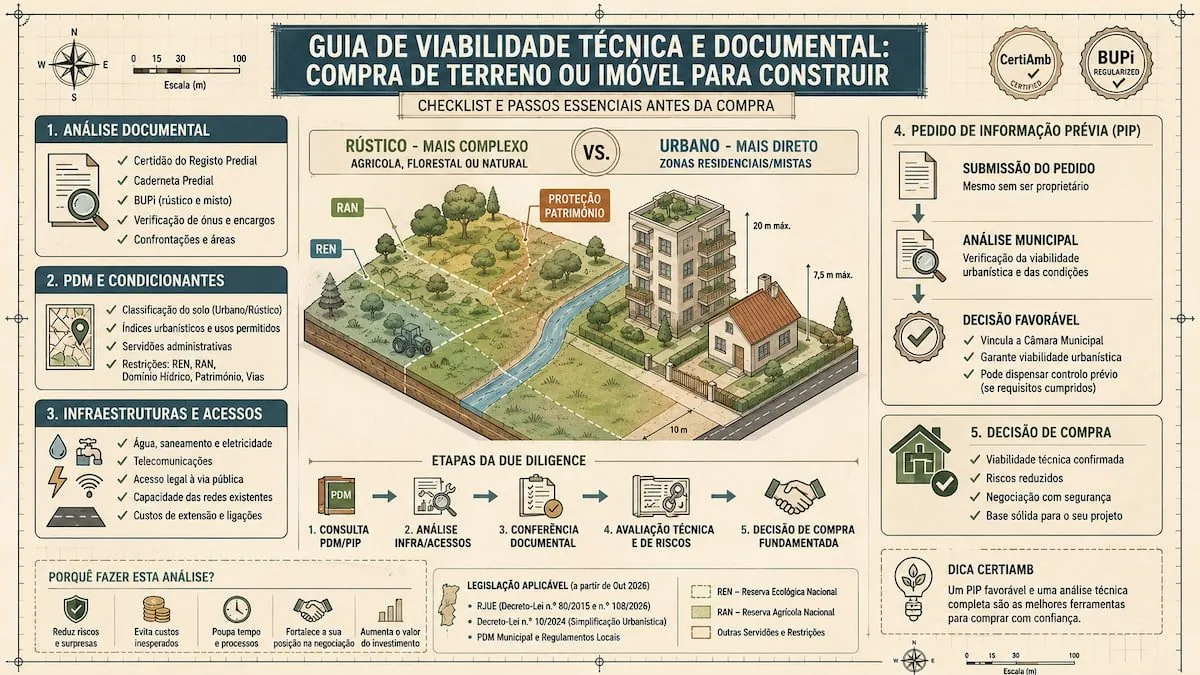
Buying a plot of land does not, in itself, confer the right to build on it. In Portugal, what may be built on each parcel is determined, first and foremost, by the Plano Diretor Municipal (PDM), the municipal master plan, and the fundamental distinction it draws is the classification of land as urban (solo urbano) or rural (solo rústico). Almost everything follows from that classification: the permitted uses, the building indices, the building height and, in many cases, whether anything at all can be built.
Over the past two years the subject has gained prominence with the so-called "land law", Decreto-Lei n.º 117/2024, and the legislative correction that followed in 2025. At CertiAmb, studying the planning framework of the land is the first step of any project, as part of the technical consultancy we provide to owners and investors. Each land class means something different, the reclassification regime has changed more than once, and a PDM has its own way of being read. That is where the reliable answer about what you can build on your plot comes from.
Urban land and rural land: the classification that decides everything
The 2014-2015 reform, carried out by the framework law on land policy (Lei n.º 31/2014, de 30 de maio) and by the Legal Framework for Land Management Instruments (RJIGT, Decreto-Lei n.º 80/2015, de 14 de maio), reduced the land classes to two:
- Urban land: land that is fully or partially urbanised or built up and is, as such, allocated to urbanisation or building by a territorial plan;
- Rural land: land intended for agricultural, livestock and forestry use, for conservation and for the exploitation of natural resources, or which cannot be classified as urban.
The old intermediate category of "urbanisable land" disappeared, and municipalities had to bring their plans into line with the new classification rules by 31 December 2024. In municipalities that did not complete that adaptation, the plan provisions concerning urbanisable areas or areas of programmed urbanisation fall under the suspension regime of article 199 of the RJIGT, with the suspension decreed by the territorially competent regional coordination and development commission (CCDR) after hearing the municipality. The CCDR does not decree it if the municipality shows, with reasons, that the revision of the plans is nearing completion or that the delay is not attributable to it. The regime comes from Lei n.º 53-A/2025. In practice, old expectations along the lines of "the land used to be urbanisable" may no longer have any legal basis.
What can be built on rural land
The guiding rule is clear: rural land is not intended for urban development. Building is exceptional and must serve the activities proper to this territory. Within that framework, PDMs typically allow:
- facilities supporting agricultural, livestock and forestry activities (warehouses, storage buildings, greenhouses);
- housing for the own residence of whoever farms the land, where the regulation provides for it;
- rural tourism ventures and other uses of value to the territory;
- limited extensions of existing, lawfully built structures.
These possibilities are subject to conditions set municipality by municipality: a minimum plot size (from a few thousand square metres to several hectares), very low building indices, a limited number of storeys and landscape-integration rules. There is no single national yardstick: what is feasible in one municipality may be prohibited in the next, and only a reading of the specific PDM can provide the answer.
The "land law": what changed in 2024-2025 and where it stands in 2026
Decreto-Lei n.º 117/2024, de 30 de dezembro, the seventh amendment to the RJIGT, reshaped the special, simplified regime for reclassifying rural land as urban land by municipal deliberation. The two articles that set it out, Article 72-A for economic activities, storage, logistics and dry ports and Article 72-B for housing, had been added to the RJIGT by Decreto-Lei n.º 10/2024, de 8 de janeiro. It entered into force on 29 January 2025 and immediately attracted strong criticism, for the pressure it could place on agricultural and natural land and for the doubts surrounding the concept of "moderate value housing".
Following parliamentary review, Lei n.º 53-A/2025, de 9 de abril, in force since 14 April 2025, with retroactive effect to 31 December 2024, corrected the regime on essential points:
- in reclassification for housing, under article 72-B, at least 700/1000 (70%) of the total above-ground construction area must be allocated to public housing, affordable rental or controlled-cost housing, the "moderate value" concept was dropped;
- the land must be contiguous with urban land;
- an opinion from the CCDR is now required (non-binding, to be issued within 20 days of the proposal being sent, failing which it is deemed granted), together with a demonstration of the impacts on infrastructure and of the economic and financial feasibility of the operation;
- the urbanisation works must be completed within four years, extendable by no more than one;
- the areas of the REN in which reclassification for housing is outright prohibited were extended.
Two points are worth retaining. First, this is a temporary regime: it runs until 31 December 2028, without prejudice to procedures initiated in the meantime. Second, the initiative lies with the municipality. It is not a mechanism available to owners to "convert their land to urban". In practice the regime has so far been applied sparingly and unevenly between municipalities.
August 2026 brought a case that shows this regime in operation. Through Aviso n.º 21175/2026/2 (Diário da República no. 165/2026, 2nd series, 26 August), the Municipality of Trofa approved the 1st simplified amendment to the 1st Revision of its PDM under article 72-A(1) of the RJIGT: about 13.4 hectares at Monte de Baixo, in the parish of Guidões, moved from Espaços Florestais de Produção to Espaços de Atividades Económicas. The amendment takes effect on sheets 1.1, 1.2 and 1.6 of the zoning plan and entered into force on the working day following publication.
The dates set out in the notice help calibrate expectations: municipal council decision on 24 June 2026, unanimous approval by the municipal assembly on 26 June, publication on 26 August. What the notice does not say is how long the preparatory stage before those decisions took, so the visible interval is not a basis for estimating how long the process runs. Note the purpose as well: economic activities, not housing. The requirement of 700/1000 of the construction area appears in article 72-B, which is the one dealing with reclassification for residential purposes.
What the PDM defines: uses, indices and building heights
The PDM essentially comprises a regulation and two plans that must be read together: the zoning plan (planta de ordenamento), which qualifies the land into categories (agricultural, forestry, natural, residential or economic-activity spaces, among others), and the constraints plan (planta de condicionantes), which identifies easements and public-interest restrictions. For each category, the regulation sets the parameters any project must respect:
- permitted, conditional and prohibited uses;
- building index and maximum construction area;
- facade height and number of storeys;
- setbacks from boundaries and minimum plot size;
- infrastructure, parking and landscape-integration requirements.
RAN, REN and other constraints: when the PDM is not enough
Even where the PDM allows a use, public-interest restrictions prevail. The two most relevant on rural land are the National Agricultural Reserve (RAN, Decreto-Lei n.º 73/2009, de 31 de março), which protects the soils with the greatest agricultural capability and admits non-agricultural uses only in the cases and under the conditions set out in its own regime, often subject to a decision by the competent regional authority, and the National Ecological Reserve (REN, Decreto-Lei n.º 166/2008, de 22 de agosto), which covers areas of ecological value and risk prevention, flood-prone zones, erosion areas, coastal strips, where compatible uses are very limited.
To these are added the water domain and the protection strips along watercourses, road, power-line and gas-pipeline easements, the protection of cork and holm oaks, and listed heritage. A plot may simultaneously sit on rural land, within the RAN and in a flood-prone zone, and each layer adds its own regime. It is this overlapping of constraints, more than the classification itself, that often renders a project unfeasible.
How to confirm what you can build: consulting the PDM and prior information
The safe route has three steps. First, consult the PDM, the regulation and the plans are available from the municipal council and on the National Territorial Information System (SNIT), run by the Directorate-General for Territory (DGT). Second, obtain a location plan and, if necessary, a certificate on the planning status of the parcel. Third, and decisive before any investment, submit a prior information request (PIP) under the Legal Framework for Urbanisation and Building (RJUE): a favourable prior information decision binds the municipal council when deciding on the permit application submitted on the basis of it.
Note that the procedural framework has changed: Decreto-Lei n.º 108/2026, the twenty-first amendment to the RJUE, entered into force on 1 October 2026 (the date set by Decreto-Lei n.º 155-B/2026; until 30 September 2026 the RJUE as amended by Decreto-Lei n.º 10/2024 applied) and reshaped the prior-control procedures for development operations. Among other changes, article 17 distinguishes the effects of the PIP: after an ordinary PIP (article 14(1)), the permit application or prior notification must be submitted within two years of notification; after a qualified PIP (article 14(2)), which exempts the operation from permit and prior notification, the operation itself must be started within the same period. Once the period has run, the owner may, once only, ask for a declaration that the assumptions still hold, which opens one more year to submit the application or notification or, for a qualified PIP, to start the operation. Until 30 September 2026, under the wording of Decreto-Lei n.º 10/2024, the two-year period concerned the start of operations exempted from prior control by a qualified PIP. It does not change land classification, but anyone applying for a permit from that date onwards does so under the new rules, which also apply to earlier procedures still at the screening and preliminary assessment stage. We explain the process in our guide to construction permitting in Portugal. And if you are weighing up a purchase with works in mind, see also our analysis of building from scratch versus buying to renovate.
A nearby example: the new Cartaxo PDM
The importance of keeping track of municipal plans is plain to see in the region where we work every day. The revision of the Cartaxo PDM was approved by the Municipal Council and the Municipal Assembly on 24 June 2026, published by Aviso n.º 18829/2026/2 (Diário da República no. 145/2026, 2nd series, 29 July), and has been in force since 30 July 2026. The new rules include restrictions in flood zones (no basements and thresholds above the flood level), a 10-metre protection strip along watercourses, a clearer framework for tourism investment and an increase in the index applicable to greenhouses from 0.05 to 0.60: a clear signal of support for protected agriculture. We have summarised these changes in our news piece on the new Cartaxo PDM.
For anyone who owns land in the municipality or in the Santarém region, this is the right moment to reassess the planning status of each parcel. CertiAmb supports architecture and engineering projects in Cartaxo and the neighbouring municipalities, from the feasibility study through to permitting.
Frequent mistakes and risks
- buying rural land on the assumption that "it will become urban later": reclassification is exceptional, municipally driven and, today, tightly constrained;
- relying on listings advertising "land with building feasibility" without a municipal certificate or a PIP to prove it;
- ignoring the constraints plan and discovering too late that the parcel sits within the RAN, the REN or a flood-prone zone;
- taking the advertised boundaries and area at face value without checking the land registry, the tax record and a topographic survey;
- acquiring parcels below the minimum area the PDM requires for any building at all.
For foreign investors, these risks are compounded by distance and unfamiliarity with the Portuguese system: which is why we have prepared a dedicated guide for those investing from abroad.
CertiAmb's integrated approach
The feasibility of a plot is rarely settled by a single answer: it requires cross-checking the PDM, the constraints, the available infrastructure and the intended project. At CertiAmb we bring architecture, engineering and consulting together under a single coordination: we analyse the planning framework, prepare the prior information request, develop the design and manage the permitting process with the municipal council. You can find out more about our team and our method on the About CertiAmb page.
Frequently asked questions
Can I build a house on rural (rústico) land?
Only in the exceptional cases provided for in the municipality's PDM, typically housing linked to farming the land or rural tourism, and subject to conditions such as a minimum plot size and very low indices. As a rule, rural land is not intended for urban development.
Does the "land law" let me convert my plot to urban land?
Not automatically. The simplified reclassification procedures in articles 72-A and 72-B of the RJIGT depend on a municipal decision. For housing purposes, article 72-B has required, since Lei n.º 53-A/2025, contiguity with urban land, at least 700/1000 of the above-ground construction area allocated to public housing, affordable rental or controlled-cost housing, an opinion from the CCDR and a demonstration of feasibility. The regime runs until 31 December 2028.
What is the prior information request (PIP)?
It is a formal request to the municipal council, provided for in the RJUE, on the feasibility of a development operation on a given plot. A favourable decision binds the council when deciding on the permit application submitted on the basis of it: the safest instrument before buying or designing. From 1 October 2026, under Decreto-Lei n.º 108/2026, the effects depend on the type of PIP: after an ordinary PIP, the permit application or prior notification must be submitted within two years of notification; after a qualified PIP, which exempts the operation from permit and prior notification, it is the operation itself that must be started within that period. Until 30 September 2026, that two-year period concerns the start of operations exempted from prior control by a qualified PIP.
What are the RAN and the REN?
They are public-interest restrictions that prevail over the PDM: the National Agricultural Reserve protects the soils with the greatest agricultural capability; the National Ecological Reserve covers areas of ecological value and risk prevention, such as flood-prone zones. In both, building is severely restricted.
How do I consult my municipality's PDM?
The regulation, the zoning plan and the constraints plan are available from the municipal council and on the SNIT, run by the Directorate-General for Territory. For an answer with legal value on a specific plot, request a municipal certificate or submit a prior information request.
Closing notes
Before buying, selling or designing, the right question is not "what do I want to build?" but "what do the PDM and the constraints allow to be built here?". Answering it early costs little; answering it late can cost the investment. If you own a plot, or are thinking of acquiring one, and want to know precisely what you can do with it, talk to the CertiAmb team.
Update note (1 August 2026): the postponement has been published. Decree-Law no. 155-B/2026 of 31 July amended article 13(1) of Decree-Law no. 108/2026 and set the entry into force of the RJUE revision at 1 October 2026. Until 30 September 2026 the previous regime applied; from 1 October the new one applies. Details in our article on DL 108/2026.
This article is provided for information purposes only and does not constitute legal, tax or technical advice. Each situation should be assessed individually by a qualified professional.