Insights
Hiring a building contractor in Portugal: alvará, contract and guarantees
Before hiring a building contractor in Portugal, the owner needs to know who will sign, which works the price covers and how completion will be verified. An attractive total leaves these questions unanswered if the quotation does not identify the business, the materials and the exclusions.
Start with company records and IMPIC authorisation. Then check references, compare detailed quotations and agree a contract that allows you to track progress, payments and changes. Each check serves a different purpose. None, on its own, guarantees completion.
Confirm the business and the signatory's authority
Ask for the full legal name, tax number (NIF or NIPC), address and contact details. Compare these across the quotation, IMPIC record, contract and invoices. If a trading name differs from the registered name, clarify the relationship before paying.
For a company, consult its permanent commercial registration certificate and check who represents it and how it is bound. One signature may be insufficient where joint signatures are required. If an attorney signs, request the power of attorney and check that it covers the contract. Also check the payment beneficiary; a third party's account requires a documented explanation.
IMPIC: check the authorisation for your works
Law 41/2015 of 3 June distinguishes private and public works titles. For a business established in Portugal undertaking private works, check its alvará or certificate and current status through IMPIC's public search. Keep a dated copy.
IMPIC provides separate searches for alvarás, certificates, registrations and occasional services. Also check the list of authorisations cancelled within the past year. Other search types are in the IMPIC search menu.
- A private works alvará authorises works within its value class. It does not list categories or subcategories and does not remove the technical requirements for each project (Article 24).
- A private works certificate allows works up to 20% of the class 1 ceiling (Article 25). With class 1 set at €200,000 by Portaria 212/2022, this limit is €40,000.
- A public works alvará lists categories and subcategories for that regime. It also authorises private works within the approved class (Article 6(3)).
Identify the specialist contractors, subcontractors and responsible professionals. Company authorisation does not replace checking the qualifications required for the team and the specific work. Private works titles have indefinite validity but may be suspended or cancelled. Check their status again if relevant circumstances change during construction.
Article 28 permits occasional services by businesses legally established in another European Economic Area (EEA) state without an establishment in Portugal. Article 27 concerns establishment in Portugal and covers both recognition of EEA authorisations and businesses from states party to the World Trade Organization General Agreement on Trade in Services. In the cases specified in Article 28, authorisation may not depend on registration already appearing online. If a search returns no result, clarify the applicable regime with IMPIC; do not assume that the same exception applies to every foreign business.
Experience, staffing and ability to deliver
Ask for references involving similar scale and construction methods, with permission to contact the clients. Confirm the company's actual role, the team available for your project, the subcontracted work and the daily site contact. Photographs alone do not establish who carried out a project.
Ask how materials with long delivery times will be secured and which other commitments affect the start date. IMPIC authorisation is not a guarantee of future liquidity. Assess a recently incorporated business on its specific circumstances, including its team's experience; its incorporation date alone does not prove likely default.
What the 2026 sector figures show
In its release dated 14 October 2026, Iberinform reports 164 companies in its insolvency indicator for the "Construction and Public Works" category from January to September 2026, an increase of 18% against the same period in 2025. It also reports 6,000 company formations in that category and period, up 12%.
The release does not provide a detailed methodology for counting cases, classifying proceedings or mapping activity codes. The 18% increase concerns the reported count, not the proportion of contractors that are insolvent. These indicators cannot establish an individual company's risk or support comparing insolvencies solely against new companies. They provide context for checking each appointment.
Compare what the quotations include
Give bidders the same version of the design documents and bill of quantities. Compare units, quantities, unit prices, materials, equipment, labour and exclusions. Clarify responsibility for transport, scaffolding, waste, testing, connections and preparatory works. An item marked "to be defined" needs an agreed approval and pricing method.
Request a clear price excluding VAT, the applicable tax treatment and the total payable. Quoting a price excluding VAT does not prove irregular invoicing; establish what will be invoiced and on what terms. Check quotation validity and any price adjustment provisions.
The written contract: legal minimum and agreed terms
Article 26 of Law 41/2015 requires private works contracts and subcontracts governed by Portuguese law to be in writing when their value exceeds 10% of the class 1 ceiling, currently €20,000. "Exceeds" does not include equality at that threshold. The minimum content covers full identification of the parties; IMPIC alvarás, certificates or registrations where previously granted or made; the scope, including written and drawn documents where these exist; the price and completion period.
Failure to comply with that paragraph makes the contract void, but the business hired by the owner cannot invoke that nullity (paragraph 3). Even below the threshold, we recommend a written agreement so that the completed works can be compared with what was agreed.
Beyond the legal minimum, agree the pricing basis, milestones, conditions for starting work, payments, handover and the treatment of changes and delays. Retentions, delay penalties and advance payment guarantees are terms to define and review in the contract; they are not a universally mandatory package. Identify the applicable insurance and request evidence, scope of cover and validity.
Link payments to verified work
The payment plan should connect each amount to planned and completed work. Agree who prepares and approves measurement records, how long review takes and which documents support payment. Track the contract price, approved changes, advances, measured work and payments separately.
For a materials advance, identify the order, supplier, delivery date and how the advance will be deducted from subsequent payments. Assess whether a specific guarantee is appropriate. A retention or bank guarantee provides only the protection set out in its terms; it does not eliminate the risk of interruption.
Record changes and handover
Before implementing a change, record its reason, design, price, effect on the programme and approval. Attach the revised drawing or specification. In an emergency, record the instruction and complete the documentation as soon as possible. Dated photographs and meeting minutes help establish what happened.
At handover, compare the works with the contract, list defects and outstanding items, and assign responsibility and dates for corrections. Keep the handover record, test results, manuals and delivery evidence. Remedial work and payment should follow the agreed terms and applicable rights.
Defects: identify the regime before counting time limits
Article 1225 of the Portuguese Civil Code provides for liability in certain contracts to construct, alter or repair property intended to last, for defects under the conditions it specifies, arising within five years of handover or within the agreed warranty period. It also sets specific time limits for notification and exercising rights. This provision does not cover every applicable regime.
For relationships covered by the consumer protection rules in Decree-Law 84/2021, nonconformity in residential property existing at delivery must manifest within ten years for structural construction elements and five years for other nonconformities (Article 23). Nonconformity appearing within those ten or five years is presumed to have existed at delivery, unless incompatible with the nature of the property or the characteristics of the nonconformity (Article 23(4)). Article 25 sets a separate three-year period from notification for the rights under Article 24, subject to statutory suspensions. Check the subject matter, consumer status and contract date: the decree entered into force on 1 January 2022, and Article 53 defines its application over time. Applying it to goods supplied under works contracts requires the adaptations in Article 3; these periods do not automatically apply to every repair.
If a defect appears, document it and notify the contractor as soon as you discover it, using a method that provides evidence. Under the general Civil Code rules for works contracts, notification is due within 30 days of discovery or the rights lapse (Article 1220); for works covered by Article 1225, the notification period is one year. These periods do not automatically apply to relationships covered by the special consumer regime. Collect the contract, handover and discovery dates, correspondence and previous repairs for legal assessment of the time limit and appropriate remedy. Do not wait for the end of an assumed single warranty period.
Frequently asked questions
Does an alvará confirm quality and financial stability?
It confirms authorisation within the title and its current status. Experience, available staffing and ability to perform the contract require separate checks. It does not guarantee future liquidity.
Is a written contract compulsory from €20,000?
Article 26 requires writing when the value exceeds 10% of the class 1 ceiling, currently €20,000. The threshold must be exceeded, not merely reached. We recommend written agreements below it too.
What is a safe advance payment percentage?
No percentage guarantees completion. Agree the purpose, supporting evidence, any guarantee and how the advance will be deducted from later payments.
Do all defects have the same time limits?
No. The regime depends on the contract, its date, subject matter and the parties' status. The periods for defects to appear, notification and exercising rights serve different purposes and need to be checked for the specific case.
Before you appoint a contractor
Before signing, collect identification and evidence of authority, the IMPIC search, references, the detailed quotation and the final contract with its attachments. CertiAmb can support technical comparison of quotations and construction monitoring, including quantity checks and change records. Contract clauses and claim deadlines should be reviewed with legal support appropriate to the contract.
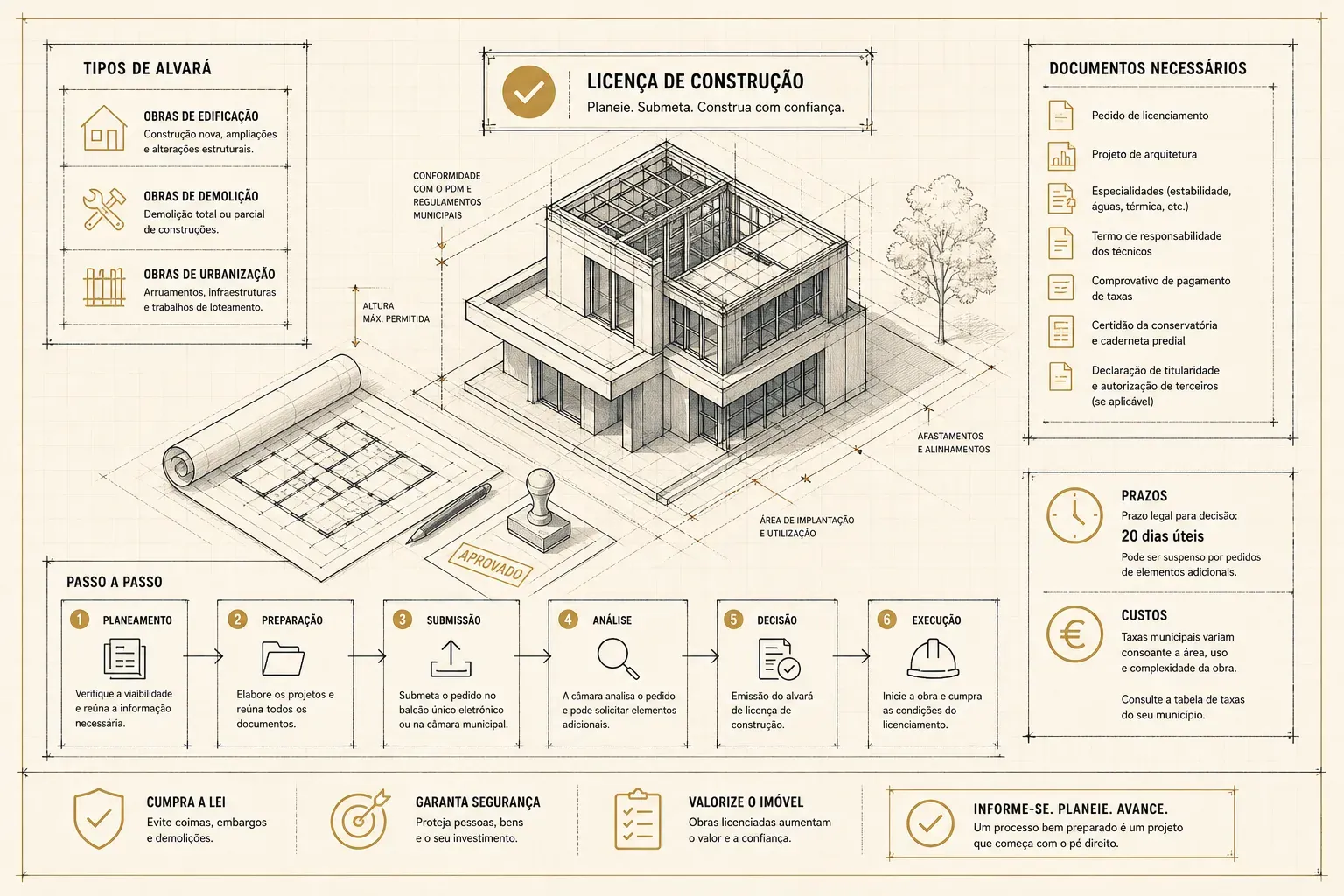
The municipal procedure for the works is a separate check, explained in our licensing guide. For tax treatment, see our guide to VAT in construction.
This article is provided for information purposes only and does not constitute legal, tax or technical advice. Each situation should be assessed individually by a qualified professional.