Insights
Reduced VAT on housing construction: conditions, mixed use and refunds
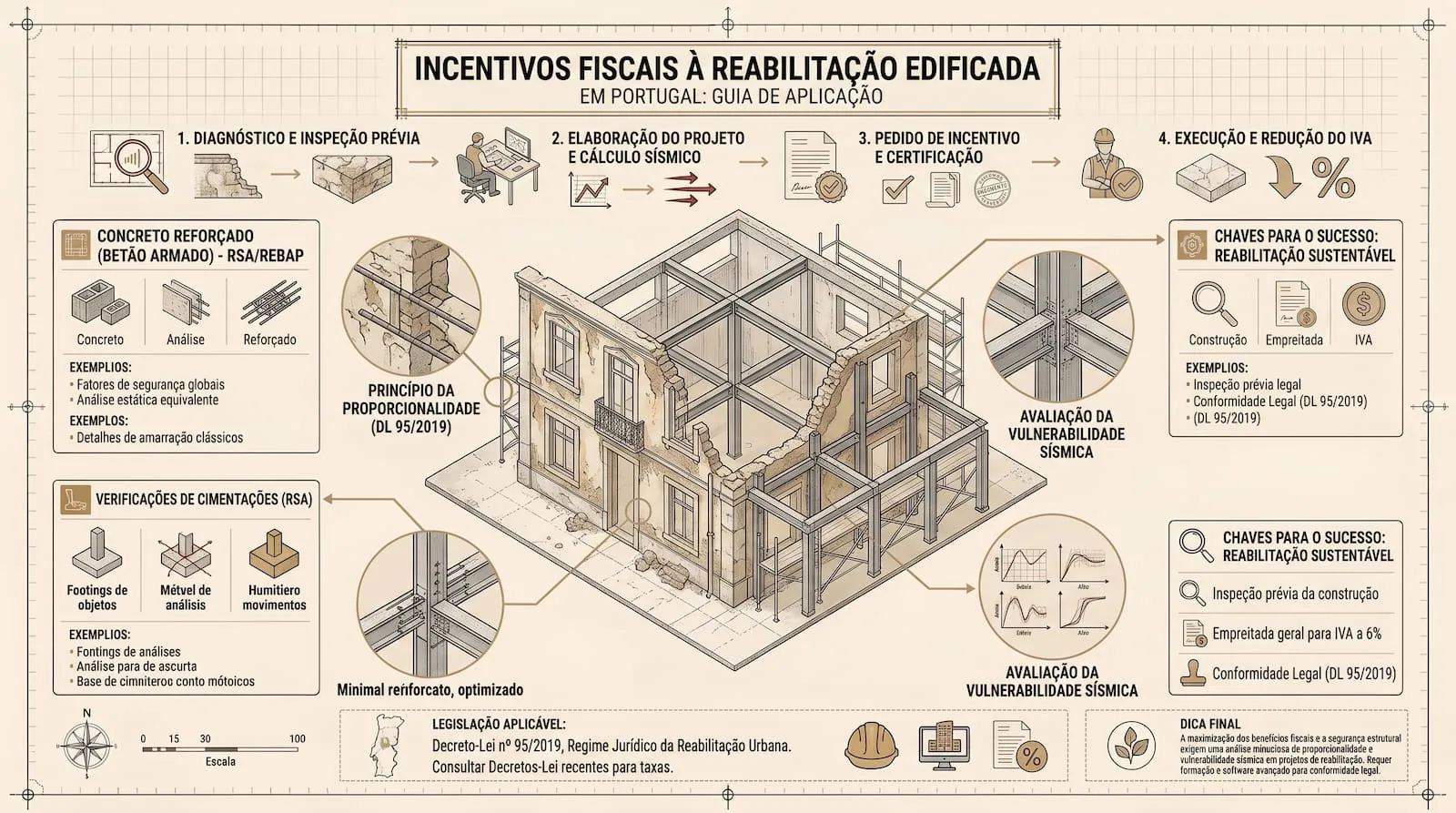
Housing construction and rehabilitation contracts may qualify for the reduced VAT rate, 6% in mainland Portugal, when the conditions of the applicable regime are met. The regime was approved by Law 9-A/2026, of 6 March (legislative authorisation), and enacted by Decree-Law 97/2026, of 20 May, as part of the housing tax package. The reduced rate is applied under the new item 2.42.1 of List I annexed to the VAT Code, in force until 31 December 2032. The Tax Authority's administrative guidance is set out in Circular Letter (Ofício-Circulado) 25116/2026, of 23 June.
Worth knowing: who benefits, what is excluded, how the self-build refund works and which deadlines and penalties can turn a benefit worth tens of thousands of euros into a tax problem. A preliminary note: CertiAmb does not provide tax advice, each case should be confirmed with your accountant or tax adviser. Our role is the usual one: the design, the licensing and the works that make the benefit possible.
What the reduced rate covers
The reduced rate applies to construction or rehabilitation works contracts for residential properties in three main situations:
- Sale as own permanent home: new or rehabilitated properties intended for sale, priced up to €660,982 (the 2026 value, matching the upper limit of the 2nd bracket of the young buyers' IMT). The conditions are cumulative: the sale must be for the buyer's own permanent home, with the IMT rates for that purpose applied to the purchase; it must take place within 24 months of the start-of-use documentation (Article 62-A of the RJUE); and the acquisition deed must expressly state that the item 2.42.1 rate was applied;
- Moderate-rent residential rental: construction or rehabilitation for rental with rents up to €2,300 per month, VAT-exempt leases reported to the Tax Authority, a first lease within 24 months and leases in force for at least 36 months, consecutive or interpolated, in the first five years after the start-of-use documentation, with no subletting above that limit;
- Investment Contracts for Rental (CIA), works under these new long-term contracts signed with the IHRU (up to 25 years), a regime that also provides for a 50% VAT refund on architecture and engineering services.
Under item 2.42.1, eligible contracts are those whose procedural initiative, the licensing application or the submission of the prior notification, occurs between 25 September 2025 and 31 December 2029, provided the VAT becomes chargeable from 1 January 2026 and while item 2.42.1 of List I remains in force (until 31 December 2032). These limits, €660,982 for the price and €2,300 for the monthly rent, may be updated by ministerial order, so they should be confirmed at the date of the project. The date your file enters the municipality has therefore acquired tax value: one more reason for a well-run, delay-free licensing process.
Buildings with several units and mixed uses
In a building containing housing and commercial premises, item 2.42.1 does not automatically cover the entire works contract. Article 10(3) and (4) of Decree-Law 97/2026 limits the reduced rate to the proportion attributable to residential units meeting the sale or rental conditions. The same rule covers floors or parts capable of independent use, even without a condominium ownership structure (propriedade horizontal).
Under points 3.5 to 3.10 of Circular Letter 25116/2026, the proportion is the sum of the eligible units' 'A' areas divided by the sum of all units' 'A' areas. This is the area determined under Article 40 of the Municipal Property Tax Code (CIMI), taking account of private areas, ancillary areas and open land, with the applicable coefficients. Counting apartments or using only usable floor area does not reproduce that method.
The Tax Authority's example 4 considers a 1,000 m² building with no land beyond its footprint:
| Part of the building | Area in the example | VAT treatment |
|---|---|---|
| Shop | 200 m² | Standard rate |
| Apartment for rental meeting the conditions | 300 m² | Reduced rate |
| Apartment for sale above the price limit | 500 m² | Standard rate |
In that example, the Tax Authority applies the reduced rate to 30% of the total works contract value and the standard rate to the remaining 70%. Those areas and percentages belong to that case; another building's calculation must follow the 'A' field and each unit's conditions. Under the reverse-charge arrangement described by the Tax Authority, the contractor invoices without VAT, stating 'IVA - Autoliquidação', and the developer accounts for VAT on the two portions.
For a sale as the buyer's own permanent home (HPP), the declaration in the acquisition deed and the buyer's subsequent use are separate matters. In points 3.1 and 3.4, the Tax Authority explains that the deed must state the HPP purpose; for co-ownership or joint ownership, it must cover every buyer. If only one of two co-owners declares that purpose, example 3 excludes the reduced rate for the entire works contract for that property, without dividing it by the buyers' ownership shares. If all declare it and one later fails to meet the occupancy requirement, the consequence described by the Tax Authority concerns that buyer's IMT, without changing the VAT rate applied. The exceptions in Article 10(6) remain applicable.
To prepare the tax assessment with an accountant, we recommend a schedule for each unit or independently usable part, recording its intended use, 'A' area, price or rent, and relevant documents and deadlines. Investment Contracts for Rental (CIA) fall under item 2.42.2: Article 3(3) of Annex I applies the proportionality rules in Article 10(3) and (4) to them, with the necessary adaptations.
VAT for the first half of 2026
Item 2.42.1 takes effect on 1 July 2026, under Article 18(4) of Decree-Law 97/2026. For VAT that became chargeable between 1 January and 30 June 2026, the Tax Authority sets out adjustment procedures, subject to the conditions for the benefit, in paragraphs 11 and 12 of Ofício-Circulado n.º 25116/2026.
- With full or partial deduction rights: the difference from VAT previously accounted for at the standard rate under the reverse charge can be adjusted in field 40 of the July 2026 or third-quarter 2026 VAT return, or the following tax period, without a joint election.
- With exclusively non-deductible transactions: the procedure requires a joint election by the supplier and the customer. The supplier issues credit notes for all the VAT charged; the customer acknowledges receipt and accounts for VAT at the reduced rate under the reverse charge, as set out in paragraph 11.
Where the reverse charge applies, the contractor invoices without VAT and includes the wording 'IVA - Autoliquidação'; the customer accounts for the tax. Eligibility, documents and the adjustment period should be checked with a certified accountant.
Self-build: how you recover the difference when building your own home
Self-build does not get 6% VAT on the invoice: it has a partial refund regime of its own, set out in Annex II to Decree-Law 97/2026. An individual who, outside any business activity, contracts works directly to build their own permanent home pays VAT at the standard rate (23% on the mainland) and then asks the Tax Authority to refund the difference between the standard and the reduced rate, for VAT chargeable until 31 December 2032. The essential rules:
- the property value, meaning the tax registry value (VPT) or, if higher, the land acquisition value plus construction costs (excluding VAT), must not exceed €660,982;
- the house must become your own permanent home (proven by your tax address) within six months of the start-of-use documentation and remain so for at least 12 months, save in exceptional circumstances, otherwise the benefit is lost;
- only standard-rate VAT charged on construction works contracts and duly invoiced is eligible; merely buying materials is not;
- the request is filed electronically with the Tax Authority within 12 months of the start-of-use documentation, with the works contracts, the use documentation, proof of the land value and the invoices;
- the Tax Authority has 150 days to refund, by transfer to the IBAN on file;
- requests for the first three quarters of 2026 are filed from 1 October 2026, with the 12-month period counted from that date.
Note the decisive detail: the occupancy and request deadlines run from the start-of-use documentation under Article 62-A of the RJUE, which replaced the former use permit. Until 30 September 2026 (RJUE as amended by Decree-Law 10/2024), that documentation was the statement of responsibility by the site director or the works supervisor, delivered to the municipality together with the as-built drawings where the design was changed; from 1 October 2026 (Decree-Law 108/2026 revision), it is the prior notification of use, on the official form, with the elements required by ministerial order and the statement of responsibility. Works that drag on without their documentation in order, as-built drawings, terms of responsibility, site logbook, delay a refund worth tens of thousands of euros.
What is excluded
The following exclusions concern item 2.42.1; other VAT provisions must be assessed separately.
- properties intended for commerce, services or industry, and residential properties above the price or rent limits;
- buying materials directly in shops: the benefit applies to works contracts;
- architecture and engineering services, which keep the standard rate, with only a 50% VAT refund foreseen for these services under the CIA;
Note that the exclusions for cleaning, green-space maintenance and swimming pools, saunas and similar facilities, like the 20 per cent cap on incorporated materials, belong to verba 2.27 of list I, on improvement and conservation works, and not to verba 2.42.
Penalties: where the benefit can be lost
The legislator designed the regime with safeguards, and shifted part of the risk to the buyer:
- anyone who buys a home that benefited from 6% VAT and does not make it their own permanent home within six months of the purchase, or does not keep it exclusively as such for the following 12 months, is subject to an IMT surcharge of 10% of the taxable value (Article 10(5) of Decree-Law 97/2026), with no change to the VAT rate applied; responsibility for the property's use lies with the buyer, not the developer. The exceptions in Article 10(6) of the same decree-law apply.
- in self-build, failing the minimum residence period (or changing the property's purpose) forfeits the refund, and the Tax Authority may demand back the VAT already refunded;
- if the property is sold above the price limit or after the 24-month deadline, the VAT must be regularised at the standard rate;
- the express mention in the acquisition deed that the item 2.42.1 rate was applied is not a mere precaution: it is a cumulative legal condition of the benefit on sale (Article 10 of Decree-Law 97/2026) and, if it is missing, the VAT must be regularised at the standard rate.
VAT adjustments and compensatory interest
Article 11 of Decree-Law 97/2026 distinguishes adjustments by the following tax period, under the conditions in paragraph 2(a), from replacement returns in other cases. There is no general exemption from penalties: paragraph 2(a) preserves any compensatory interest due, while paragraph 2(b) preserves applicable interest and other penalties.
Compensatory interest depends on the requirements of Article 35 of the General Tax Law, including a delay in assessment attributable to the taxable person. The statutory reference rate is 4% per year, through paragraph 10's reference to the rate set by Portaria 291/2003 of 8 April. Liability and the calculation period must be established for the particular case; an adjustment does not automatically add 4% to the value of the works.
For landlords and investors, the package also includes complementary measures, 10% income tax on rents up to €2,300, partial corporate tax exclusion and exemption of capital gains reinvested in moderate-rent housing, which reinforce the case for rehabilitation for rental.
What this changes in project decisions
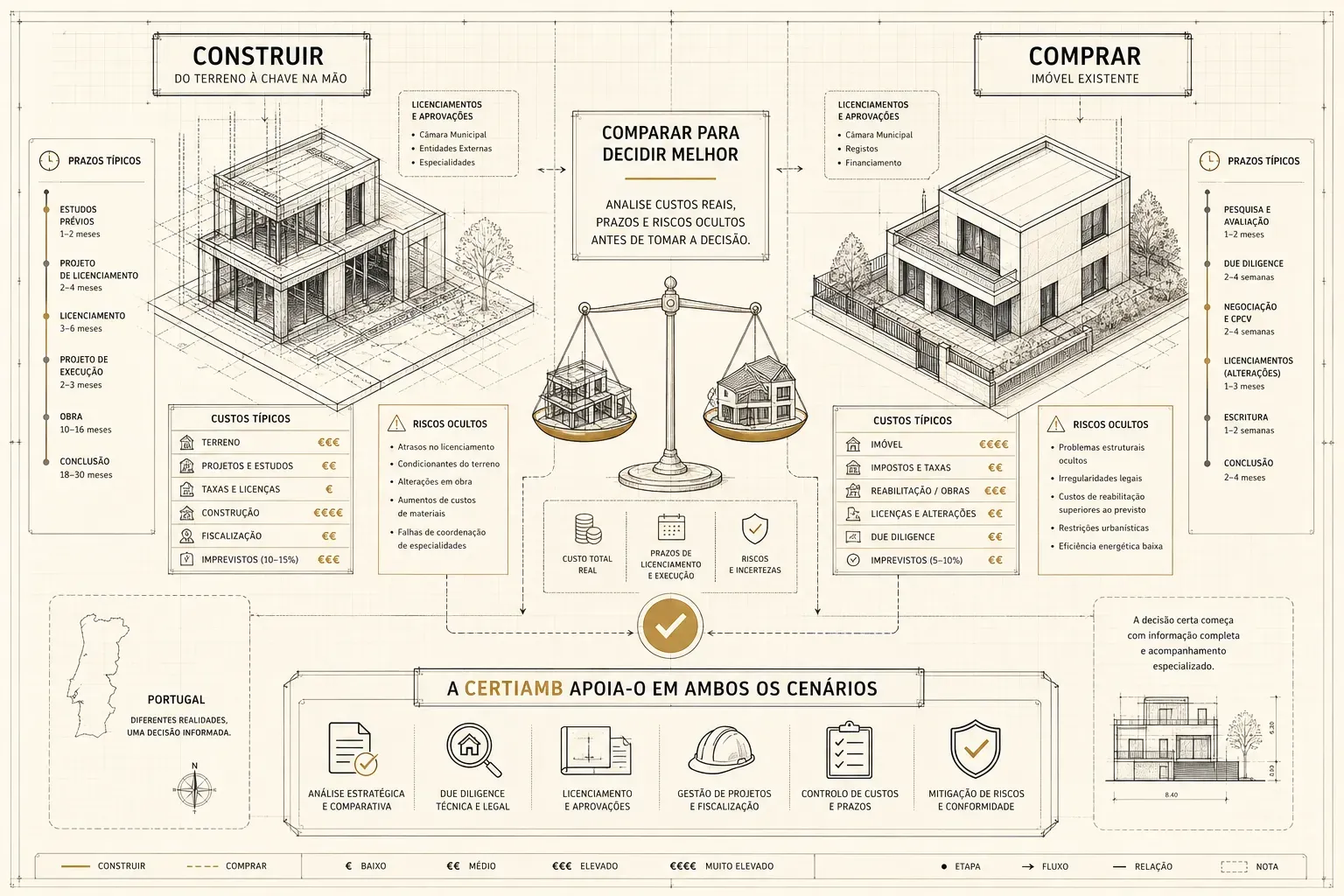
The VAT cut reopens calculations that seemed closed. Building instead of buying becomes viable again in many scenarios; postponed rehabilitations regain feasibility; and the €660,982 threshold creates an objective incentive to design for the moderate-price segment. At the same time, the regime rewards rigour: well-drafted works contracts (with materials inside the right perimeter), licensing submitted within the time window and start-of-use documentation delivered without delay. That is the kind of documentary and procedural discipline an integrated architecture and engineering team guarantees by method.
Frequent mistakes and risks
- assuming «the works are at 6%» without checking the property's purpose, the price or rent limits and the time window;
- buying materials directly to «save money», and stepping outside the benefit's perimeter;
- not formalising the works contract in writing, making the framing hard to prove;
- delaying the start-of-use documentation and, with it, the self-build refund request;
- leaving the express mention of item 2.42.1 out of the acquisition deed, which forces the VAT to be regularised;
- selling or moving out before the 12 months, ignoring the IMT surcharge;
- deciding without professional tax advice. This article informs, it does not replace your accountant.
Frequently asked questions
Which works qualify for the reduced VAT rate?
Item 2.42.1 covers works contracts for sale as the buyer's own permanent home up to €660,982 or for residential rental up to €2,300 per month, subject to the other conditions for each route. In buildings with several units, only the eligible proportion qualifies. The procedural initiative must fall between 25 September 2025 and 31 December 2029, with VAT chargeable from 1 January 2026 and effects from 1 July 2026; the first half of 2026 has specific adjustment procedures. CIA fall under item 2.42.2 and their own regime.
I am building my own house. Am I entitled?
Yes, by refund, not by a 6% rate on the invoice: the contractor invoices at the standard rate and the Tax Authority returns the difference. The property value must not exceed €660,982; the house must become your own permanent home within six months of the start-of-use documentation and remain so for at least 12 months; the request is filed within 12 months of that documentation (for the first three quarters of 2026, from 1 October 2026); the refund takes up to 150 days.
Are materials and design services covered?
Direct purchases of materials do not qualify under this works-contract regime. Architecture and engineering services retain their own VAT treatment; CIA provide for a refund of 50% of the eligible VAT on those services.
What penalties exist?
A buyer's subsequent failure to use the property as their own permanent home may trigger an IMT surcharge of 10% of the taxable value, subject to the exceptions in Article 10(6) of Decree-Law 97/2026, without changing the works contract's VAT treatment on that ground. Failure to meet item 2.42.1 conditions requires adjustment under Article 11; compensatory interest depends on the legal requirements, with a reference rate of 4% per year. In self-build, failure to meet the conditions may result in loss of the refund, subject to the statutory exceptions.
When does item 2.42.1 take effect and expire?
Item 2.42.1 takes effect on 1 July 2026 and covers VAT chargeable from 1 January 2026, with adjustments for the first half of the year under paragraphs 11 and 12 of Circular Letter 25116/2026. The procedural initiative must occur between 25 September 2025 and 31 December 2029. The item expires on 31 December 2032, with eligibility determined by when VAT becomes chargeable.
Does the reduced rate apply to an entire mixed-use building?
No. Under item 2.42.1, it applies only to the proportion of the works contract attributable to the 'A' areas, determined under Article 40 of the CIMI, of units meeting the conditions. The Tax Authority uses all units' 'A' areas as the denominator. The rule also covers independently usable parts without condominium ownership. In example 4 of Circular Letter 25116/2026, only 30% of the works contract qualifies for the reduced rate.
Closing notes
The reduced VAT rate is a conditional benefit, with limits, time windows and penalties that demand informed decisions from day one of the project. If you are planning to build or rehabilitate for housing, your own, for sale or for rental, talk to the CertiAmb team: we deliver the feasibility study, the full design and the licensing within the deadlines the benefit requires, in coordination with your tax adviser.
This article is provided for information purposes only and does not constitute legal, tax or technical advice. Each situation should be assessed individually by a qualified professional.