News
Lagoa (Algarve): new AL rules from 1 November
Municipality: Lagoa
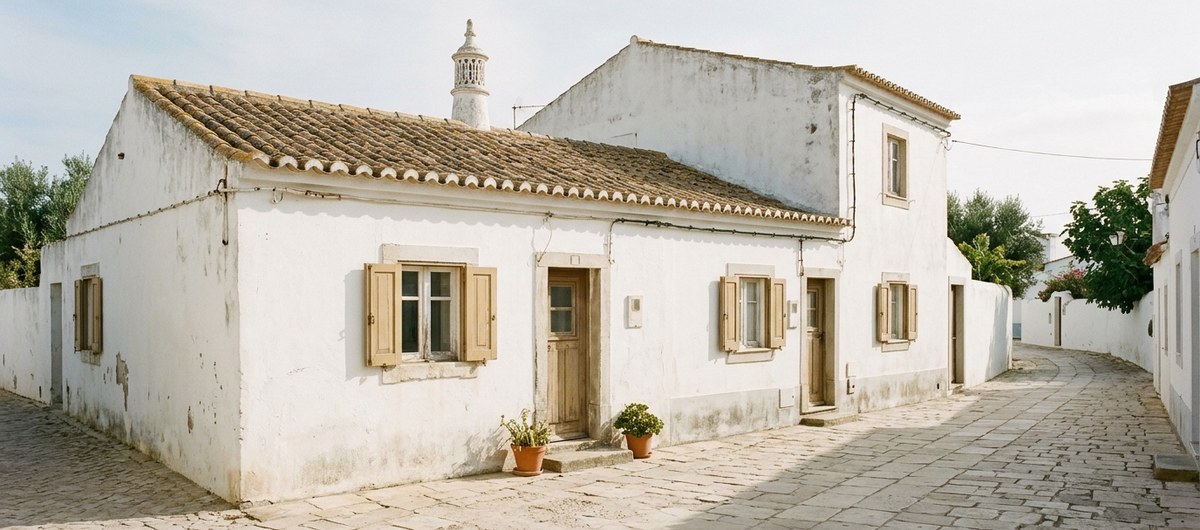
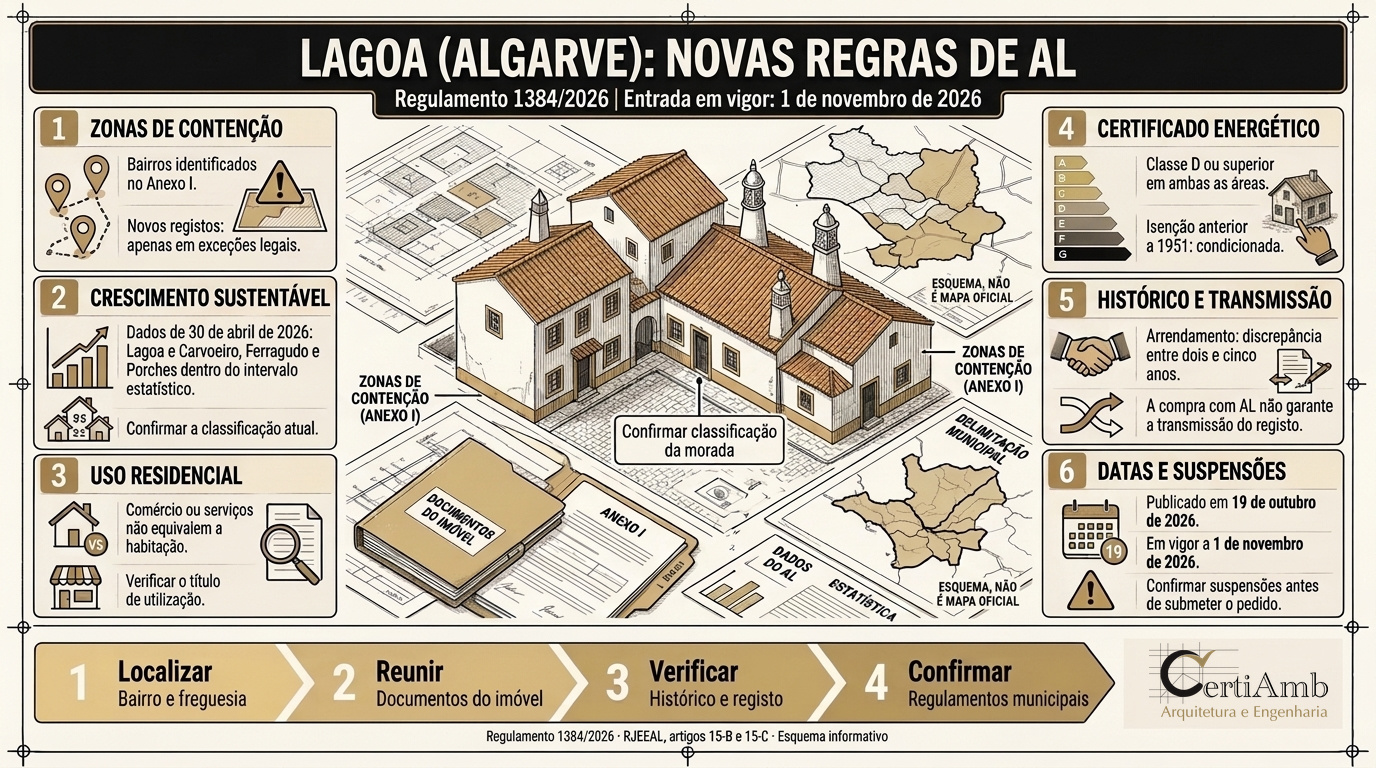
Lagoa, in the Algarve, had 3,156 alojamento local (AL) registrations on 30 April 2026, representing 14.96% of the dwellings counted in Annex III. Regulation No. 1384/2026 was published on 19 October and applies from 1 November. Buyers looking at Carvoeiro, Ferragudo or Porches to run a property as AL should check its area, documents and history before relying on that income.
Which neighbourhoods are containment areas?
Article 7 identifies municipal, SAAL and other public housing, publicly funded cooperatives and housing development contracts (CDH). Examples include Marinhas, Zeca Afonso, Jacinto Correia, the municipal neighbourhood in Porches, Casas dos Pescadores, CHE Lagoense and CDH de Ferragudo. Annex I maps their boundaries. Containment also covers sustainable growth areas exceeding both applicable ratios under Article 7(1)(g).
Carvoeiro, Ferragudo and Porches: the published figures
Article 6 combines the relevance ratio (AL share of all dwellings) and the pressure ratio (AL compared with second homes and vacant dwellings). Sustainable growth requires relevance above 5% and pressure above 25% up to 50%; containment requires more than 15% and more than 50%, respectively. The table compares the figures dated 30 April 2026 with those thresholds.
| Territory | AL registrations | Relevance | Pressure | Threshold assessment |
|---|---|---|---|---|
| UF Lagoa e Carvoeiro | 1876 | 19.61 % | 34.61 % | Within sustainable growth thresholds |
| Ferragudo | 345 | 15.94 % | 26.68 % | Within sustainable growth thresholds |
| Porches | 693 | 18.98 % | 25.50 % | Within sustainable growth thresholds |
| UF Estômbar e Parchal | 242 | 4.23 % | 11.74 % | Below both thresholds; check containment neighbourhoods |
The overall Estômbar e Parchal result does not remove containment in neighbourhoods such as Boa Esperança, Ibne Ammar and CHE Lagoense Parchal. Porches and Ferragudo are near the lower threshold: with unchanged denominators, 14 and 22 fewer registrations respectively would take pressure below 25%. The current municipal classification still needs confirmation.
What if the property is inside an ARU?
The September 2025 suspension maps labelled all six ARUs as containment areas. The approved regulation lists them as monitoring units in Annex II, with pressure ratios of 2.96% to 17.66%. These figures do not automatically replace the parish regime: Article 10 allows smaller units with supporting grounds. Article 7 neighbourhoods also apply. The municipality must update the indicators and review the regulation every three years (Article 16).
Containment exceptions and buying an existing AL
In containment areas, Article 8 allows exceptions for a wholly vacant property for over three years; rehabilitation within the last three years raising a poor or very poor condition by two levels; certain conversions to residential use; or new construction after demolition due to very poor condition or collapse risk, also within the last three years. Acquisition at public auction or directly from the municipality bars these exceptions.
The rooms exception requires the operator’s permanent home and tax address for over three years: one room in a T2, two in a T3 and three in larger properties. The operator need not be the owner.
Article 9(6) limits transfers of house, apartment and hospedagem registrations in containment areas to succession, gifts to spouses, cohabiting partners, descendants or ascendants, and the specified cases of divorce, judicial separation or dissolution of a de facto union. Ordinary sale is not listed. National Article 15-B(1)(e) refers to new house/apartment numbers: establish the applicable scope before paying a premium for an existing AL. Rooms retain the condition in Article 8(1)(e).
Residential use, energy rating D and inspection
Residential use is required throughout the municipality (Article 5). In both area types, including containment exceptions, Article 11 documents include 1:100 plans, condominium documents and an energy certificate of D or above. Notifying the condominium administrator differs from obtaining approval: a hostel in a building under horizontal ownership needs assembly minutes authorising installation (RJEEAL, Article 6(2)(f)).
The pre-1951 D exemption requires an urban planning obstacle, reasons and a municipal decision. Outside both areas, Article 12 refers to the national procedure, but refers to Article 10 rather than Article 11; confirm with the municipality which documents it will require. Inspection is due within 90 days in containment and 60 elsewhere after prior notification; this is not an approval deadline.
Previous residential letting: two years nationally, five locally
RJEEAL Articles 15-B(1)(a) and 15-C(2)(a) refer to residential leases in the two years before registration. Lagoa requires five-year declarations in both areas (Article 11), although its explanatory note distinguishes two and five years. Article 8(2)(a) says «há pelo menos cinco anos» and excepts the applicant tenant’s own contract. Until the municipal requirement is amended or set aside in the applicable case, the declaration requires confirmation covering five years.
Collect earlier contracts before signing the preliminary purchase agreement (CPCV). Article 11(4) links false declarations to the offence in Penal Code Article 348-A and a prohibition on operation. If the property was let during that period, obtain legal advice before signing the declaration.
Applications before 1 November and the ARU suspension
Article 19(2) excludes applications filed before 1 November which are still within the municipality’s opposition period on that date. Both conditions are required. Earlier filing can therefore matter, provided no suspension applies to the property.
On 24 September 2025, the Municipal Assembly suspended new registrations for three months in six ARUs, CDH de Ferragudo and Jacinto Correia (Notice 114/2025). Notice 3/2026 of 13 January announced another three months. DL 151/2026 later permitted a fresh suspension decision within statutory limits, ending when the regulation takes effect. Before filing in these areas before 1 November, confirm whether the municipality used that power.
Before buying
Before the CPCV, check the area, residential use, acquisition history, leases, energy certificate and transferability. CertiAmb’s Property Check supports initial screening and identifies missing documents; it does not replace case-specific legal advice.
Sources
- Regulamento 1384/2026
- Original PDF
- RJEEAL · DL 76/2024 · artigos 15-B e 15-C
- DL 151/2026 · artigos 3–6
- Edital 114/2025
- Edital 3/2026 · 13.01.2026
- Município · documentação autárquica