Insights
Demolition design and permitting: from prior control to waste management
There is a persistent idea that demolishing is the opposite of building, and therefore simpler. The legal and technical reality is different: a demolition engages, at the same time, the urban-planning permitting regime, the construction-site safety regime, waste legislation and, in older buildings, the asbestos regime, which was profoundly changed in 2026. A mistake on any of these fronts translates into embargoes, administrative offences or, worse, harm to people and neighbouring buildings.
At CertiAmb, the demolition design is treated with the same rigour as any other element of the process, in coordination with the engineering-discipline projects and with the permitting of the urban operation. Demolition only requires prior control in certain cases, the design has a mandatory content, and the assessment must account for the 2026 changes to the RJUE, asbestos rules and waste management.
When demolition requires a licence
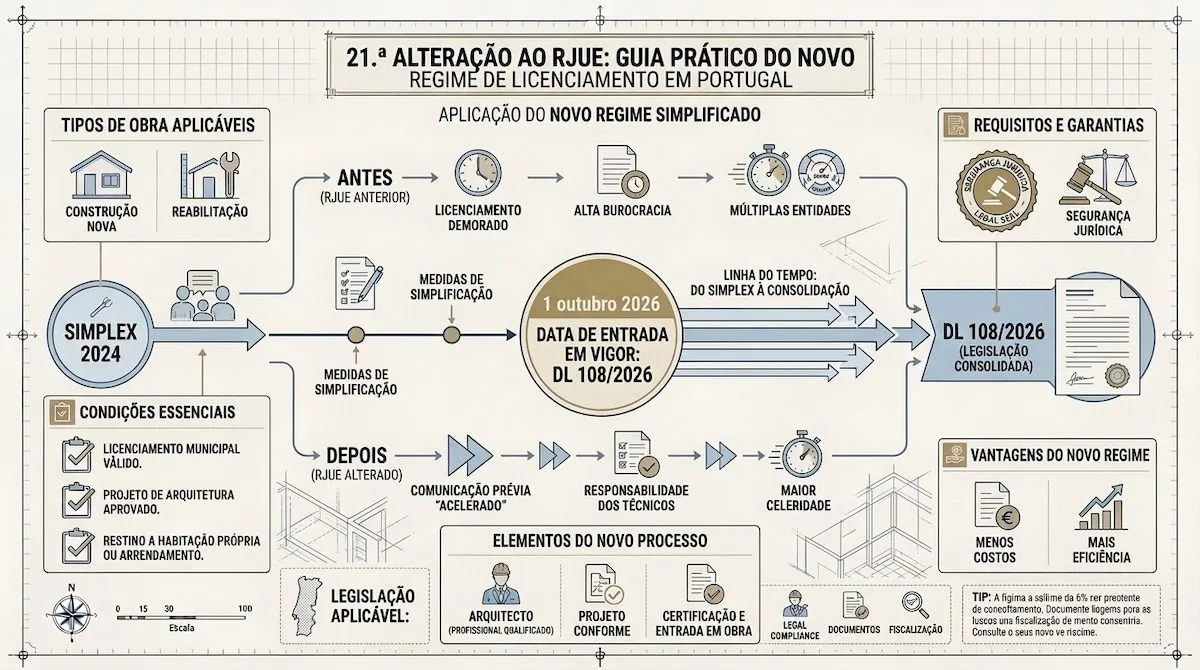
The reference instrument is the Legal Regime for Urbanisation and Building (RJUE, Decreto-Lei n.º 555/99, as currently worded). Under the wording applicable following the 2026 reform, Article 4(2)(f) requires an administrative licence for demolition not integrated into reconstruction works, subject to the statutory exemptions. Integration into reconstruction requires checking the regime for that operation; it does not mean that a reconstruction permit always exists. In areas covered by a detailed plan, implementation unit or subdivision operation that sets the parameters listed in Article 4(4)(d), demolition is subject to prior communication.
Exemptions extend beyond small structures. Article 6 includes, among other cases, works of minor urban-planning relevance, operations preceded by favourable prior information covering all applicable Article 14(2) elements, and demolition of illegal buildings. Each exemption must be checked against its conditions, heritage protection and special legislation. Decreto-Lei n.º 108/2026, with a general commencement date of 1 October 2026 following Decreto-Lei n.º 155-B/2026, applies to new procedures and earlier ones still at the initial scrutiny stage, under its Article 12.
For listed buildings, buildings undergoing classification, their protection zones and under applicable territorial plans, demolition may be restricted or refused. Portaria n.º 320/2026/1, Annex V, Part VI, items 28 to 30, distinguishes the documents for prior information, licensing and prior communication for demolition. These include the condition of the building, future use of the land, a PPGRCD and the necessary engineering designs. We describe the general procedural framework in How construction permitting works in Portugal.
The demolition design: documents, method and sequencing
Safe demolition starts on paper. Technical preparation must adapt the method and sequence to the building and identified risks. The elements to develop include:
- a descriptive and justifying report, with a survey of the existing building (architectural, structural and photographic);
- the definition of the demolition method (manual, mechanical or mixed) and its sequencing, as a rule from top to bottom and element by element;
- a shoring and retention plan, including the retention of party walls and of façades to be preserved;
- the prior disconnection of the water, sewerage, gas, electricity and telecommunications networks, coordinated with the utility operators;
- measures to protect people, the public highway and adjoining buildings (hoardings, protective fans, netting, dust suppression);
- an estimate of, and a strategy for, the management of construction and demolition waste.
The design is signed by a qualified professional, under a certificate of technical responsibility, and must be reconciled with the stability assessment, above all where there are adjoining terraced buildings, basements or shared structures. This is precisely where a structural reading of the building, by those who master the structural design, prevents uncontrolled collapse.
Site safety: Decreto-Lei n.º 273/2003
Construction-site safety is governed by Decreto-Lei n.º 273/2003, de 29 de outubro. It provides, in particular, for:
- the health and safety plan (PSS), mandatory for works subject to a design that involve the special risks in Article 7 or require prior notification of site opening; its development for execution is technically validated by the construction-stage safety coordinator and approved by the client;
- a design-stage safety coordinator in the Article 9(1) situations, including planned involvement of two or more companies on site; a construction-stage coordinator where two or more companies, including subcontractors, carry out the works;
- prior notification of the opening of the site to the ACT (the labour authority) where the works are expected to last more than 30 days with more than 20 workers simultaneously, or to involve more than 500 person-days;
- safety procedure sheets for works involving special risks, where a PSS is not required;
- the technical compilation of the works, handed to the owner at the end.
In a demolition, the PSS is not a bureaucratic document: it is the instrument that fixes the dismantling sequence, the exclusion zones and the emergency arrangements. Its enforcement on site is a natural part of site supervision and construction management services.
Asbestos: mandatory identification and new rules since June 2026
Existing materials must be identified before work begins, with particular attention to construction predating the ban on marketing and use of asbestos. Worker protection is governed by Decreto-Lei n.º 266/2007 of 24 July, amended by Decreto-Lei n.º 109/2026, de 29 de maio, in force since 1 June 2026. Changes affecting demolition include:
- identification of materials presumed to contain asbestos before work starts (Article 10-A), the responsibility of the employer or client in the specified cases; where no information is available, detection must be carried out by a qualified operator, with material analysis by an IPAC-accredited laboratory;
- an occupational exposure limit of 0.01 fibres/cm³;
- priority given to the removal of asbestos, over other forms of handling, wherever the risk of exposure is likely;
- an approved work plan and company authorisation under Article 24; the ACT must make the list of authorised companies publicly available;
- specific technical training, with drills simulating complex scenarios, for those carrying out asbestos demolition or removal;
- from 21 December 2029, measurement must include fibres narrower than 0.2 μm; counting uses electron microscopy or an alternative method giving equivalent or more accurate results, under Article 8 and the transitional rules of Decreto-Lei n.º 109/2026.
Asbestos waste is hazardous CDW requiring closed, labelled packaging and authorised destinations. Portaria n.º 40/2014 of 17 February, in force since 18 February 2014, regulates removal and management of this waste. Its Articles 7 and 8 were amended by Portaria n.º 145/2017 of 26 April to provide for transport with e-GAR notes; the old paper forms in the original 2014 text should not be used as the current reference.
Construction and demolition waste: sorting, e-GAR and targets
Construction and demolition waste (CDW) is governed by the General Waste Management Regime (RGGR), approved in Annex I to Decreto-Lei n.º 102-D/2020 of 10 December. Decreto-Lei n.º 205/2026 of 27 October, the fifth amendment to the regime, entered into force generally on 1 November 2026. Essential CDW management duties in a demolition include the following:
- favour selective demolition and separate reusable materials from waste; sort CDW on site or, where that is not possible, send it to a waste treatment operator;
- send CDW to authorised destinations and document transport through e-GAR electronic tracking notes where required;
- in public works contracts and concessions, accompany the execution design with a PPGRCD (CDW Prevention and Management Plan), under Article 55;
- in private works subject to licensing or prior communication, keep CDW records with the electronic site logbook and attach completed e-GAR notes, duties already provided for in Article 54;
- contribute to the target in Article 27(1)(b): 70% by weight for preparation for reuse, recycling and other material recovery of non-hazardous CDW, excluding natural materials in category 17 05 04 of the European List of Waste (LER).
The pre-demolition audit was introduced by Decreto-Lei n.º 24/2024 of 26 March, effective from 27 March 2024, in Article 49(10). The Portuguese wording is: No caso de demolição ou renovação de edifícios ou infraestruturas de obras públicas, os produtores de RCD promovem uma auditoria de pré-demolição.
Since 1 November 2026, this is paragraph 11. Reading it together with the PPGRCD and acceptance under the Public Contracts Code points to the public-works context; this is an interpretation of the framework, not an extension of the wording to all works. Articles 50(2) and 55-A expressly refer to that audit. Those references do not establish an automatic requirement for the same audit in every private renovation; Article 54 duties and the asbestos survey have their own legal bases.
Article 49(5) requires municipal urbanisation and building regulations (RMUE) to provide for completion checks and the selective demolition plan for works subject to prior control. Small household repairs and DIY works carried out by the owner or tenant fall under the specific municipal arrangements in paragraphs 3 and 4, with local conditions and tariffs to be confirmed.
Rules in force since 1 November 2026
Audit and inventory. Article 49(12) refers the conduct of the audit to a Technical Note approved by the National Waste Authority (ANR). Under Article 50(2), the client appoints an auditor or team with qualified experts, responsible for an inventory identifying and quantifying reusable materials and components and CDW, together with a preliminary destination plan. The contractor and treatment operator have their own responsibilities and cooperate on traceability; the manufacturer may supply information. Article 55-A requires a report identifying and assessing materials and recommending destinations, and provides for the ANR to publish an inventory template. Acceptance of the works under the Public Contracts Code must take the report into account.
Private works. Within Article 54, the site logbook must record the selective-deconstruction methodology, reusable materials, estimated CDW quantities and planned destinations in detail, with particular attention to asbestos. Actual quantities sorted and sent to licensed operators must also be entered. Use or the provisional acceptance record depends on a statement of responsibility signed by the person responsible for the works, listing quantities produced, including asbestos, quantities sorted and evidence of delivery. Site clearance, proper CDW management and repair of any damage or deterioration, including assessment of possible soil contamination where indicated, also condition use of the building or unit, as well as provisional acceptance (paragraph 2).
PPGRCD for public works. The CDW estimate in Article 55(2)(f) must be based on the audit. The plan must be signed by its author and identify the associated responsibilities; amendments during execution follow paragraph 5, with reasons and involvement of the client and contractor or successful bidder, as applicable.
Asbestos and municipal collection. Article 49(9) allows the municipal system to collect and manage asbestos-containing CDW from private works exempt from licensing and not subject to prior communication, under the ministerial order referred to in paragraph 8 and a specific tariff. Portaria n.º 40/2014, as amended, must be read alongside this provision. The legal possibility requires confirmation of service availability, acceptance conditions and the applicable local tariff.
For a specific operation, confirm the Article 49(12) Technical Note and Article 55-A(2) inventory template with the National Waste Authority (ANR), a role performed by the Portuguese Environment Agency (APA). On the APA CDW, general rules, templates and CLOSER pages consulted on 11 November 2026, these two instruments could not be identified as approved under those provisions. This search result does not establish that they have not been published or remove the legal duties. The PPGRCD and CDW record templates serve different purposes.
The Article 55 PPGRCD regime covers public works contracts and concessions. Alongside that regime, Portaria n.º 320/2026/1 also includes a PPGRCD among the demolition application documents in Annex V, items 28 to 30. Private works preparation must therefore distinguish the plan supporting the urban-planning procedure, Article 54 records and the audit under Articles 49, 50 and 55-A.
Neighbouring buildings, the public highway and noise
Demolition may give rise to civil liability for damage to neighbouring buildings. For excavations, Article 1348 of the Civil Code protects the support of adjoining properties and provides for compensation for damage even where precautions were taken. Condition surveys and photographic records before work starts, and crack and settlement monitoring in sensitive cases, are good practice. Occupying the public highway requires checking the applicable municipal authorisation. Articles 14 and 15 of the General Noise Regulation (Decreto-Lei n.º 9/2007) prohibit temporary noisy activities near dwellings on Saturdays, Sundays and public holidays, and on weekdays between 8 p.m. and 8 a.m.; a special noise licence requires exceptional, duly justified circumstances. Schools during operating hours and hospitals have their own protection, while Article 17 provides specific rules for urgent works.
What has changed, and what is coming
- Asbestos. Decreto-Lei n.º 109/2026 has been in force since 1 June 2026. Measurement must include fibres narrower than 0.2 μm from 21 December 2029; the law allows electron microscopy or an alternative method giving equivalent or more accurate results.
- Permitting. The RJUE revision by Decreto-Lei n.º 108/2026 has applied generally since 1 October 2026, and Portaria n.º 320/2026/1 now sets the application documents for demolition, including the PPGRCD.
- Construction sites. Decreto-Lei n.º 123/2025 of 21 November governs temporary accommodation for construction workers away from home and links the accommodation plan to the PSS or safety procedure sheets. A specific project requires checking the applicable requirements and technical regulations.
- CDW: 1 November 2026. Decreto-Lei n.º 205/2026 of 27 October strengthens the audit within Article 49(11), the inventory and report, the records and statement of responsibility under Article 54, and the PPGRCD for public works. Article 117(2)(nnn) and (ppp) provides for serious environmental administrative offences covering failure to sign the statement for the private works concerned and failure to carry out the audit or prepare its report where required. The special dates in Article 7 for Articles 11, 114 and 115 do not change the general date for these CDW rules.
Demolish or rehabilitate?
Demolition is not always the right answer, nor is it always permissible. The heritage value of the building, its location within an urban rehabilitation area, the actual condition of the structure, the carbon embodied in the materials and the existing incentives for rehabilitation should all be weighed before deciding. A prior technical assessment, independent and well-founded, prevents both hasty demolitions and unviable rehabilitations. This is exactly the kind of decision that benefits from an integrated approach to architecture, engineering and consulting. You can find out more about our team and our method on the About CertiAmb page.
Frequently asked questions
Do I need a permit to demolish a building in Portugal?
As a rule, demolition not integrated into reconstruction works requires a licence under Article 4(2)(f) of the RJUE. In areas covered by a detailed plan, implementation unit or subdivision operation that sets the parameters listed in Article 4(4)(d), demolition is subject to prior communication. The exemptions in Articles 6 and 6-A, heritage protection and special legislation must be checked; integration into reconstruction still requires assessing the regime for that operation.
What must a demolition design include?
Technical preparation must cover the existing-building survey, method and sequence, necessary shoring and retention, utility disconnection and protection of people and neighbouring buildings. Portaria n.º 320/2026/1, Annex V, Part VI, sets the application documents for each demolition procedure, including a PPGRCD and the necessary engineering designs.
How do I know whether the building contains asbestos?
Materials presumed to contain asbestos must be identified before work begins. Under Article 10-A of Decreto-Lei n.º 266/2007, added by Decreto-Lei n.º 109/2026, where no information is available, detection must be carried out by a qualified operator; material analysis is performed by an IPAC-accredited laboratory.
What happens to the demolition waste?
CDW is sorted and sent to authorised destinations, with e-GAR notes where required. Private works within Article 54 require CDW records and copies of completed e-GAR notes; since 1 November 2026, they also require detailed site-logbook entries and a statement of responsibility with quantities and proof of delivery, on which use or provisional acceptance depends. The Article 49 audit has existed since 27 March 2024 in former paragraph 10, now paragraph 11. The public-works framework, private-works duties and urban-planning procedure must be distinguished; these rules do not automatically require an audit for every private renovation.
Can demolition and new construction be handled in the same procedure?
Demolition integrated into reconstruction works must be assessed under the regime for that operation. An intention to build a new building on the site does not by itself exempt an autonomous demolition from licensing. Articles 4 and 6 of the RJUE and the specific design must be checked.
Closing notes
A successful demolition is one that makes no news: no incidents, no damage to neighbours, no fines, and waste that generates value instead of accumulating liabilities. That is achieved with design, permitting and execution coordinated from day one, and with attention to the new rules of 2025 and 2026, from asbestos to waste. If you have a demolition or a rehabilitation in view and want to assess the right path, talk to the CertiAmb team.
This article is provided for information purposes only and does not constitute legal, tax or technical advice. Each situation should be assessed individually by a qualified professional.